Maths › Further Mechanics 2 › Equilibrium, suspension, toppling and sliding
Equilibrium, suspension, toppling and sliding
Two conditions hold a rigid body still: no resultant force, and no resultant moment about any point at all. A couple explains why any point will do, and the moment condition predicts which way a hanging body tilts and whether a body on a slope slides away or falls over first.
Builds on Centres of mass of plane figures and frameworks and Friction and inclined planes.
IN THIS TOPIC
- Find the moment of a couple, and use the fact that it is the same about any point.
- Reduce a system of coplanar forces to a resultant force and a couple.
- Find the angle at which a suspended lamina hangs.
- Determine the angle at which a body on a rough slope topples.
- Decide whether toppling or sliding happens first.
- Use the two conditions for the equilibrium of a rigid body: no resultant force and no resultant moment.
COMMON MISCONCEPTION
A body on a slope topples as soon as its centre of mass is higher than the lower edge of its base.
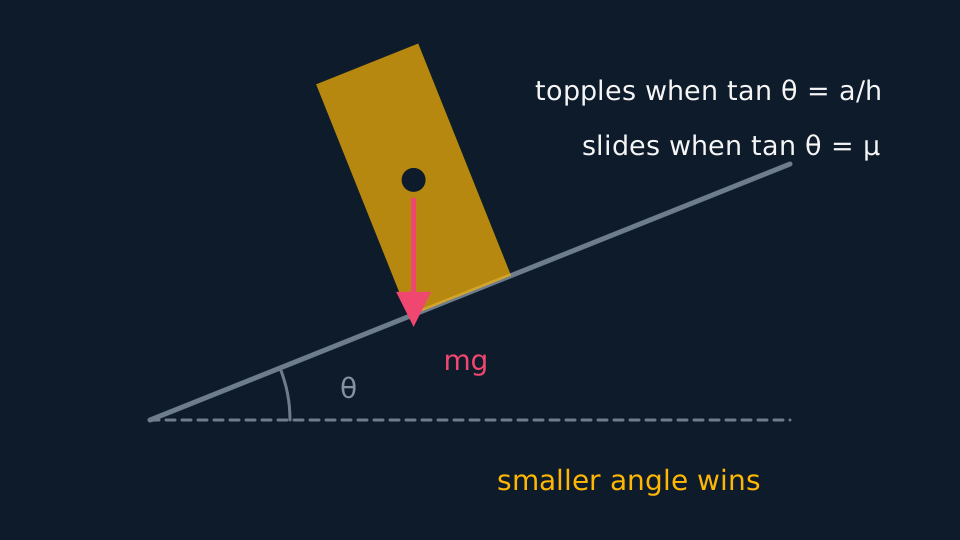
Toppling begins when the vertical through the centre of mass passes outside the base, which for a block of base 2a and height 2h happens at tan θ = a/h. The height of G settles nothing on its own; what matters is whether the line of the weight still lands inside the base, since only then can the normal reaction balance the moments. Sliding needs tan θ = μ, and the smaller angle happens first.
Couples and moments
A rigid body is in equilibrium when two conditions hold together: the forces have no resultant, and their moments have no resultant either. The second condition names no particular point, and everything below relies on that, so start by seeing why it holds.
Take two equal and opposite forces of magnitude F whose lines of action are parallel but different, a perpendicular distance d apart. Their resultant is zero, so they push the body nowhere. What they do have is a turning effect, and that pair of forces is a couple.
Take moments about a point on one of the two lines: the force in that line has no moment, and the other gives Fd. Take them about a point outside both lines, at perpendicular distances x and x + d: the two moments now turn in opposite senses and subtract, F(x + d) − Fx = Fd, with x gone. Take them about a point between the lines, at distances x₁ and x₂ adding to d: the two turn the same way and add, F(x₁ + x₂) = Fd. The moment of a couple is Fd about every point, and that independence of the pivot is the defining property of a couple.
Two habits follow from it. Moments may be taken about the point that makes an unwanted force disappear, since shifting the pivot leaves any couple in the system contributing the same amount as before. And a force may be moved onto a parallel line through any point you like, provided a couple is added to pay for the move, so a system of coplanar forces reduces to one resultant force through a point of your choosing together with one couple. Both zero, and the body is in equilibrium; force zero and couple not, and the body turns without being pushed anywhere at all.
WORKED EXAMPLE
The same moment about two points
Two horizontal forces of 12 N act on a rigid body in opposite directions, along parallel lines 0.25 m apart. Find the moment of the couple, and check it about a point 1 m above the lower line.
About a point on the lower line the lower force has no moment, and the upper force acts 0.25 m away, giving 12 × 0.25 = 3 N m.
About the higher point, the lower force is 1 m below it and gives 12 × 1 = 12 N m; the upper force is 0.75 m below it and gives 12 × 0.75 = 9 N m the other way.
The total is 12 − 9 = 3 N m, the same as before, although neither of the two moments making it up was. How far along the point sits makes no difference either, since the moment of a horizontal force depends on its height alone.
The forces sum to zero, so no resultant force goes with that moment: the couple turns the body without shifting it.
Hanging from a point
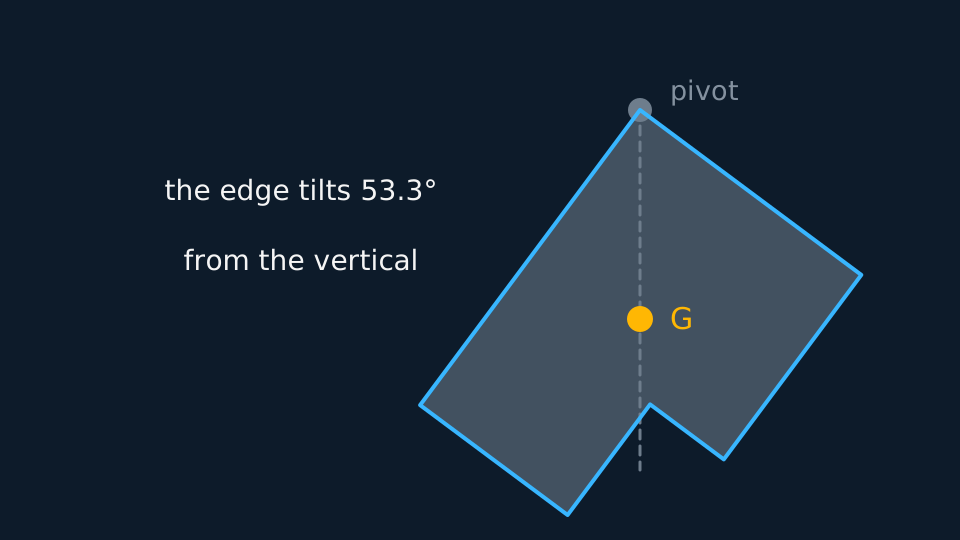
A body suspended freely from a point hangs so that its centre of mass is vertically below that point. Nothing else is needed. Draw the line from the pivot to G, and the angle any edge makes with the vertical is the angle between that edge and that line.
In practice you find the horizontal and vertical displacements from the pivot to G in the body's own frame, then take an inverse tangent. Which way round the division goes decides which angle you get, so say clearly whether you are giving the angle to the vertical or the angle to an edge, and sketch the tilted body to confirm the sense.
WORKED EXAMPLE
Hanging a lamina
The lamina from earlier, an 8 by 6 rectangle with a 3 by 2 corner removed, has G at (4.36, 3.29). It is hung from the corner (8, 6). Find the angle the long edge makes with the vertical.
Displacements from the pivot to G, in the body's frame: 8 − 4.36 = 3.64 along the long edge, and 6 − 3.29 = 2.71 along the short one.
The line from the pivot to G becomes vertical. The long edge lies at arctan(2.71/3.64) = 36.7° to it.
The short edge is therefore at 53.3° to the vertical, and quoting that instead is the standard error here.
A check on the sketch: the pivot at (8, 6) and the far corner at (0, 0) sit almost exactly on the line through G, so that corner hangs nearly straight below the pivot.
Topple or slide
A body on a rough slope stays put until one of two things happens. It slides when the slope reaches the friction limit, tan θ = μ. It topples when the vertical through the centre of mass passes outside the base, which for a block of base 2a and height 2h happens at tan θ = a/h.
Whichever angle is smaller happens first. The height of the centre of mass above the ground settles nothing on its own. What matters is whether the line of the weight still lands inside the base, since only then can the normal reaction act at a point that balances the moments.
GUIDED PRACTICE
Which happens first
A uniform block 0.4 m wide and 1 m tall stands on a rough plane with coefficient of friction 0.3, which is slowly tilted. Find whether it topples or slides, and at what angle.
Show the working
Toppling: the base half-width is 0.2 and the height of G is 0.5, so tan θ = 0.2/0.5 = 0.4 and θ = 21.8°.
Sliding: tan θ = μ = 0.3, so θ = 16.7°.
The smaller angle is reached first, so the block slides at 16.7° and never topples.
A narrower or taller block, or a rougher surface, could reverse the verdict.
ASSESSMENT FOCUS
- Say which point you are taking moments about, and pick the one that removes an unknown. Any couple in the system contributes the same wherever you pick.
- For a suspended body, draw the vertical through the pivot and mark G on it before calculating anything.
- Say which angle you are giving: to the vertical, to the horizontal, or to a named edge.
- For toppling, use half the base width over the height of G, not the full width.
- Compare both angles and state explicitly which is smaller and therefore which happens.
- A body already resting on a slope needs its own diagram, since the base and the vertical are no longer at right angles.
CHECK YOURSELF
A uniform cube of side 0.6 m rests on a rough plane with μ = 0.8. Does it topple or slide as the plane is tilted?
Show a hint
Compare tan θ for each.
Show the answer
Toppling needs tan θ = 0.3/0.3 = 1, so 45°. Sliding needs tan θ = 0.8, so 38.7°. The smaller comes first, so it slides.
A couple is two equal and opposite forces on different lines, of moment Fd about any point, which is why the pivot for taking moments may be chosen to suit you.
A freely suspended body hangs with its centre of mass vertically below the point of suspension.
On a slope, sliding needs tan θ = μ and toppling needs tan θ = a/h, with a the base half-width and h the height of G.
Whichever of those two angles is smaller is the one that happens.
WORKBOOK
Printable practice for this topic: original exam-style questions with room to work, and a fully worked answer book. Free to use; please do not redistribute or sell.
Or read them with their worked answers on the equilibrium, suspension, toppling and sliding questions page.
CHECK YOUR PROGRESS
Rate how confident you feel with each objective for this lesson. Ratings are saved in this browser, on this device, unless you sign in.
- Find the moment of a couple, and use the fact that it is the same about any point.
- Reduce a system of coplanar forces to a resultant force and a couple.
- Find the angle at which a suspended lamina hangs.
- Determine the angle at which a body on a rough slope topples.
- Decide whether toppling or sliding happens first.
- Use the two conditions for the equilibrium of a rigid body: no resultant force and no resultant moment.
Open the full revision checklist to see every objective in the course in one place.