Maths › Integration › Areas, parametric curves and the limit of a sum
Areas, parametric curves and the limit of a sum
The region between two curves is one integral of top minus bottom, and the area under a curve given parametrically can be found without converting back to Cartesian form. Both rest on the definition of the definite integral as the limit of a sum of thinner and thinner strips.
Builds on Definite integrals and areas and Parametric equations.
IN THIS TOPIC
- Find the area between two curves with one integral of top minus bottom.
- Find areas under parametric curves using ∫y (dx/dt) dt, with a Cartesian check.
- Read a definite integral as the limit of a sum of strips of width δx.
COMMON MISCONCEPTION
The area between two curves only makes sense when both sit above the x-axis.
One integral of top minus bottom between the intersections gives the enclosed area wherever the region sits relative to the axis. Adding the same constant to both curves leaves every vertical difference unchanged, so moving the axis cannot change the result. State which curve is the upper one: a negative answer means the subtraction was taken the wrong way round.
Between two curves
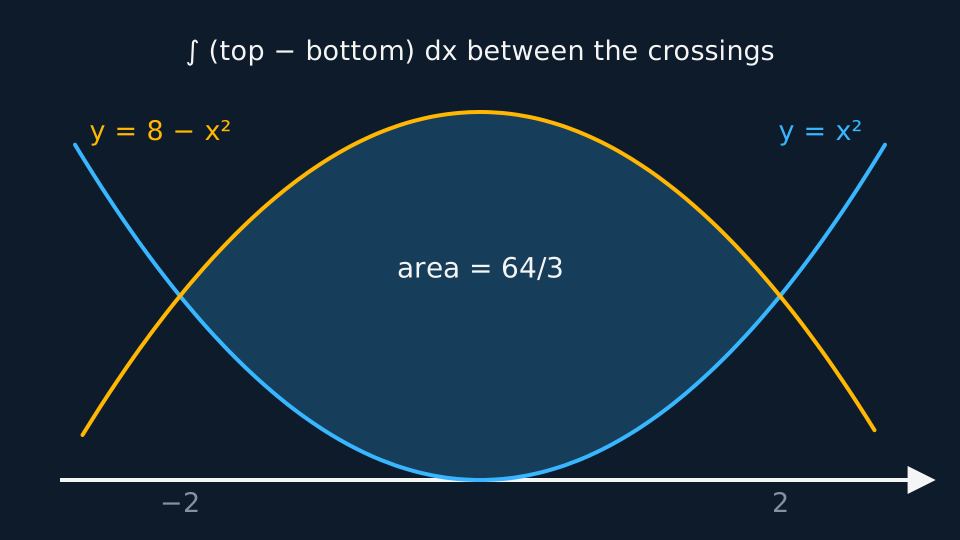
The vertical distance between two curves is the difference of their y-values, top minus bottom, and integrating that difference between the points of intersection gives the enclosed area, whether or not the region lies above the x-axis. Adding the same constant to both curves leaves every difference unchanged, which is why the position of the axis does not affect the result.
WORKED EXAMPLE
One integral, both boundaries
Find the area enclosed between y = 8 − x2 and y = x2.
Crossings first: x2 = 8 − x2 gives x = ±2.
Integrate the gap: ∫−22 (8 − 2x2) dx = [8x − 2x3/3].
Evaluating, (16 − 16/3) − (−16 + 16/3) = 64/3.
State which curve is the upper one. Subtracting them the other way round gives the negative of the area, so a negative result means the subtraction should be reversed.
GUIDED PRACTICE
A tighter lens
Find the area enclosed between y = √x and y = x2, before opening the working.
Show the working
The curves cross where √x = x2, at x = 0 and x = 1, with √x on top between them.
∫01 (x1/2 − x2) dx = [(2/3)x3/2 − x3/3] = 2/3 − 1/3 = 1/3.
The two curves are reflections of each other in y = x, so the region is symmetric about that line, which provides a check on the result.
Areas from parametric curves
A parametric curve gives x and y through a parameter t, and the area integral converts to run entirely in t. Since dx = (dx/dt) dt,
with t-limits corresponding to the x-limits of the region, and with x increasing over that range of t. Converting to Cartesian form first is also valid where the conversion is straightforward, and doing the question both ways checks the answer.
WORKED EXAMPLE
Staying in the parameter
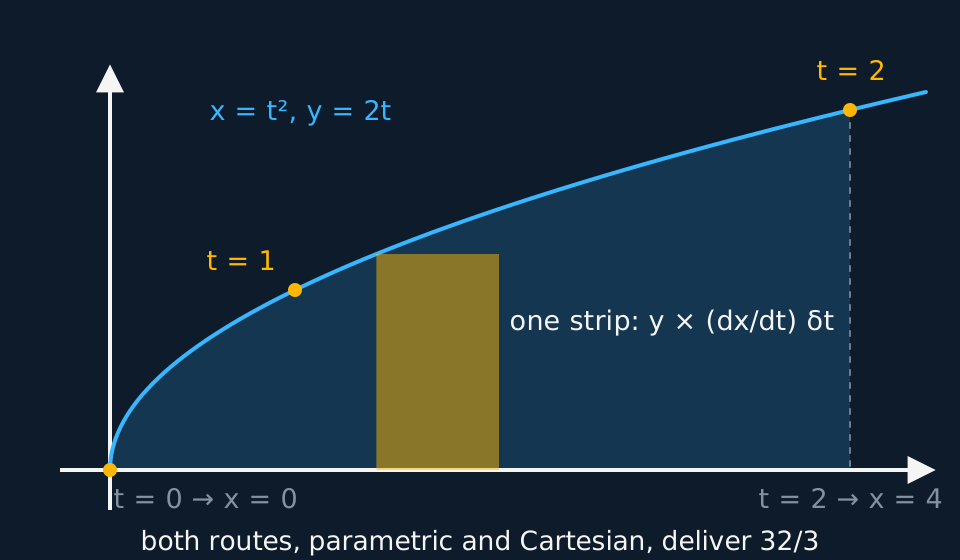
The curve x = t2, y = 2t is traced for t ≥ 0. Find the area under it from t = 0 to t = 2.
dx/dt = 2t, so the area is ∫02 2t × 2t dt = ∫02 4t2 dt.
That is [4t3/3] from 0 to 2 = 32/3.
Cartesian check: the curve is y2 = 4x, so y = 2√x for y ≥ 0, and ∫04 2√x dx = 32/3, the same value by the other method.
Describe the drawing
The parametric curve x equals t squared, y equals 2t sweeping over a shaded region down to the x-axis, with one amber strip of height y and width dx by dt times delta t pulled out, dots at t equals 0, 1 and 2, and the t-limits translated beneath the axis into the x-limits 0 and 4: both integrals measure 32 over 3.
INDEPENDENT PRACTICE
Another trace
Find the area under the curve x = t3, y = t2 from t = 0 to t = 2.
Show the working
dx/dt = 3t2, so the area is ∫02 t2 × 3t2 dt = ∫02 3t4 dt.
That is [3t5/5] from 0 to 2 = 96/5.
The t-limits were given here. Where a question gives x-limits instead, convert them into values of t before integrating.
The limit of a sum
The definite integral is defined as a limit. Divide the region into strips of width δx, approximate each strip's area by f(x) δx, and add them. The sum approximates the area, with the error decreasing as δx decreases, and the definite integral is the limit of those sums as δx tends to zero.
The notation records that definition: the integral sign is an elongated S for sum, and dx occupies the position of the strip width δx.
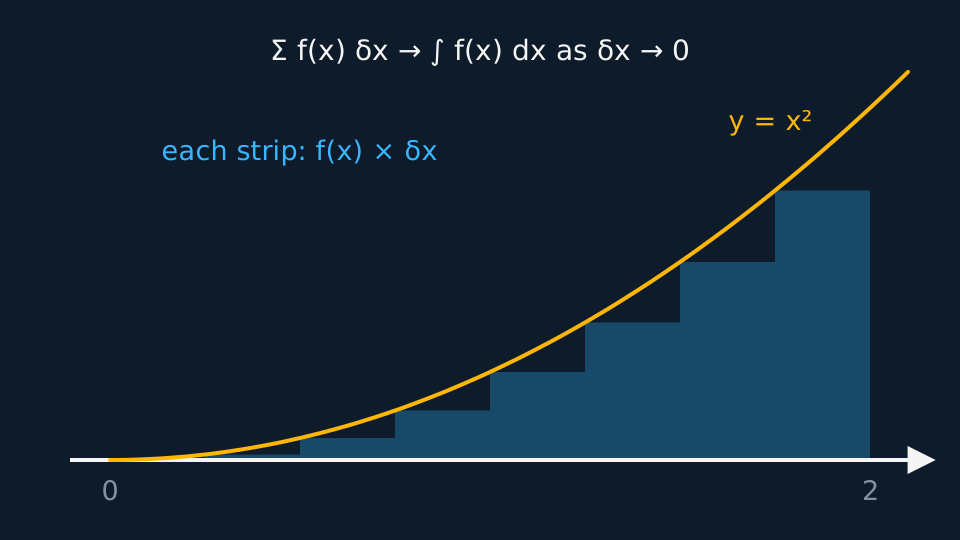
Questions on this definition ask for a translation rather than a calculation: given a sum of the form Σ f(x) δx over an interval, state the definite integral it tends to, including the limits.
ASSESSMENT FOCUS
- Between two curves, find the crossings, integrate top minus bottom between them, and state which curve is on top.
- A negative answer means the subtraction was taken the wrong way round; reverse it and state which curve is on top.
- For parametric areas use ∫y (dx/dt) dt with t-limits, converting any given x-limits into values of t before integrating.
CHECK YOURSELF
The curve x = 2 cos t, y = sin t for 0 ≤ t ≤ π/2 is a quarter of an ellipse. Show that the area under it is π/2.
Show a hint
As t runs π/2 → 0, x runs 0 → 2; then a sin² rewrite.
Show the answer
dx/dt = −2 sin t, and x increases as t falls, so the area is ∫ from π/2 to 0 of sin t × (−2 sin t) dt = ∫0π/2 2 sin2 t dt.
The double angle rewrite gives ∫0π/2 (1 − cos 2t) dt = [t − ½ sin 2t] = π/2.
Four such quarters give the ellipse area 2π, which agrees with πab for a = 2 and b = 1.
The area between two curves is one integral of top minus bottom between their intersections, wherever the region lies relative to the axis.
Parametric areas are found in t as ∫y (dx/dt) dt, and the definite integral is defined as the limit of a sum of strips as δx tends to zero.
WORKBOOK
Printable practice for this topic: original exam-style questions with room to work, and a fully worked answer book. Free to use; please do not redistribute or sell.
Or read them with their worked answers on the areas, parametric curves and the limit of a sum questions page.
CHECK YOUR PROGRESS
Rate how confident you feel with each objective for this lesson. Ratings are saved in this browser, on this device, unless you sign in.
- Find the area between two curves with one integral of top minus bottom.
- Find areas under parametric curves using ∫y (dx/dt) dt, with a Cartesian check.
- Read a definite integral as the limit of a sum of strips of width δx.
Open the full revision checklist to see every objective in the course in one place.