Maths › Mechanics › Friction and inclined planes
Friction and inclined planes
Static friction adjusts to oppose impending motion up to its limiting value, F ≤ μR, where R is the normal reaction. At limiting equilibrium, and while sliding, F = μR. On an inclined plane, resolving the weight along and perpendicular to the slope lets the same model cover both statics and sliding.
Builds on Forces and Newton's laws.
IN THIS TOPIC
- Use F ≤ μR, with equality only in limiting equilibrium or during sliding.
- Work out R properly when the applied force has a vertical component.
- Treat the normal and frictional forces as the two components of one contact force, and find its magnitude.
- Resolve forces along and perpendicular to an inclined plane.
- Decide whether an object on a rough slope slips, and find its acceleration when it does.
- Fix the direction of friction before writing an equation, and reverse it when the sliding it opposes reverses.
- Solve the standard arrangement of a particle on a plane joined by a string over a pulley at the top of it to a particle hanging freely.
COMMON MISCONCEPTION
Friction on a stationary object always equals μR.
Friction takes the value required to balance the other tangential forces, provided that value satisfies |F| ≤ μR. F = μR holds only at limiting equilibrium or while the object slides. A 4 kg box on a floor with μ = 0.5 has μR = 19.6 N, so under a 15 N horizontal push it stays still and the friction acting on it is 15 N.
How friction behaves
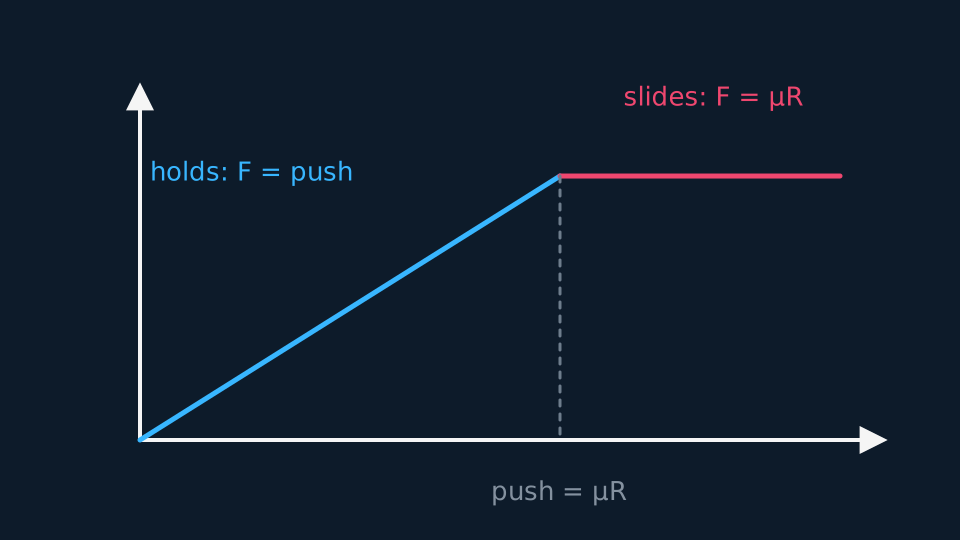
In equilibrium, friction takes the value required to balance the other tangential forces, provided |F| ≤ μR. At limiting equilibrium, |F| = μR, where μ is the coefficient of friction and R the normal reaction. If the other tangential forces would require a larger value, equilibrium is impossible: the object slides and friction takes the value F = μR, opposing the sliding.
Do not assume R = mg. R must be found from the equation perpendicular to the surface. A rope pulling at an angle above the horizontal reduces R; a push angled downwards increases it, so a heavy suitcase is easier to pull than to push.
WORKED EXAMPLE
An angled pull on rough ground
A 20 kg crate on rough horizontal ground, μ = 0.2, is pulled by a rope at 25° above the horizontal with tension 80 N. Find the acceleration.
Perpendicular: R + 80 sin 25° = 20g, so R = 196 − 33.8 = 162 N, not 196 N.
Friction: F = μR = 0.2 × 162.2 = 32.4 N.
Along the ground: 80 cos 25° − 32.4 = 72.5 − 32.4 = 40.1 N, so a = 40.1/20 = 2.00 m s⁻².
Using R = 196 N instead would have given F = 39.2 N and a = 1.67 m s⁻², and that error would carry into every later part of the question.
The contact force and its components
The normal reaction R and friction F may be treated as perpendicular components of the resultant contact force. Its magnitude is √(R² + F²). Questions use three names for these: the normal contact force for the component perpendicular to the surface, the frictional contact force for the component along it, and the magnitude of the contact force for the magnitude of the resultant.
The crate above had R = 162.2 N and F = 32.4 N, so the ground pushes on it with a contact force of magnitude √(162.2² + 32.4²) = 165 N, tilted back from the normal by the friction. For a block resting in equilibrium on a rough slope, R = mg cos θ and F = mg sin θ, so the magnitude is mg. That is necessary, since the only other force on the block is its weight and the two must balance.
Work with the two components throughout: R comes from the equation perpendicular to the surface, F takes the value required up to μR, and F = ma is applied along a stated direction. Combine them into a single magnitude only when the question asks for the contact force by name.
On a slope
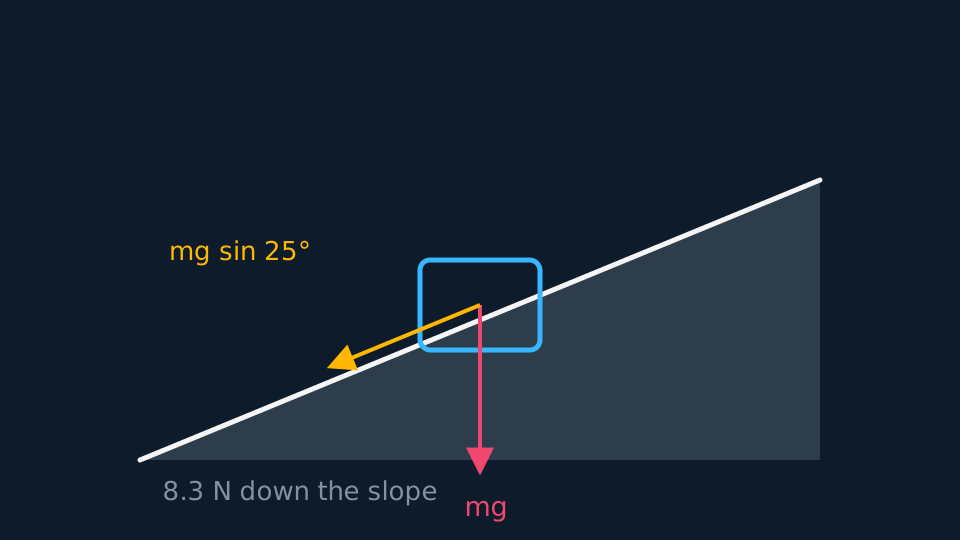
Axes along and perpendicular to the slope simplify the working immediately. The weight resolves into mg sin θ pulling down the slope and mg cos θ pressing into it, so on a plain slope R = mg cos θ and the limiting friction is μmg cos θ.
WORKED EXAMPLE
Does it slide, and how fast?
A 2 kg block sits on a rough 25° slope, μ = 0.3. Show it slides, and find its acceleration.
Down-slope component: mg sin 25° = 8.28 N. Limiting friction: 0.3 × mg cos 25° = 5.33 N.
8.28 > 5.33, so equilibrium is impossible and it slides.
Sliding: ma = 8.28 − 5.33 = 2.95 N, so a = 1.48 m s⁻² down the slope.
Equivalent check: tan 25° = 0.466 > 0.3 = μ. For a block on a plain slope with no other applied force, slipping occurs exactly when tan θ exceeds μ.
The direction of friction
Friction acts in the direction opposing the relative sliding, or the sliding that would occur. A block being pushed up a slope has friction acting down the slope; the same block released and slipping has friction acting up it. Determine this direction before writing the equation, since it fixes the sign of the friction term.
In a two-part question that pushes a block up a slope and then removes the force, the direction of friction reverses when the block stops. The deceleration going up and the acceleration coming back down are therefore different in magnitude.
A slope, a string and a pulley
In this arrangement a particle lies on the plane, a string runs from it up the line of greatest slope and over a smooth pulley fixed at the top, and a second particle hangs on the other end. The string is light and inextensible over a smooth pulley, so while it is taut there is one tension and one magnitude of acceleration; the plane is resolved along and perpendicular to itself as above. Write one equation per particle, each in that particle's own direction of travel, and add them to eliminate T.
WORKED EXAMPLE
Up the slope, down the string
A particle A of mass 4 kg lies on a smooth plane inclined at 30°. A light inextensible string from A passes up the slope, over a smooth pulley at the top, and carries a particle B of mass 3 kg hanging freely. Find the acceleration and the tension.
Direction of motion: B is pulled down by 3g = 29.4 N and the component of A's weight down the slope is 4g sin 30° = 19.6 N. The plane is smooth, so the larger of these determines the motion: B descends and A moves up the slope.
For B, with down positive: 3g − T = 3a. For A, with up the slope positive: T − 4g sin 30° = 4a.
Adding: 3g − 4g sin 30° = 7a, so 9.8 = 7a and a = 1.4 m s⁻². Then T = 3(g − a) = 3 × 8.4 = 25.2 N.
Check on A's equation: 25.2 − 19.6 = 5.6 = 4 × 1.4. T lies between 19.6 N and 29.4 N, as it must while A accelerates up the slope and B accelerates downwards.
On a rough plane a friction term is added. With μ = 0.2, the perpendicular equation gives R = 4g cos 30° = 33.9 N, so friction is 0.2 × 33.9 = 6.79 N acting down the slope while A moves up it. A's equation becomes T − 19.6 − 6.79 = 4a, the sum becomes 29.4 − 19.6 − 6.79 = 7a, and a = 0.430 m s⁻² with T = 3(g − a) = 28.1 N. The acceleration is smaller and the tension larger, since T = 3(g − a) increases as a decreases.
Before choosing a direction, test whether equilibrium is possible. With particle A of mass m_A on a plane at angle θ and particle B of mass m_B hanging:
If this inequality holds, the system can remain at rest. Otherwise it moves towards the side with the larger driving force, and friction opposes that motion. Testing only whether the hanging weight exceeds mg sin θ plus limiting friction is not sufficient: a hanging weight that is small enough lets the particle on the plane slide down instead.
ASSESSMENT FOCUS
- Write F ≤ μR and state when equality holds. For an object that is not in limiting equilibrium and not sliding, F is determined by the other forces, not by μR.
- Do not assume R = mg. Resolve perpendicular to the surface and use the result.
- On slopes, resolve the weight along and perpendicular to the plane and keep the axes tilted.
- “On the point of slipping” means limiting equilibrium, so F = μR exactly.
- State which way friction acts before writing the equation, with the reason.
- “The magnitude of the contact force” asks for √(R² + F²); R alone is the normal component only.
- For a connected system on a rough plane, test both directions with |m_Bg − m_Ag sin θ| ≤ μm_Ag cos θ before assuming which way it moves.
CHECK YOURSELF
A 4 kg box rests on a rough horizontal floor, μ = 0.5. A horizontal force of 15 N is applied. Show the box does not move, and state the friction force acting.
Show a hint
Compare the applied force with the limiting friction.
Show the answer
Limiting friction: μR = 0.5 × 4 × 9.8 = 19.6 N, and the applied force is 15 N < 19.6 N, so the box does not move.
Friction equals the applied force: 15 N, not 19.6 N.
Friction matches the applied force up to μR, and only sliding or the limiting case makes that an equality.
On a slope, mg sin θ along and mg cos θ into it, and compare tan θ with μ to see whether the block slips.
WORKBOOK
Printable practice for this topic: original exam-style questions with room to work, and a fully worked answer book. Free to use; please do not redistribute or sell.
Or read them with their worked answers on the friction and inclined planes questions page.
CHECK YOUR PROGRESS
Rate how confident you feel with each objective for this lesson. Ratings are saved in this browser, on this device, unless you sign in.
- Use F ≤ μR, with equality only in limiting equilibrium or during sliding.
- Work out R properly when the applied force has a vertical component.
- Treat the normal and frictional forces as the two components of one contact force, and find its magnitude.
- Resolve forces along and perpendicular to an inclined plane.
- Decide whether an object on a rough slope slips, and find its acceleration when it does.
- Fix the direction of friction before writing an equation, and reverse it when the sliding it opposes reverses.
- Solve the standard arrangement of a particle on a plane joined by a string over a pulley at the top of it to a particle hanging freely.
Open the full revision checklist to see every objective in the course in one place.