Maths › Further Pure 1 › Series solutions of differential equations
Series solutions of differential equations
Use the differential equation and initial values to calculate successive derivatives at the expansion point, then substitute them into the Taylor polynomial. Record any solution excluded by a substitution or division, and state that the series is reliable only near the expansion point.
Builds on Taylor series and First order equations and integrating factors.
IN THIS TOPIC
- Extract successive derivative values at the starting point directly from the equation.
- Assemble the Taylor polynomial of the solution as far as a stated power.
- Apply a given substitution to reduce an equation to a solvable type, and list any solution the substitution excludes.
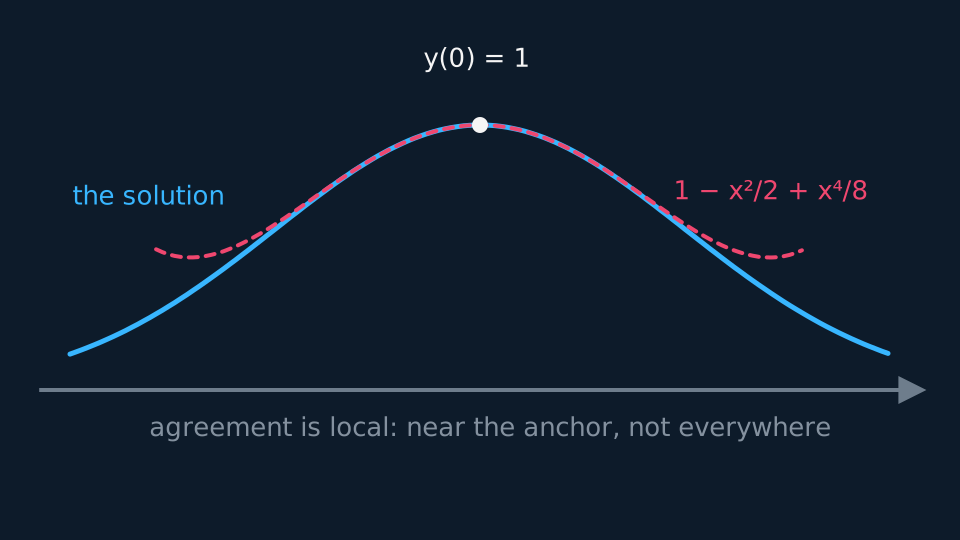
- Compare a truncated series with an exact solution, near the expansion point and far from it.
COMMON MISCONCEPTION
A differential equation with no closed-form solution gives no information about its solution.
The equation itself supplies the derivatives. Rearrange for the highest derivative and substitute the initial values, then differentiate the whole equation and substitute again; each round yields the next Taylor coefficient of the solution about that point. For y'' + xy' + y = 0 with y = 1 and y' = 0 at x = 0 that gives y = 1 − x²/2 + x⁴/8 + …, valid locally about the origin.
Successive derivatives from the equation
Rearrange the equation for the highest derivative and substitute the initial values, which gives the second derivative at the expansion point. Differentiate the whole equation and substitute again for the third derivative. Each round gives the next Taylor coefficient of the solution.
When the equation's coefficients and the required solution are analytic near the initial point, repeated differentiation determines the local Taylor coefficients. The polynomial obtained approximates the solution near that point and says nothing about behaviour far from it.
WORKED EXAMPLE
A worked series solution
Find a series solution of y'' + xy' + y = 0, with y = 1 and y' = 0 at x = 0, up to the term in x⁴.
At x = 0: y'' = −xy' − y = −1.
Differentiate. The third derivative is −2y' − xy'', which is 0 at x = 0. Once more, the fourth is −3y'' − x times the third, so it takes the value 3.
Taylor: y = 1 − x²/2! + 3x⁴/4! = 1 − x²/2 + x⁴/8 + …
This one happens to have the closed form y = e−x²/2, and its expansion agrees term for term. At x = 0.4 the series gives 0.9232 and the exact value is 0.9231.
Two points of technique
Differentiate the equation as it stands, product rule included. In y'' + xy' + y = 0 the middle term is a product, so differentiating it gives y' + xy''. Dropping the first of those two terms changes every coefficient after it.
Keep the factorials visible while the series is being built, so that a coefficient such as 3/4! can be checked against the derivative it came from, and simplify only on the final line.
The expansion point need not be zero. If the conditions are given at x = 2, every derivative is evaluated there and the answer comes out in powers of (x − 2). Only the bracket changes.
Reduction by substitution
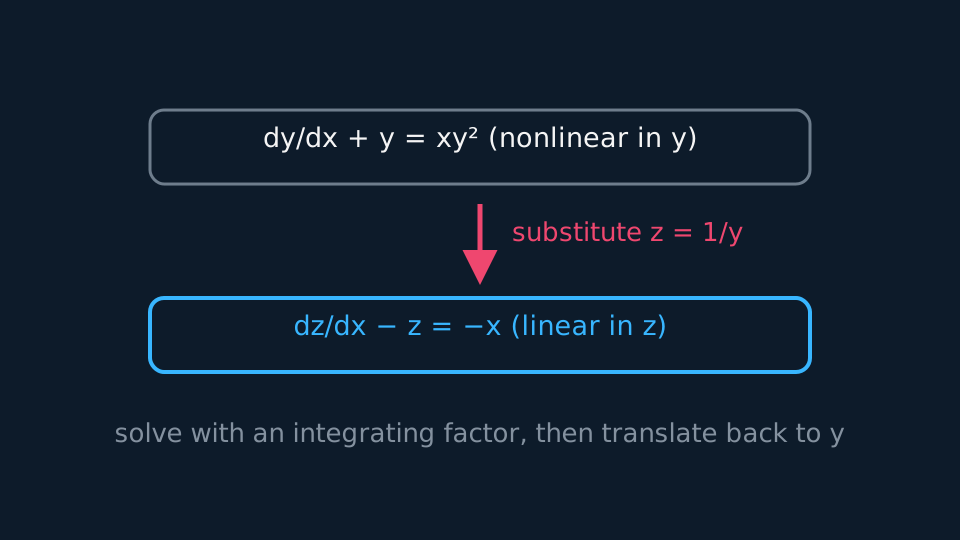
Some equations become a standard type under a change of variable. The question supplies the substitution; transform both the derivative and the function, solve the resulting equation, and translate the answer back. Record any solution the substitution excludes.
WORKED EXAMPLE
A reciprocal substitution
Use z = 1/y to solve dy/dx + y = xy².
The substitution z = 1/y assumes y ≠ 0.
dz/dx = −(1/y²)(dy/dx), so dividing the equation by −y² gives dz/dx − z = −x, which is linear in z.
Integrating factor e−x: z = x + 1 + Cex.
It gives the non-zero family y = 1/(x + 1 + Cex). The original equation also has the constant solution y = 0, which must be listed separately.
GUIDED PRACTICE
Second derivative from the equation
For y'' = x + y² with y(0) = 1 and y'(0) = 2, find the second and third derivatives at 0, and write the series solution up to x³.
Show the working
y''(0) = 0 + 1² = 1.
Differentiating gives 1 + 2yy' for the third derivative, which at 0 is 1 + 2(1)(2) = 5.
y = 1 + 2x + x²/2 + 5x³/6 + … Both coefficients came from the equation itself, which was never solved.
ASSESSMENT FOCUS
- Rearrange for the highest derivative first, since every later step reuses that arrangement.
- Differentiate the equation as it stands, products and all, before substituting any numbers.
- Keep the factorials visible until the final line.
- Under a substitution, transform dy/dx explicitly and show that transformation before quoting the new equation.
- State any solution a substitution or a division removes, such as y = 0 under z = 1/y, and list it beside the family.
CHECK YOURSELF
For y' = x² + y with y(0) = 1, find the second and third derivatives of y at x = 0.
Show a hint
Differentiate the equation itself, then substitute x = 0.
Show the answer
y'' = 2x + y', and y'(0) = 1, so y''(0) = 1. Differentiating again gives 2 + y'', so the third derivative at 0 is 3.
Solve for the highest derivative, then differentiate and substitute repeatedly; each round yields the next Taylor coefficient, valid locally about the expansion point.
A given substitution turns the equation into a standard type. Transform the derivatives, solve, translate back, and list any solution the substitution excluded.
WORKBOOK
Printable practice for this topic: original exam-style questions with room to work, and a fully worked answer book. Free to use; please do not redistribute or sell.
Or read them with their worked answers on the series solutions of differential equations questions page.
CHECK YOUR PROGRESS
Rate how confident you feel with each objective for this lesson. Ratings are saved in this browser, on this device, unless you sign in.
- Extract successive derivative values at the starting point directly from the equation.
- Assemble the Taylor polynomial of the solution as far as a stated power.
- Apply a given substitution to reduce an equation to a solvable type, and list any solution the substitution excludes.
- Compare a truncated series with an exact solution, near the expansion point and far from it.
Open the full revision checklist to see every objective in the course in one place.