Maths › Coordinate geometry › Circles
Circles
The equation of a circle comes from Pythagoras' theorem: every point on it lies at distance r from a fixed centre. Completing the square recovers the centre and radius from an expanded equation, and the lesson puts three GCSE circle theorems to work in coordinate problems. The discriminant of a quadratic decides whether a line meets a circle, and the distance between the centres decides how two circles lie.
Builds on Quadratic functions and Straight lines.
IN THIS TOPIC
- Move between the centre-radius form and the general form by completing the square.
- Find the tangent at a point from the gradient of the radius.
- Get a chord length from the half-chord right triangle without solving anything.
- Find where a line meets a circle by substituting it in, and read the discriminant as two crossings, a tangent or a miss.
- Use the angle in a semicircle in both directions: a diameter subtends a right angle, and a right angle names a diameter.
- Find the circle through three given points.
- Decide how two circles lie by comparing the distance between their centres with the sum and the difference of the radii, and find the crossings when there are two.
COMMON MISCONCEPTION
A line that meets a circle meets it twice.
A tangent meets a circle exactly once. Substituting the line into the circle's equation leaves a quadratic, and its discriminant settles the count: positive for two intersections, zero for the single point of contact of a tangent, and negative for none. State the case in words as well as computing the discriminant.
From Pythagoras to the equation
A circle is the set of points at a fixed distance r from a centre (a, b), and the distance between two points is Pythagoras. Square the distance condition and the equation appears,
with the centre and radius visible. No circle equation is given in the formulae booklet, so this one must be learnt. Expanding gives the general form x2 + y2 + 2fx + 2gy + c = 0, and completing the square in x and y separately recovers the centre and radius from it.
WORKED EXAMPLE
Unscrambling a general form
Find the centre and radius of the circle x2 + y2 − 6x + 4y − 12 = 0.
Complete the square in each variable. (x − 3)2 − 9 + (y + 2)2 − 4 − 12 = 0.
Gather the constants. (x − 3)2 + (y + 2)2 = 25.
Centre (3, −2), radius 5. The signs of the centre coordinates are the opposite of those inside the brackets, and the radius is the square root of the right-hand side.
Tangents
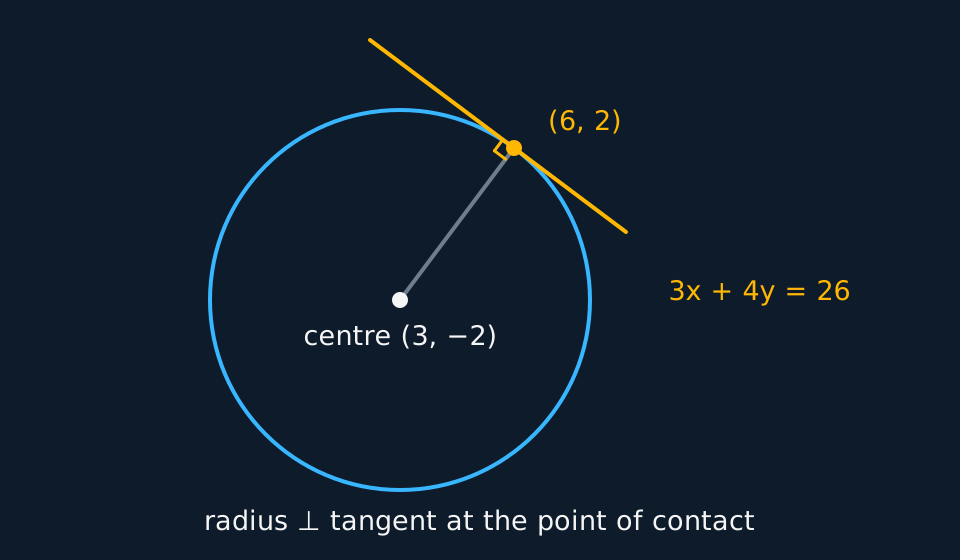
The radius to a point of contact is perpendicular to the tangent there, so the tangent's gradient is the negative reciprocal of the gradient of the radius, and the equation follows from point-gradient form. Two positions have no negative reciprocal to take, so their tangents are written down directly. A horizontal radius meets a vertical tangent, whose equation is x = the x-coordinate of the point, and a vertical radius meets a horizontal tangent y = the y-coordinate.
WORKED EXAMPLE
A tangent, without calculus
Find the equation of the tangent to (x − 3)2 + (y + 2)2 = 25 at the point (6, 2).
Confirm the point is on the circle. 32 + 42 = 25, so it is.
The radius from (3, −2) to (6, 2) has gradient 4/3, so the tangent's gradient is −3/4.
Through (6, 2), y − 2 = −3/4(x − 6), which clears to 3x + 4y − 26 = 0.
No differentiation is required: the perpendicularity of radius and tangent gives the gradient.
Chords, and lines that miss
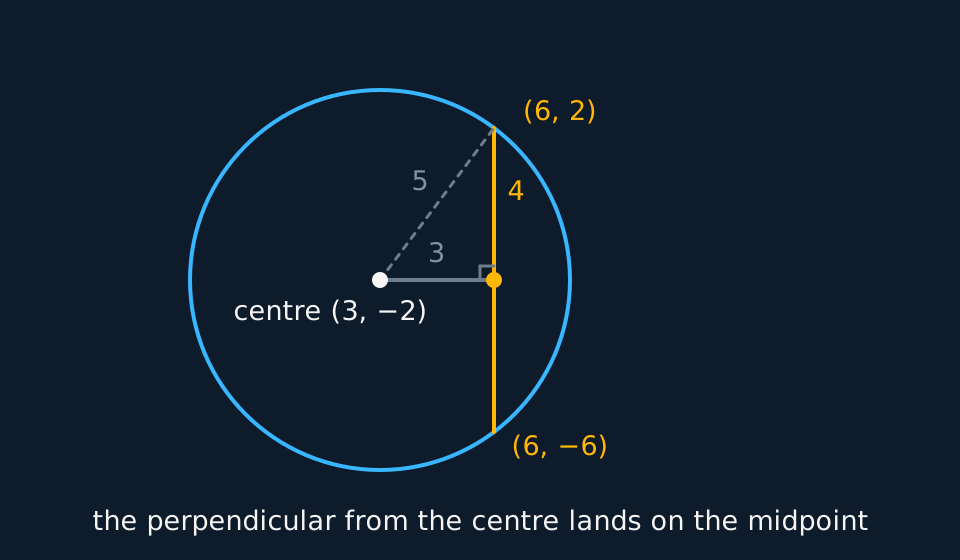
The second circle theorem says the perpendicular from the centre bisects a chord, which builds a right triangle out of half the chord, the distance from the centre to the line, and the radius as hypotenuse. Substituting a line into a circle's equation gives a quadratic instead, and its discriminant gives the number of intersections without a sketch: positive for two intersections, zero for a single point of contact, which is a tangent, and negative for none.
GUIDED PRACTICE
A chord measured by Pythagoras
The line x = 6 cuts the circle (x − 3)2 + (y + 2)2 = 25 in a chord. Find the chord's length, before opening the working.
Show the working
Substituting x = 6 gives (y + 2)2 = 16, so y = 2 or y = −6. The chord runs from (6, 2) to (6, −6), length 8.
The theorem route agrees without solving anything. The centre is 3 from the line x = 6 and the radius is 5, so the half-chord is √(25 − 9) = 4.
Two independent methods giving the same length is a check on both.
Two circles, and one distance
A line against a circle came down to a discriminant because substitution left a quadratic behind. Two circles leave no such quadratic, and need none. The count is settled by the distance d between the two centres, compared with the radii r1 and r2.
Take a point moving round the second circle. Its distance from the first centre is least at the near end of the line of centres, |d − r2|, and greatest at the far end, d + r2, and it varies continuously between them, so it takes every value in that range. A point shared by the two circles is a point of the second circle whose distance from the first centre is r1, so a shared point exists when r1 falls in that range. Written so that d stands alone, the condition is |r1 − r2| ≤ d ≤ r1 + r2.
The number of shared points comes from symmetry. Both circles are symmetric in the line of centres, so a shared point off that line is matched by its mirror image, which is shared as well, and the two arrive together. A single point of contact has to sit on the line of centres itself, and that happens at the two ends of the range rather than between them. Five arrangements follow, each with its own comparison.
| Distance between the centres | How the two circles lie |
|---|---|
| d > r1 + r2 | apart, neither inside the other, with no common point |
| d = r1 + r2 | touching externally, at one point on the line of centres |
| |r1 − r2| < d < r1 + r2 | crossing, at two points either side of the line of centres |
| d = |r1 − r2|, with d > 0 | touching internally, the smaller circle inside the larger |
| d < |r1 − r2| | the smaller circle inside the larger, with no common point |
Coincident centres are the case the table cannot show. Concentric circles of unequal radii are the last row with d = 0, the smaller sitting inside the larger. Concentric circles of equal radius are one circle written twice, and they share every point of it rather than one or two. Since d and the radii are lengths, the comparisons survive squaring, and d2 set against (r1 + r2)2 and (r1 − r2)2 settles the case with no square root taken.
WORKED EXAMPLE
One circle, five neighbours
The circle C is (x − 3)2 + (y + 2)2 = 25, centre (3, −2) and radius 5. Say how C lies against each of these five circles.
Centre (15, 3), radius 4. d = √(122 + 52) = 13 and the radii sum to 9, so 13 > 9 and the two are apart.
Centre (9, 6), radius 5. d = √(62 + 82) = 10, which is the sum 5 + 5, so they touch externally. Contact is halfway along the line of centres, at (6, 2).
Centre (7, 2), radius 7. d = √(42 + 42) = √32 ≈ 5.66, with sum 12 and difference 2. Since 2 < 5.66 < 12 they cross at two points.
Centre (6, 2), radius 10. d = √(32 + 42) = 5, which is the difference 10 − 5, so they touch internally, C inside the larger circle and the two meeting at (0, −6).
Centre (4, −1), radius 1. d = √2 ≈ 1.41 against a difference of 4, and 1.41 < 4, so the small circle lies inside C without touching it.
Each case needs one distance and two comparisons. A diagram not drawn to scale cannot distinguish the five arrangements, so the comparison must be computed.
When the answer is two points, finding them starts with a subtraction. Both equations in general form carry x2 + y2, so subtracting one from the other cancels the squares and leaves a linear equation which every common point satisfies. That line is the common chord, and with it in hand the problem is the line-and-circle problem of the last section: substitute the line into either circle and solve.
WORKED EXAMPLE
Where two circles cross
Show that x2 + y2 − 6x + 4y − 12 = 0 and x2 + y2 − 14x − 4y + 4 = 0 cross at two points, and find those points.
Completing the square in each gives (x − 3)2 + (y + 2)2 = 25 and (x − 7)2 + (y − 2)2 = 49, so the centres are (3, −2) and (7, 2) and the radii are 5 and 7.
d2 = 42 + 42 = 32. The sum of the radii squares to 144 and their difference to 4, and 4 < 32 < 144, so the circles cross at two points.
Subtract the second equation from the first. The squares go, leaving 8x + 8y − 16 = 0, that is x + y = 2.
Substituting y = 2 − x into the first circle gives (x − 3)2 + (4 − x)2 = 25, which tidies to 2x2 − 14x = 0, so x = 0 or x = 7.
The crossings are (0, 2) and (7, −5). Both satisfy the second equation as well, 0 + 4 − 0 − 8 + 4 = 0 and 49 + 25 − 98 + 20 + 4 = 0, which checks the solutions.
The chord between them has length √(72 + 72) = 7√2, and the half-chord triangle agrees: the centre (3, −2) is |3 − 2 − 2|/√2 = 1/√2 from the line x + y − 2 = 0, and √(25 − 1/2) = 7/√2 is half of 7√2.
The same subtraction applies in the touching case. Take C and the radius-5 circle about (9, 6), the pair that touched at (6, 2). Their expanded equations differ by 12x + 16y − 104 = 0, or 3x + 4y − 26 = 0, which is the tangent to C at (6, 2). Subtracting produces the common tangent when two circles touch, the common chord when they cross, and a line neither circle reaches when they miss. Coincident centres are again the exception, since then the x and y terms cancel too and no line survives.
The angle in a semicircle
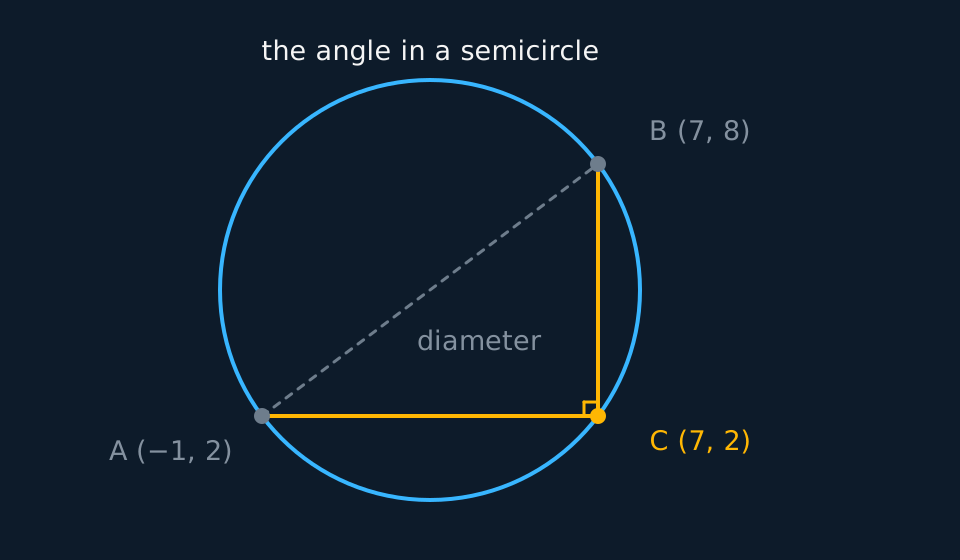
The third theorem says an angle in a semicircle is a right angle. If AB is a diameter then every other point of the circle sees AB at 90°, and the converse runs the other way, so a right angle at C means AB is a diameter of the circle through A, B and C. That converse is the fast route through most circumcircle questions, because a diameter gives the centre, its midpoint, and the radius, half its length, at once.
INDEPENDENT PRACTICE
A circumcircle by right angle
Find the equation of the circle through A(−1, 2), B(7, 8) and C(7, 2).
Show the working
Look at C first. CA is horizontal and CB is vertical, so the angle at C is a right angle.
By the converse of the semicircle theorem, AB is a diameter. Centre = midpoint of AB = (3, 5), and r2 = ((7 + 1)2 + (8 − 2)2)/4 = 100/4 = 25.
The circle is (x − 3)2 + (y − 5)2 = 25, and substituting C gives 16 + 9 = 25, confirming all three points sit on it.
Where no angle is a right angle, use the general method: the centre is the intersection of the perpendicular bisectors of two of the chords.
ASSESSMENT FOCUS
- Complete the square in x and y separately and watch both signs. (x − 3)2 means the centre has x = +3, and r is the square root of the right-hand side.
- In the general form x2 + y2 + 2fx + 2gy + c = 0 the centre is (−f, −g) and r2 = f2 + g2 − c, which requires f2 + g2 > c. Show the completed square where a question says “show that”.
- A tangent question is a gradient question: find the gradient of the radius, take the negative reciprocal, and use point-gradient form. Calculus is not required.
- Chord lengths come from the half-chord right triangle, (half chord)2 = r2 − d2, with d the distance from the centre to the line.
- Before finding a circumcircle centre by bisectors, test the three vertices for a right angle: if there is one, the side opposite it is a diameter, which gives the centre and radius directly.
- Substituting a line into a circle gives a quadratic whose discriminant determines the case: two intersections, one point of contact, or none. State the case in words as well as computing the discriminant.
- For two circles, compare the distance between the centres with r1 + r2 and |r1 − r2|. Outside that range they have no common point, at either end they touch, and between the ends they cross twice. Squaring both sides avoids surds in the comparison.
- To find where two circles cross, subtract their general forms to get the common chord, then substitute that line into either circle. Substituting one circle equation into the other does not simplify the problem, since the squared terms remain.
CHECK YOURSELF
Find the centre and radius of the circle x2 + y2 + 8x − 2y + 8 = 0, and state whether the point (−1, 1) lies on it.
Show a hint
Complete the square in each variable, then substitute the point.
Show the answer
(x + 4)2 − 16 + (y − 1)2 − 1 + 8 = 0, so (x + 4)2 + (y − 1)2 = 9.
Centre (−4, 1), radius 3.
At (−1, 1) the left side is 32 + 0 = 9, so the point lies on the circle, at the end of the horizontal radius.
A circle is Pythagoras about a fixed centre, and completing the square recovers the centre and radius from any form.
Radius meets tangent at a right angle, the perpendicular from the centre bisects a chord, and a right angle on the circle names a diameter.
Two circles meet when the distance between their centres lies between |r1 − r2| and r1 + r2, touching at either end of that range.
WORKBOOK
Printable practice for this topic: original exam-style questions with room to work, and a fully worked answer book. Free to use; please do not redistribute or sell.
Or read them with their worked answers on the circles questions page.
CHECK YOUR PROGRESS
Rate how confident you feel with each objective for this lesson. Ratings are saved in this browser, on this device, unless you sign in.
- Move between the centre-radius form and the general form by completing the square.
- Find the tangent at a point from the gradient of the radius.
- Get a chord length from the half-chord right triangle without solving anything.
- Find where a line meets a circle by substituting it in, and read the discriminant as two crossings, a tangent or a miss.
- Use the angle in a semicircle in both directions: a diameter subtends a right angle, and a right angle names a diameter.
- Find the circle through three given points.
- Decide how two circles lie by comparing the distance between their centres with the sum and the difference of the radii, and find the crossings when there are two.
Open the full revision checklist to see every objective in the course in one place.