Maths › Coordinate geometry › Parametric equations
Parametric equations
Instead of relating y to x directly, both can be given in terms of a third variable, so a curve is traced out as that parameter increases. Parametric equations describe circles, parabolas and flight paths naturally, and eliminating the parameter converts them back to Cartesian form when a question calls for it.
Builds on Circles and Trigonometric graphs and equations.
IN THIS TOPIC
- Trace and sketch a curve given parametrically, using values of the parameter.
- Convert between parametric and Cartesian forms, and say which part of the Cartesian curve you actually get.
- Use parametric equations as models, projectile motion included.
COMMON MISCONCEPTION
Eliminating the parameter changes nothing.
The Cartesian equation gives the curve the points lie on; the range of the parameter decides which part of it is covered. For x = t2, y = t4 the equation is y = x2, but x = t2 ≥ 0 for every real t, so the curve is only the right-hand half of that parabola. State the restriction as part of the answer.
A point with a clock
A parametric curve gives x and y separately as functions of a parameter t, and the curve is the set of points (x(t), y(t)) for t in the stated range. In a motion model the parameter is time.
WORKED EXAMPLE
Plotting, then converting
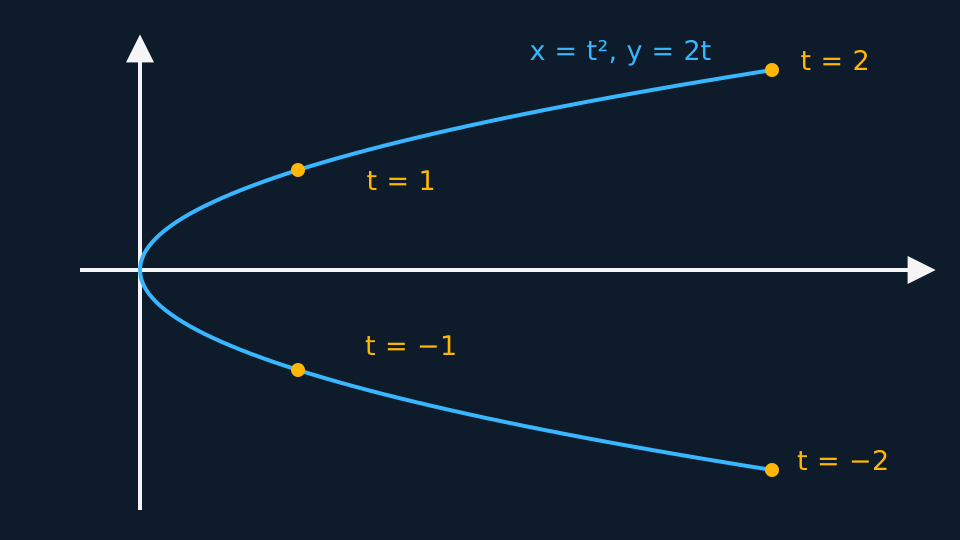
Sketch the curve x = t2, y = 2t for −2 ≤ t ≤ 2, and find its Cartesian equation.
A short table of t-values gives (4, −4), (1, −2), (0, 0), (1, 2) and (4, 4), sweeping up the right-opening curve in the figure.
To convert, make t the subject of the simpler equation. t = y/2, and substituting gives x = (y/2)2.
The Cartesian equation is y2 = 4x, a parabola on its side.
Make t the subject of the simpler of the two equations, then substitute into the other.
Converting, with care
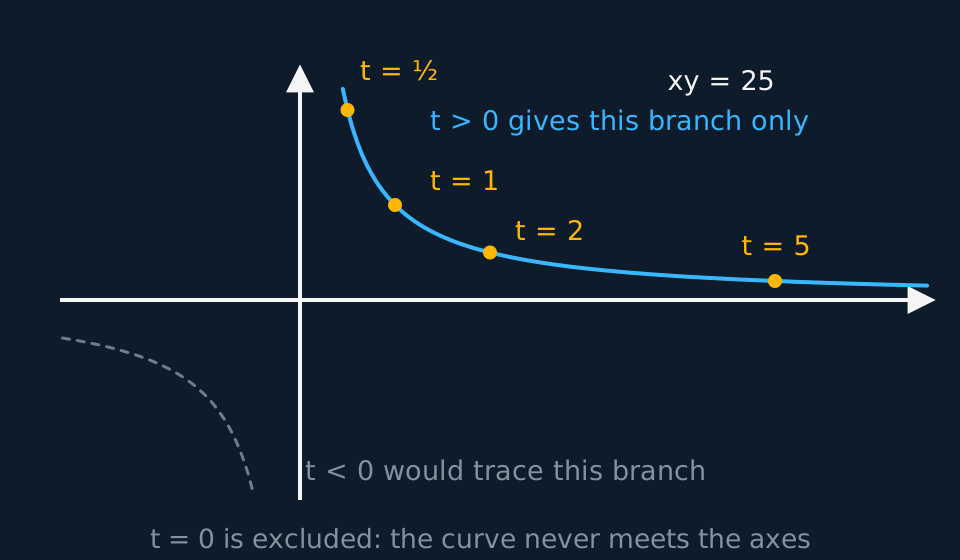
A pair defined by sin and cos is converted using an identity rather than by making t the subject. For x = 3 cos t, y = 3 sin t, squaring and adding uses sin2 t + cos2 t = 1 to give x2 + y2 = 9, a circle of radius 3. For x = 5t, y = 5/t, multiplying gives xy = 25 straight away. The domain of t must be stated: the second pair excludes t = 0, and a parametrisation may cover only part of the Cartesian curve.
Describe the drawing
Axes with the hyperbola x y equals 25 ghosted in dashed grey in both the first and third quadrants, and the branch actually traced by x equals 5t, y equals 5 over t with t positive drawn solid in cyan through marked points at t equals one half, 1, 2 and 5: the parameter's domain decides which part of the Cartesian curve exists, and t equals 0 never happens.
WORKED EXAMPLE
Which part of the Cartesian curve
The curve C has parametric equations x = t2, y = t4. Find its Cartesian equation, and state which part of that Cartesian curve C actually is.
Since y = (t2)2, the Cartesian equation is y = x2.
But x = t2 ≥ 0 for every real t, so C is only the right-hand half of the parabola, x ≥ 0.
The Cartesian equation gives the curve on which the points lie; the range of the parameter determines which part of it the parametrisation covers. State that restriction as part of the answer.
GUIDED PRACTICE
Two classic pairs
Find Cartesian equations for (a) x = 3 cos t, y = 3 sin t, and (b) x = 5t, y = 5/t with t ≠ 0, before opening the working.
Show the working
(a) Square and add. x2 + y2 = 9 cos2 t + 9 sin2 t = 9, the circle of radius 3 about the origin, fully traced as t runs through a period.
(b) Multiply. xy = (5t)(5/t) = 25, the reciprocal curve; t ≠ 0 matches the fact that the curve never meets the axes.
One conversion used an identity and the other used cancellation, each determined by the form of the pair.
Parametric models
In a motion model both coordinates are functions of the same time variable, which is why projectile motion appears in this topic and in mechanics.
INDEPENDENT PRACTICE
A flight, fully read
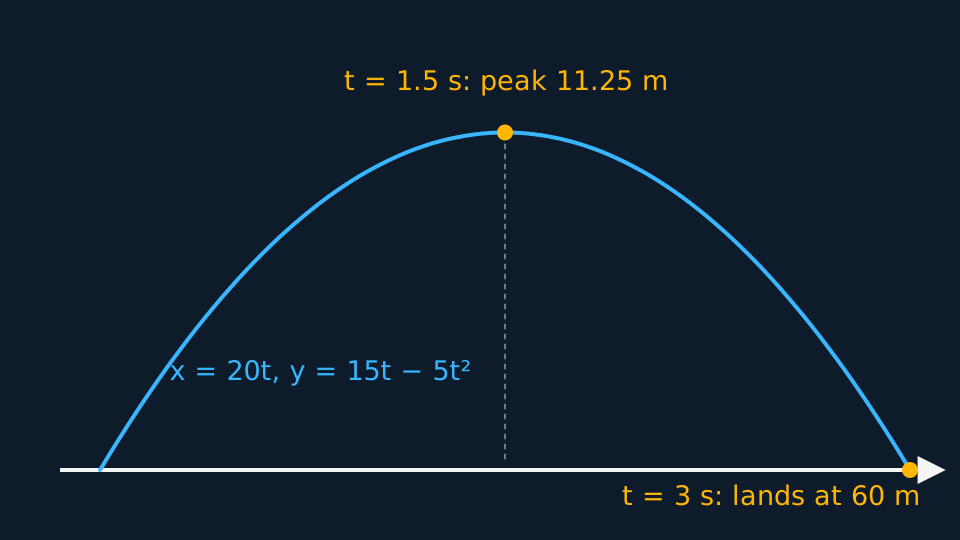
A ball's flight is modelled by x = 20t, y = 15t − 5t2, in metres and seconds. Find when and where it lands, its greatest height, and the Cartesian equation of its path.
Show the working
Landing. y = 0 gives 5t(3 − t) = 0, so t = 3, and x = 20 × 3 = 60 m.
Greatest height. y peaks midway between the roots, at t = 1.5, giving y = 11.25 m.
Substituting t = x/20 into y gives y = 3x/4 − x2/80, the parabola of the figure. The model only runs from launch to landing, 0 ≤ t ≤ 3, so the flight is the piece of that parabola with 0 ≤ x ≤ 60; the unrestricted curve carries on into negative x and below the ground, points the ball never visits.
The parametric form gives the times, and the Cartesian form gives the shape of the path, with the domain stating which part of it the flight covers. Edexcel 9MA0 3.3 requires conversion in both directions.
ASSESSMENT FOCUS
- Sketch parametric curves from a t-table, with arrows on the curve showing the direction of increasing t.
- Convert by making t the subject of the simpler equation, or by a trig identity when sin and cos both appear.
- State the domain of t, and any part of the Cartesian curve the parametrisation does not cover.
- In motion models, landing is given by y = 0 and the greatest height by the vertex in t. Keep values exact until the final step, since a rounded value of t affects the later parts.
CHECK YOURSELF
The curve C is given by x = 2 cos t, y = 2 sin t for 0 ≤ t ≤ π. Find the Cartesian equation of C, and state precisely which points of that Cartesian curve C consists of.
Show a hint
Square and add; then think about what y does for t in the top half of a period.
Show the answer
Squaring and adding gives x2 + y2 = 4, the circle of radius 2.
For 0 ≤ t ≤ π the sine is never negative, so y ≥ 0 throughout.
C is the upper semicircle, from (2, 0) round through (0, 2) to (−2, 0), and not the full circle the Cartesian equation alone would suggest.
A parametric curve is the set of points (x(t), y(t)) for t in a stated range.
Eliminate t by substitution or by an identity, then state which part of the Cartesian curve the parameter range covers.
WORKBOOK
Printable practice for this topic: original exam-style questions with room to work, and a fully worked answer book. Free to use; please do not redistribute or sell.
Or read them with their worked answers on the parametric equations questions page.
USED LATER IN
CHECK YOUR PROGRESS
Rate how confident you feel with each objective for this lesson. Ratings are saved in this browser, on this device, unless you sign in.
- Trace and sketch a curve given parametrically, using values of the parameter.
- Convert between parametric and Cartesian forms, and say which part of the Cartesian curve you actually get.
- Use parametric equations as models, projectile motion included.
Open the full revision checklist to see every objective in the course in one place.