Maths › Further Pure 1 › Limits and L'Hôpital's rule
Limits and L'Hôpital's rule
First identify the form of the limit. Apply L'Hôpital's rule only to a quotient with indeterminate form 0/0 or ∞/∞, and only when its differentiability conditions hold. Products and powers may need logarithms or algebraic rearrangement before the rule applies; a supplied series may give a shorter solution.
Builds on Taylor series and Maclaurin series.
IN THIS TOPIC
- Recognise the indeterminate forms 0/0 and ∞/∞, and say why they carry no verdict.
- Evaluate limits by substituting series expansions and cancelling.
- Apply L'Hôpital's rule, repeatedly where needed, stating its hypotheses first.
- Convert products, differences and power forms into a quotient before starting.
- Quote the two standard limits, of xke−x at infinity and of xkln x at the origin.
COMMON MISCONCEPTION
If numerator and denominator both tend to zero, the fraction must tend to 1, since they shrink together.
The limit is fixed by the rates at which the two parts shrink, not by the common value 0, and it may be any real number, may be infinite, or may not exist. Series expansions display those rates, since the lowest surviving powers decide the answer: as x tends to 0, (x − arctan x)/x³ tends to 1/3 while sin 3x/x tends to 3.
What zero over zero conceals
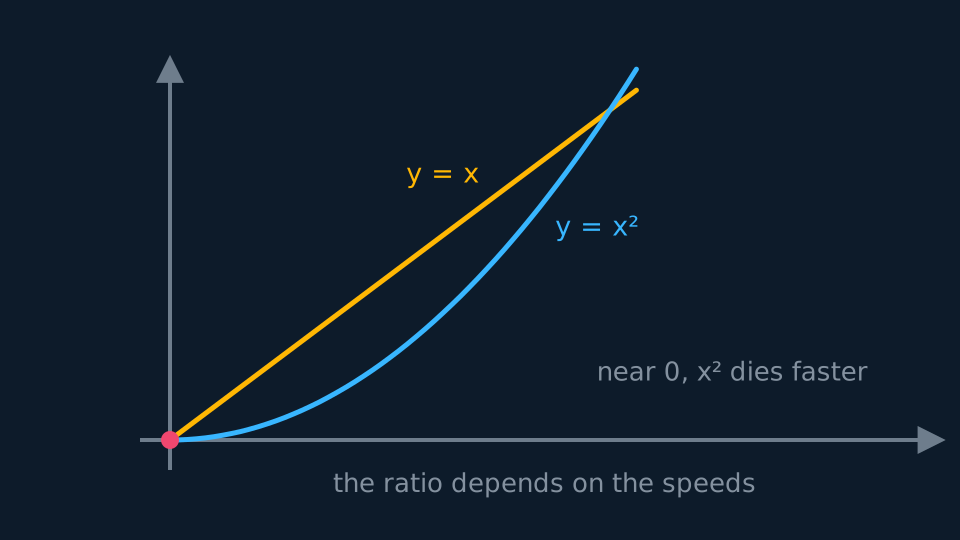
A quotient whose numerator and denominator both tend to 0 is an indeterminate form. The limit depends on the rate at which each part tends to zero, and the common value 0 does not determine it: the limit may be any real number, may be infinite, or may not exist. Series expansions display the rates. Replace each function by its expansion, and the lowest surviving powers determine the answer.
WORKED EXAMPLE
A limit by series
Find the limit as x → 0 of (x − arctan x)/x³.
arctan x = x − x³/3 + x⁵/5 − …, so the numerator is x³/3 − x⁵/5 + ….
Dividing by x³: 1/3 − x²/5 + … → 1/3.
The lowest surviving power in the numerator is x³, which matches the power in the denominator, so the limit is the ratio of the two coefficients.
GUIDED PRACTICE
Another series limit
Find the limit as x → 0 of (e2x² − 1)/x².
Show the working
eu − 1 = u + u²/2 + …, with u = 2x².
The numerator is 2x² + 2x⁴ + …, so dividing by x² gives 2 + 2x² + ….
The limit is 2. One substitution into a standard series removes the indeterminacy.
Differentiating numerator and denominator
L'Hôpital's rule. For a 0/0 or ∞/∞ limit, suppose f and g are differentiable in a deleted neighbourhood of the limiting point, g' is non-zero there, and lim f'/g' exists as a finite or infinite limit. Then lim f/g has the same value. If the new quotient is still indeterminate, apply the rule again.
Two checks come before any differentiating. Confirm that the form really is 0/0 or ∞/∞: applied to a quotient such as sin x/(x + 1), whose limit at 0 is 0, the rule returns 1 and is simply not applicable. Then differentiate numerator and denominator separately; the quotient rule does not enter.
WORKED EXAMPLE
Three rounds, or one series
Find the limit as x → 0 of (2 sin x − sin 2x)/(x − sin x).
Both parts vanish at 0, and so do their first and second derivatives, so the rule is applied three times. At the third, the numerator has become −2 cos x + 8 cos 2x and the denominator cos x, giving 6/1.
Series reach the same value in one line. The numerator expands to x³ + … and the denominator to x³/6 + ….
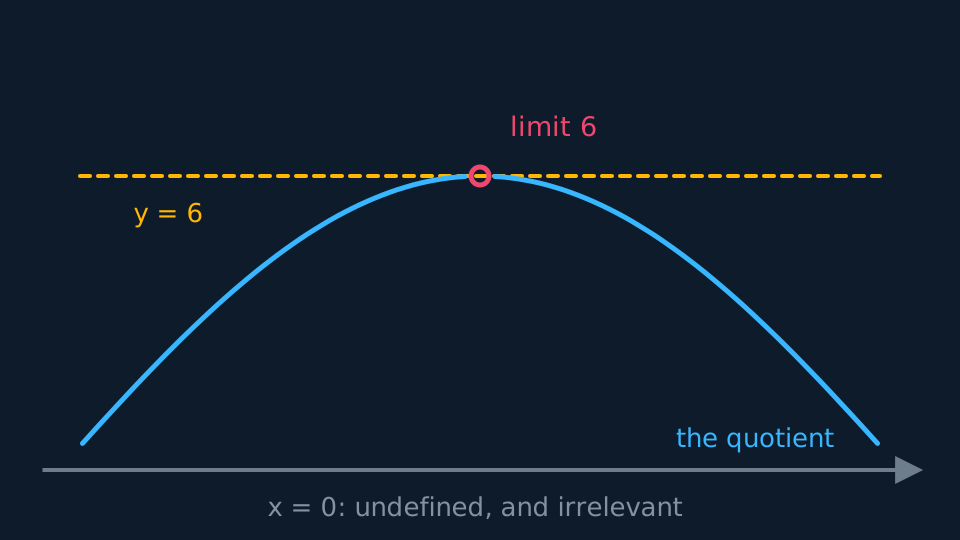
The ratio is x³/(x³/6) → 6. Where several rounds of differentiation are needed, the series route is shorter.
Forms that are not quotients
The rule applies to a quotient, so other indeterminate forms are rearranged first. A product of the shape 0 × ∞ becomes 0/0 on dividing by the reciprocal of one factor. A difference of the shape ∞ − ∞ usually yields to a common denominator. Power forms such as 1∞ and 0⁰ need logarithms taken first and the result exponentiated at the end.
Two products of that shape are worth quoting as standard results. For k > 0, xke−x → 0 as x → ∞, and xkln x → 0 as x → 0⁺. Both compare rates of change. Increasing x by 1 multiplies ex by e, a fixed factor, while it multiplies xk by a factor tending to 1, so at infinity the exponential grows faster than any fixed power; near the origin ln x tends to −∞ more slowly than any positive power of x tends to 0.
WORKED EXAMPLE
Two limits worth quoting
Show that xke−x → 0 as x → ∞, and that xkln x → 0 as x → 0⁺, for k > 0.
The first is ∞ × 0. Write it as xk/ex, which is ∞/∞. Each application of the rule lowers the power by one and leaves the exponential alone, so after enough rounds the numerator is a constant, or a power with a negative index tending to 0, while the denominator still grows without bound. With k = 3 the three rounds give 6/ex → 0.
The second is 0 × (−∞). Divide by the reciprocal of the power: ln x/x−k, now −∞/∞. One round gives (1/x)/(−kx−k−1) = −xk/k → 0.
k fixes how many applications the first limit takes and how quickly the second one arrives, and changes neither answer, so both may be quoted with k left as a letter.
Take (1 + a/x)x as x → ∞. Let y be the expression, so ln y = x ln(1 + a/x), and write that as ln(1 + a/x) divided by 1/x. The form is now 0/0, one application of the rule gives a, and the original limit is therefore ea. The same limit defines continuously compounded interest.
ASSESSMENT FOCUS
- Name the indeterminate form before anything else; the rule applies to 0/0 and ∞/∞ only.
- Differentiate numerator and denominator separately, not with the quotient rule.
- If one application returns 0/0, apply the rule again, and state that the form is still indeterminate each time.
- For power forms, take logarithms first, then exponentiate the limit of the logarithm to recover the answer.
- State the differentiability conditions, including g' non-zero near the point, when the question asks for a justification.
- Quote standard expansions accurately, and keep one term beyond the lowest surviving power.
- The two standard limits, xke−x → 0 at infinity and xkln x → 0 at the origin, may be quoted as results unless the question says 'show that'.
CHECK YOURSELF
Evaluate the limit as x → 0 of sin 3x/x.
Show a hint
One application of the rule, or the first term of the series for sin 3x.
Show the answer
The form is 0/0, so the quotient becomes 3 cos 3x/1, which tends to 3. Equally, sin 3x = 3x − … so the quotient is 3 − … and again tends to 3.
0/0 determines nothing by itself: expand in series and compare the lowest surviving powers.
L'Hôpital's rule replaces f/g by f'/g' for a 0/0 or ∞/∞ form, given differentiability near the point, g' non-zero there, and a limit for f'/g'.
Products, differences and power forms must be rearranged into a quotient before the rule applies.
For k > 0: xke−x → 0 as x → ∞, and xkln x → 0 as x → 0⁺.
WORKBOOK
Printable practice for this topic: original exam-style questions with room to work, and a fully worked answer book. Free to use; please do not redistribute or sell.
Or read them with their worked answers on the limits and L'Hôpital's rule questions page.
CHECK YOUR PROGRESS
Rate how confident you feel with each objective for this lesson. Ratings are saved in this browser, on this device, unless you sign in.
- Recognise the indeterminate forms 0/0 and ∞/∞, and say why they carry no verdict.
- Evaluate limits by substituting series expansions and cancelling.
- Apply L'Hôpital's rule, repeatedly where needed, stating its hypotheses first.
- Convert products, differences and power forms into a quotient before starting.
- Quote the two standard limits, of xke−x at infinity and of xkln x at the origin.
Open the full revision checklist to see every objective in the course in one place.