Maths › Further algebra and series › Maclaurin series
Maclaurin series
A Maclaurin polynomial is a Taylor polynomial centred at zero. It can be found from derivatives at zero or from a known series by substitution. Carry the interval of validity through any substitution, and distinguish a finite approximation from an infinite series representation.
Builds on The product, quotient and chain rules and The general binomial expansion.
IN THIS TOPIC
- Derive a Maclaurin series from repeated differentiation at zero.
- Quote the standard series and state where ln(1 + x) and arctan x are valid.
- Adapt standard series to composites, products and quotients.
- Estimate the value of a function by truncating its series, and comment on the accuracy of the estimate.
COMMON MISCONCEPTION
A curved function like sin x cannot be approximated by polynomials to any accuracy you like.
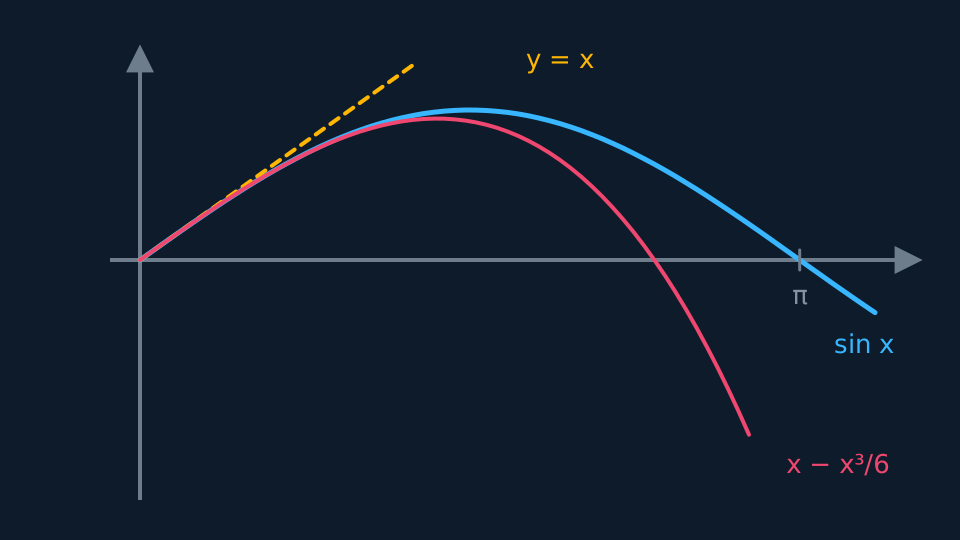
The Maclaurin series for sin x, x − x3/3! + x5/5! − …, converges to sin x for every real x, so taking enough terms brings the polynomial as close as required. Three terms already give 0.479427 against sin 0.5 = 0.479426. The interval matters: ln(1 + x) and arctan x are represented by their series only on the intervals stated with them.
Matching derivatives at zero
Suppose f(x) = a₀ + a₁x + a₂x² + a₃x³ + … and keep differentiating, setting x = 0 each time. Each substitution isolates one coefficient, so a₀ = f(0), a₁ = f'(0), and in general r! ar = f(r)(0). That forces the Maclaurin series:
Check the current formula booklet for your awarding organisation; whether or not this general form is supplied, you must know when it applies and how to derive it. For ex every derivative at 0 is 1, giving 1 + x + x²/2! + x³/3! + …. For sin x the derivatives at 0 cycle through 0, 1, 0, −1, so only odd powers occur and the signs alternate, giving x − x³/3! + x⁵/5! − ….
WORKED EXAMPLE
How good is three terms?
Estimate sin 0.5 using x − x³/3! + x⁵/5!.
0.5 − 0.125/6 + 0.03125/120 = 0.5 − 0.02083… + 0.00026…
That is 0.479427 to 6 decimal places, and the true value is 0.479426, so three terms agree with sin 0.5 to five decimal places.
Distinguish two claims. A finite Taylor polynomial can be formed when the required derivatives exist. Taylor's theorem and its remainder control the approximation error. The infinite Maclaurin series represents f only where the series converges to f; differentiability alone is not sufficient. The standard functions below do satisfy that condition on the intervals stated with them.
Standard series and their intervals of validity
The standard series are those for ex, sin x, cos x, ln(1 + x) and arctan x, together with the binomial series for (1 + x)n. The series for ex, sin x and cos x converge to the function for every x; those for ln(1 + x) and arctan x hold only on stated intervals, and the interval is part of the result:
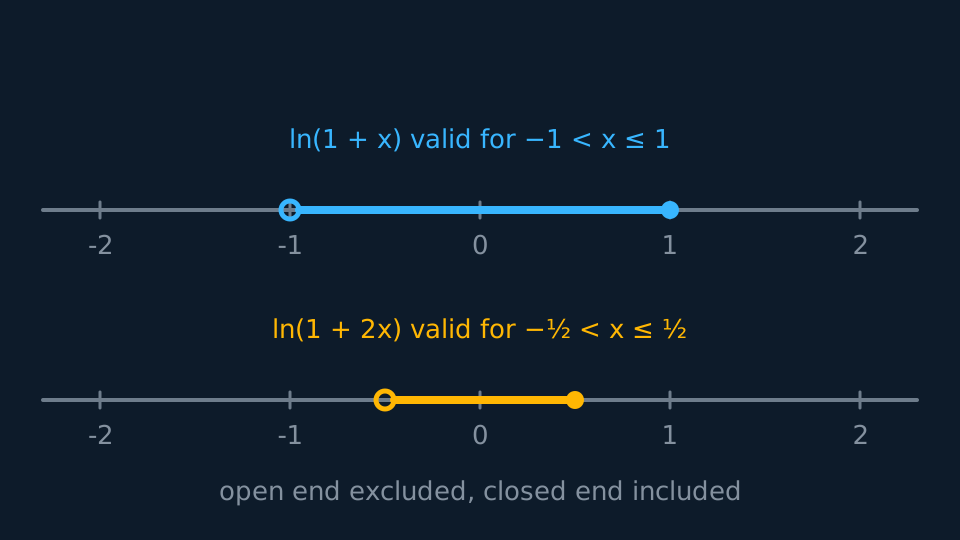
For |x| > 1 the terms do not tend to zero and the series diverges, so it gives no information about the function there. At the excluded endpoint x = −1 the terms tend to zero like 1/n, but the series −1 − 1/2 − 1/3 − … diverges, which is why the interval is open at that end. Series for composites are obtained by substitution: replacing x by 2x gives the series for ln(1 + 2x), valid for −1/2 < x ≤ 1/2, because the substituted quantity must lie in the original interval.
The series for arctan x, namely x − x³/3 + x⁵/5 − …, is valid for −1 ≤ x ≤ 1, closed at both ends. The function is defined for every real x, but outside that interval the series diverges, so state the interval alongside the series as for the logarithm.
WORKED EXAMPLE
A composite series
Find the series for e2x up to the x³ term.
Substitute 2x into 1 + x + x²/2! + x³/3!.
e2x = 1 + 2x + 4x²/2 + 8x³/6 = 1 + 2x + 2x² + (4/3)x³ + …
At x = 0.1 the four terms give 1.22133, and e0.2 = 1.22140, so the cubic approximation agrees to three decimal places.
INDEPENDENT PRACTICE
A logarithm, term by term
Write down the series for ln(1 + x) up to x⁴ and use it to estimate ln 1.5. Comment on the accuracy.
Show the working
With x = 0.5: 0.5 − 0.125 + 0.041667 − 0.015625 = 0.401.
The true value is 0.405 to 3 decimal places, so the four-term estimate is about 0.004 too small.
The series for the logarithm converges more slowly than those for ex or sin x. Nearer the end of its interval of validity, each additional term reduces the error by less.
Series with no standard form
Two methods cover most remaining cases. Multiply two series and collect powers, as in ex sin x = (1 + x + x²/2 + …)(x − x³/6 + …) = x + x² + x³/3 + …. Or differentiate repeatedly from the definition, simplifying each derivative before substituting x = 0, since an unsimplified third derivative is difficult to evaluate reliably.
WORKED EXAMPLE
Repeated differentiation on an awkward function
Find the Maclaurin series for ln(1 + sin x) up to the x³ term.
f(0) = ln 1 = 0.
f'(x) = cos x/(1 + sin x), so f'(0) = 1.
Simplify before going further: f''(x) = −1/(1 + sin x), giving f''(0) = −1.
f'''(x) = cos x/(1 + sin x)², so f'''(0) = 1.
Assembling: ln(1 + sin x) = x − x²/2 + x³/6 − …
Once the second derivative had simplified to −1/(1 + sin x), the third derivative followed from one application of the chain rule.
ASSESSMENT FOCUS
- For 'derive', show f(0), f'(0) and f''(0) explicitly before assembling the series.
- State the interval of validity with each series: those for ex, sin x and cos x converge for every x, ln(1 + x) requires −1 < x ≤ 1, and arctan x requires −1 ≤ x ≤ 1.
- After substituting into the series for ln or arctan, transform the interval of validity with the same substitution.
- Leave factorials unevaluated until the final line, so that 8/3! can be checked directly.
CHECK YOURSELF
Using the series for ex, write down the series for e−x up to the x³ term, and hence the series for ½(ex − e−x).
Show a hint
Replace x by −x, then subtract term by term: even powers cancel.
Show the answer
e−x = 1 − x + x²/2 − x³/6 + …. Subtracting and halving removes the even powers, leaving ½(ex − e−x) = x + x³/6 + …, odd powers only, all signs positive.
Maclaurin: the coefficient of xr is the rth derivative at zero divided by r factorial.
Substitute into a standard series for a composite, and transform the interval of validity for ln and arctan with the same substitution.
A finite Maclaurin polynomial needs only the required derivatives; the infinite series represents f only where it converges to f.
Simplify each derivative before evaluating it at zero.
WORKBOOK
Printable practice for this topic: original exam-style questions with room to work, and a fully worked answer book. Free to use; please do not redistribute or sell.
Or read them with their worked answers on the Maclaurin series questions page.
CHECK YOUR PROGRESS
Rate how confident you feel with each objective for this lesson. Ratings are saved in this browser, on this device, unless you sign in.
- Derive a Maclaurin series from repeated differentiation at zero.
- Quote the standard series and state where ln(1 + x) and arctan x are valid.
- Adapt standard series to composites, products and quotients.
- Estimate the value of a function by truncating its series, and comment on the accuracy of the estimate.
Open the full revision checklist to see every objective in the course in one place.