Maths › Further Pure 1 › Leibniz's theorem and the Weierstrass substitution
Leibniz's theorem and the Weierstrass substitution
Leibniz's theorem expresses the nth derivative of a product as a binomial sum of derivatives of its factors. The Weierstrass substitution t = tan(x/2) converts rational expressions in sin x and cos x into rational functions of t. Transform the differential and the limits as well as the trigonometric terms.
Builds on The t-formulae and The binomial expansion.
IN THIS TOPIC
- Apply Leibniz's theorem to find high derivatives of products directly.
- Convert trig integrands to rational functions of t = tan(x/2).
- Transform the limits of a definite integral along with the variable.
COMMON MISCONCEPTION
To find the fifth derivative of a product you have no choice but to differentiate five times.
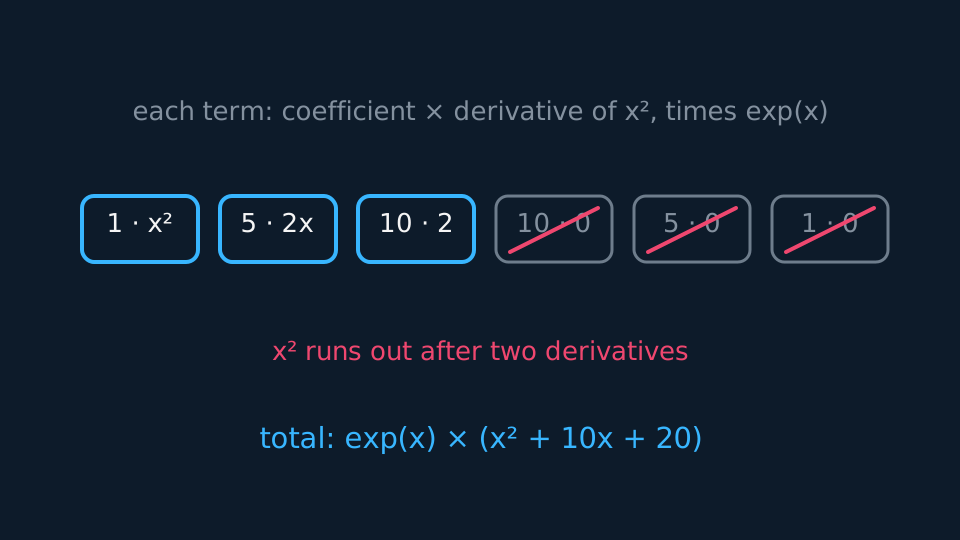
Leibniz's theorem gives the nth derivative of a product in one step, as the binomial-weighted sum of derivatives of the two factors. Take the polynomial factor first, since its higher derivatives vanish and remove most of the sum: three terms give the fifth derivative of x²ex as ex(x² + 10x + 20).
The binomial theorem for derivatives
Differentiating a product n times distributes the derivatives across both factors in every possible split, each split weighted by the number of ways of reaching it. Leibniz's theorem collects the terms.
Check the current formula booklet for your awarding organisation; whether or not the result is supplied, you must know when it applies and how to derive it. The coefficients are binomial because each differentiation selects which factor to differentiate, as each bracket in (a + b)n selects a term. When one factor is a low-degree polynomial most terms vanish, and the sum reduces to a few terms.
Describe the drawing
Six boxes for the six Leibniz terms of the fifth derivative of x squared e to the x. The first three, holding x squared, two x and the constant two with binomial weights one, five and ten, stay live; the last three are struck through because the third and later derivatives of x squared are zero. The survivors sum to e to the x times x squared plus ten x plus twenty.
WORKED EXAMPLE
A fifth derivative in one line
Find the fifth derivative of y = x²ex.
Take f = x², so only f, f' = 2x and f'' = 2 are non-zero.
Leibniz: the fifth derivative is x²ex + ⁵C₁(2x)ex + ⁵C₂(2)ex.
= ex(x² + 10x + 20). Differentiating five times directly gives the same polynomial.
The substitution that rationalises trig
With t = tan(x/2), the t-formulae convert sin x and cos x into rational functions of t, and dx = 2 dt/(1 + t²) completes the substitution. An integral built from rational combinations of the trigonometric ratios becomes an integral of a rational function of t, which partial fractions then handle. For a definite integral, transform the limits at the same time and work in t to the end. One condition first: t = tan(x/2) is undefined at odd multiples of π, so if the interval of integration contains one, split the integral there and treat each piece as a limit before substituting.
WORKED EXAMPLE
An integral with no elementary look
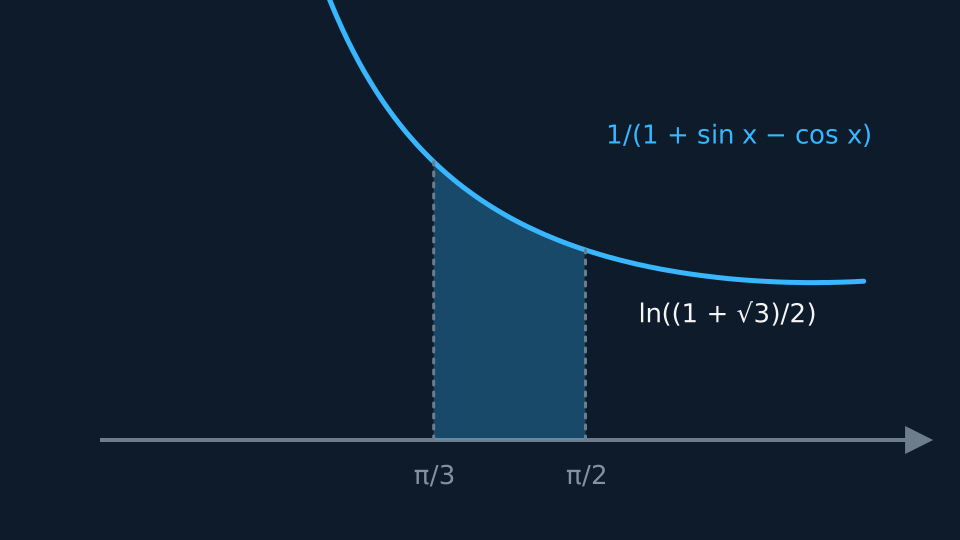
Evaluate ∫ 1/(1 + sin x − cos x) dx from π/3 to π/2.
Substituting the t-formulae, the denominator becomes 2t(t + 1)/(1 + t²), so the integrand times dx is dt/(t(t + 1)).
Partial fractions give 1/t − 1/(t + 1), which integrates to ln(t/(t + 1)).
Limits: x = π/3 gives t = 1/√3, and x = π/2 gives t = 1. The value is ln(1/2) − ln(1/(1 + √3)) = ln((1 + √3)/2) ≈ 0.312.
INDEPENDENT PRACTICE
The cosec integral
Use t = tan(x/2) to find ∫ cosec x dx.
Show the working
cosec x dx = (1 + t²)/(2t) × 2 dt/(1 + t²) = dt/t.
So the integral is ln|t| + c = ln|tan(x/2)| + c.
The standard result for ∫cosec x dx is this substitution carried out once.
ASSESSMENT FOCUS
- In Leibniz's theorem take the polynomial factor as f, since its higher derivatives vanish and remove most of the sum.
- Write the binomial coefficients out explicitly before evaluating them, so the method is visible.
- Under t = tan(x/2), replace dx by 2 dt/(1 + t²) at the same time as the trigonometric ratios.
- Transform the limits with the variable in a definite integral, and complete the evaluation in t.
CHECK YOURSELF
Using Leibniz's theorem, write down the third derivative of y = xe2x.
Show a hint
Only x and its first derivative are non-zero.
Show the answer
y''' = x(8e2x) + ³C₁(1)(4e2x) = e2x(8x + 12). Two terms only, since the second and third derivatives of x vanish.
Leibniz: the nth derivative of fg is the binomial-weighted sum of derivatives of the two factors.
t = tan(x/2) with dx = 2dt/(1 + t²) turns a rational trigonometric integrand into a rational function of t; transform the limits as well.
WORKBOOK
Printable practice for this topic: original exam-style questions with room to work, and a fully worked answer book. Free to use; please do not redistribute or sell.
Or read them with their worked answers on the Leibniz's theorem and the Weierstrass substitution questions page.
CHECK YOUR PROGRESS
Rate how confident you feel with each objective for this lesson. Ratings are saved in this browser, on this device, unless you sign in.
- Apply Leibniz's theorem to find high derivatives of products directly.
- Convert trig integrands to rational functions of t = tan(x/2).
- Transform the limits of a definite integral along with the variable.
Open the full revision checklist to see every objective in the course in one place.