Maths › Further Pure 1 › Taylor series
Taylor series
A Taylor polynomial about x = a uses derivatives evaluated at a and powers of x − a. Use Taylor's theorem or a stated remainder bound to justify accuracy. Do not assume that an infinite Taylor series equals the original function without a convergence argument.
Builds on Maclaurin series and The product, quotient and chain rules.
IN THIS TOPIC
- Quote the Taylor polynomial of f about x = a in powers of (x − a), and assemble it from a derivative table.
- Expand about a point close to the value being approximated, and say why the choice reduces the error.
- State the remainder condition that justifies an accuracy claim, and distinguish a polynomial from an infinite series.
COMMON MISCONCEPTION
Series expansions only work near zero; away from the origin a function cannot be turned into a polynomial.
A Taylor polynomial can be centred anywhere the derivatives exist. About x = a it runs in powers of (x − a), with the coefficient of (x − a)r the rth derivative at a divided by r factorial, and a = 0 is the Maclaurin special case rather than the general one. Expanding about a point close to the value wanted keeps |x − a| small, and the remainder carries it to the power n + 1.
Expanding about a general point
A Maclaurin polynomial matches the derivatives of f at 0. A Taylor polynomial of degree n about x = a matches them at a instead, using powers of x − a.
The coefficient of (x − a)r is the rth derivative at a divided by r factorial. Setting a = 0 recovers the Maclaurin polynomial as a special case. Check the current formula booklet for your awarding organisation; whether or not the general form is supplied, you must know when it applies and how to derive it.
Taylor's theorem gives a remainder such as f(n+1)(ξ)(x − a)n+1/(n + 1)! under its usual hypotheses. A smaller |x − a| can reduce the error when the derivative bound is comparable. An infinite Taylor series represents f only where it converges to f; smoothness alone is not sufficient.
WORKED EXAMPLE
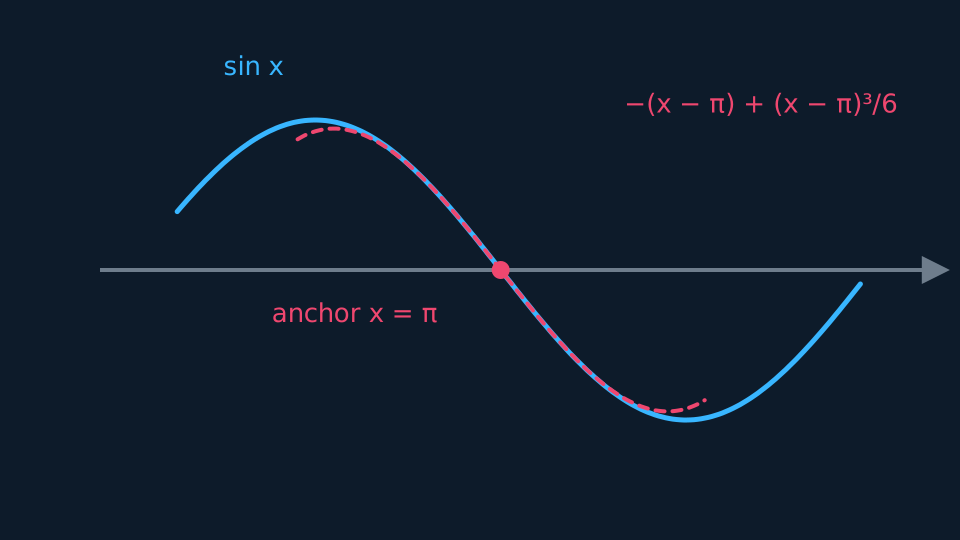
sin x in powers of (x − π)
Expand sin x in ascending powers of (x − π), up to the cubic term.
Derivatives at π: sin π = 0, cos π = −1, −sin π = 0, −cos π = 1.
So sin x = −(x − π) + (x − π)³/3! + … = −(x − π) + (x − π)³/6 + …
Check at x = π + 0.3. The series gives −0.3 + 0.0045 = −0.2955, and sin(π + 0.3) = −0.2955 to four decimal places.
Choosing the expansion point
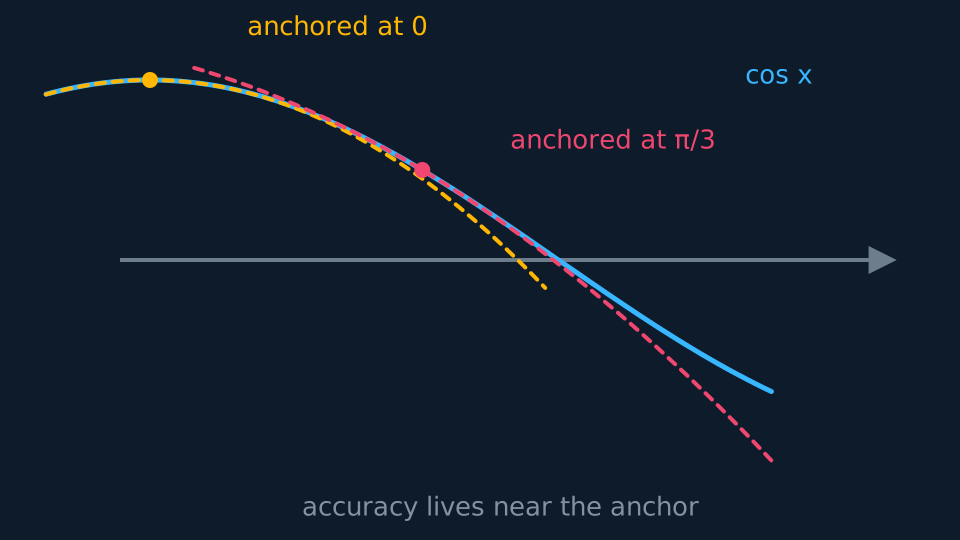
Expand about a point where the derivatives are known exactly and which lies close to the value being approximated. To approximate the cosine of an angle near 60°, expand about π/3, where cos and sin take exact values. Expanding about 0 would need more terms for the same accuracy, because |x − a| appears in the remainder to the power n + 1.
WORKED EXAMPLE
cos x about π/3
Expand cos x about x = π/3, up to the term in (x − π/3)².
Values at π/3: cos = 1/2, derivative −sin = −√3/2, second derivative −cos = −1/2.
cos x = 1/2 − (√3/2)(x − π/3) − (1/4)(x − π/3)² + …
At x = π/3 + 0.2 the three terms give 0.3168, against the true 0.3180: two decimal places from a quadratic, because |x − a| = 0.2 and the third derivative is bounded by 1, so the remainder is at most 0.2³/3! = 0.0013.
INDEPENDENT PRACTICE
A square root without a calculator
Expand √x about x = 4 up to the (x − 4)² term, and use it to estimate √4.4.
Show the working
Derivatives at 4: √4 = 2, then 1/(2√x) = 1/4, then −1/(4x3/2) = −1/32.
√x = 2 + (x − 4)/4 − (x − 4)²/64 + …
At x = 4.4: 2 + 0.1 − 0.0025 = 2.0975, against the true 2.0976. Expanding about the nearest perfect square keeps |x − a| small, which is what keeps the remainder small.
ASSESSMENT FOCUS
- Set out a derivative table at the expansion point before assembling anything, and show the values it produces.
- Leave the expansion in powers of (x − a) as asked; multiplying the brackets out returns an ordinary polynomial in x.
- The factorials divide the derivative values, so the quadratic term carries a 2! and the cubic term a 3!.
- Justify an accuracy claim from the remainder, not from the function being smooth.
CHECK YOURSELF
Write down the first three terms of the Taylor series of ex about x = 2.
Show a hint
Every derivative of the exponential at 2 is e².
Show the answer
ex = e² + e²(x − 2) + (e²/2)(x − 2)² + … Every derivative of the exponential is the same function, so e² scales every term.
Taylor about a: the coefficient of (x − a)r is the rth derivative at a over r factorial, and a = 0 gives the Maclaurin case.
Expand about a point where the derivatives are exact and which is close to the target value; the remainder carries (x − a) to the power n + 1.
An infinite Taylor series represents f only where it converges to f; smoothness alone is not sufficient.
WORKBOOK
Printable practice for this topic: original exam-style questions with room to work, and a fully worked answer book. Free to use; please do not redistribute or sell.
Or read them with their worked answers on the Taylor series questions page.
USED LATER IN
CHECK YOUR PROGRESS
Rate how confident you feel with each objective for this lesson. Ratings are saved in this browser, on this device, unless you sign in.
- Quote the Taylor polynomial of f about x = a in powers of (x − a), and assemble it from a derivative table.
- Expand about a point close to the value being approximated, and say why the choice reduces the error.
- State the remainder condition that justifies an accuracy claim, and distinguish a polynomial from an infinite series.
Open the full revision checklist to see every objective in the course in one place.