Maths › Further Pure 2 › Reduction formulae
Reduction formulae
A reduction formula expresses an integral in terms of the same integral with a lower index, and is usually found by integrating by parts. Running it down from a base case, or from two when the index drops by 2, then gives each member of the family.
Builds on Integration by substitution and by parts and Summing series.
IN THIS TOPIC
- Derive a reduction formula by integrating by parts and rearranging.
- Apply the recurrence down to a base case that integrates directly.
- Recognise when a formula drops by one step and when it drops by two.
- State the values of n for which a reduction formula and its consequences hold.
COMMON MISCONCEPTION
An integral of sin to the tenth power would take ten separate integrations by parts.
One integration by parts serves every n at once. Splitting the integrand and rearranging gives the reduction formula nIn = (n − 1)In-2 for the sine integrals from 0 to π/2, and applying it repeatedly walks down to the base cases I₀ = π/2 and I₁ = 1, which integrate directly.
Parts, once, then recur
Write In for the integral with parameter n, split the integrand so that one part differentiates towards something simpler, and integrate by parts. What comes back contains In-1 or In-2, and rearranging turns it into a reduction formula. That single integration by parts serves every n at once, so the tenth power of sine needs one application of parts rather than ten.
WORKED EXAMPLE
Down to a base case
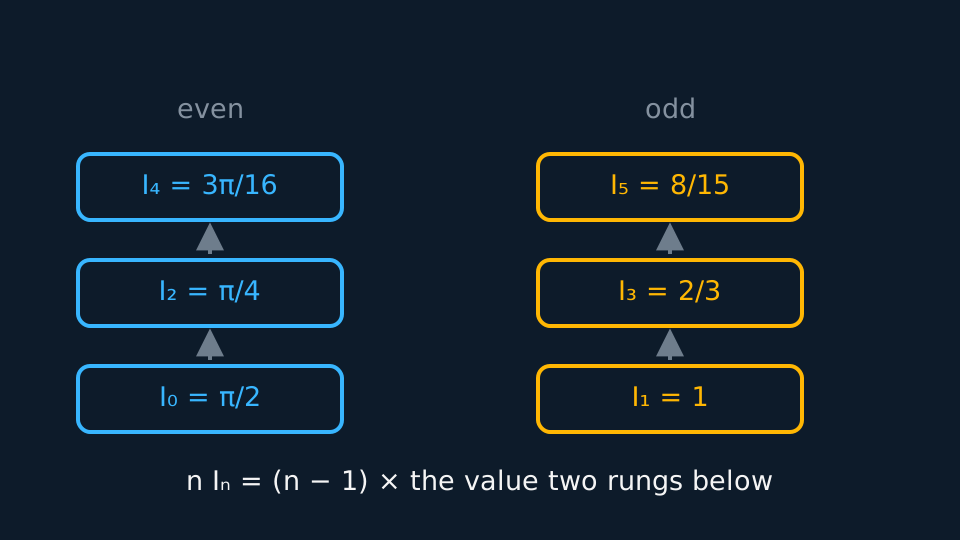
Given nIn = (n − 1)In-2 for the sine integrals from 0 to π/2, evaluate I₄ and I₅.
Base cases: I₀ = π/2, since the integrand is 1, and I₁ = 1.
I₂ = (1/2)I₀ = π/4, then I₄ = (3/4)I₂ = 3π/16.
I₃ = (2/3)I₁ = 2/3, then I₅ = (4/5)I₃ = 8/15.
Even powers keep the π and odd powers lose it, because the two chains start from different base cases.
Deriving one from scratch
Where a question asks for the derivation, the by-parts step has to be shown in full. Choose the split so that the factor differentiated becomes simpler and the factor integrated does not become harder.
Describe the drawing
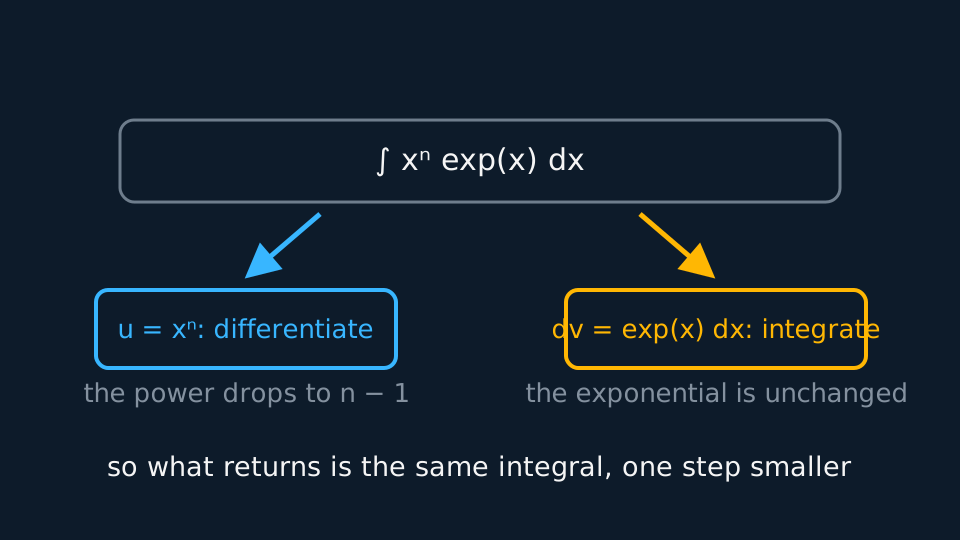
The integral of x to the n times e to the x, with two arrows splitting it into the factor to differentiate and the factor to integrate. The power drops by one under differentiation while the exponential survives unchanged, which is exactly why the by-parts result contains a smaller copy of the original.
WORKED EXAMPLE
A polynomial against an exponential
For In = ∫xnex dx from 0 to 1, derive a reduction formula and find I₃.
By parts with u = xn and dv = exdx: In = [xnex] − n∫xn-1ex dx, so In = e − nIn-1.
I₀ = e − 1. Then I₁ = e − (e − 1) = 1, I₂ = e − 2 and I₃ = e − 3(e − 2) = 6 − 2e ≈ 0.5634.
Each step drops n by one here, not by two, because only one factor of x is lost per integration.
The same split serves an infinite range, with one extra step. Take In = ∫xne−x dx from 0 to ∞. By parts it becomes [−xne−x] plus n∫xn-1e−x dx, and the bracket at the top has to be read as a limit. That limit is a quotable standard result, xke−x → 0 as x → ∞ for k > 0, so the boundary term is zero and In = nIn-1. Since I₀ = 1, repeated application gives In = n! for each non-negative integer n. Give the reason the boundary term vanishes rather than writing a zero, since that limit is what the infinite range adds to the method.
GUIDED PRACTICE
Reading the formula backwards
Given In = e − nIn-1 with I₀ = e − 1, find I₄ exactly, and comment on the size of the answer.
Show the working
I₃ = 6 − 2e from the previous example.
I₄ = e − 4(6 − 2e) = 9e − 24 ≈ 0.4645.
The values decrease slowly towards zero, because xn is small across most of [0, 1] once n is large. The alternating signs in the algebra still produce positive numbers, which checks the arithmetic.
ASSESSMENT FOCUS
- Define I sub n as an integral before deriving anything, so that the recurrence has a stated meaning.
- Show the by-parts line in full, evaluated bracket included, before rearranging.
- Identify the base case explicitly, and check whether the recurrence steps down by one or by two.
- Over an infinite range, name the limit that sends the boundary term to zero instead of writing a bare zero.
- State the range of n a reduction formula holds for; the gamma integral gives n! for non-negative integers only.
- Give an exact value unless the question requests a decimal approximation, so π and e stay in the final line.
CHECK YOURSELF
Given nIn = (n − 1)In-2 with I₁ = 1, find I₃.
Show a hint
Put n = 3 into the formula.
Show the answer
3I₃ = 2I₁ = 2, so I₃ = 2/3.
Integrate by parts once, rearrange into a recurrence, then apply it down to a base case that integrates directly.
∫₀∞ xne−x dx = n! for each non-negative integer n, the boundary term vanishing by the standard limit xke−x → 0.
WORKBOOK
Printable practice for this topic: original exam-style questions with room to work, and a fully worked answer book. Free to use; please do not redistribute or sell.
Or read them with their worked answers on the reduction formulae questions page.
CHECK YOUR PROGRESS
Rate how confident you feel with each objective for this lesson. Ratings are saved in this browser, on this device, unless you sign in.
- Derive a reduction formula by integrating by parts and rearranging.
- Apply the recurrence down to a base case that integrates directly.
- Recognise when a formula drops by one step and when it drops by two.
- State the values of n for which a reduction formula and its consequences hold.
Open the full revision checklist to see every objective in the course in one place.