Maths › Further Pure 2 › Arc length and surface area
Arc length and surface area
The length of a curve is found by approximating it with short straight pieces, measuring each by Pythagoras, and adding them with an integral. Rotating the same arc about an axis gives a surface of revolution, whose area integrates the distance from the axis, so that distance must be non-negative.
Builds on Volumes of revolution and Polar curves.
IN THIS TOPIC
- Apply the arc length formula in cartesian, parametric and polar form.
- Compute the area of a surface of revolution as 2π times the integral of the non-negative distance from the axis with respect to arc length.
- Choose the correct radius when the axis of rotation changes.
- Check answers against circles, cones and spheres.
COMMON MISCONCEPTION
The length of a curve between two points is found by integrating y with respect to x.
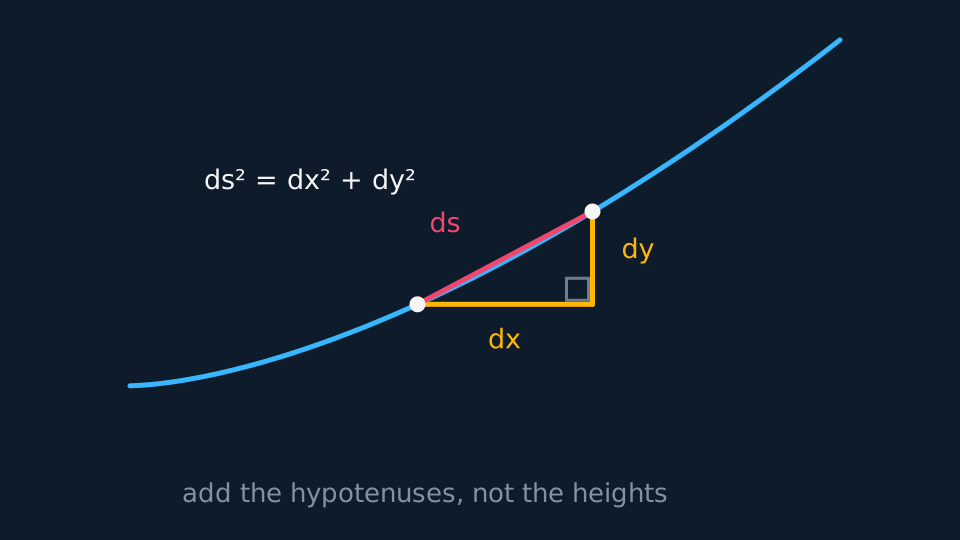
Integrating y with respect to x measures the area under the curve, not the distance along it. Over a small step the curve is near enough straight, with run dx and rise dy, so the element of length is √(dx² + dy²) and the cartesian formula integrates √(1 + (dy/dx)²) with respect to x.
Pythagoras on a small scale
Over a tiny step the curve is near enough straight, with horizontal run dx and rise dy, so its length is √(dx² + dy²). Factor out dx and the cartesian formula appears.
Check the current formula booklet for your awarding organisation. Factoring out dt instead gives the element √((dx/dt)² + (dy/dt)²) dt, and polar form gives √(r² + (dr/dθ)²) dθ.
WORKED EXAMPLE
A length that comes out exactly
Find the length of y = x3/2 from x = 0 to x = 4.
dy/dx = (3/2)√x, so 1 + (dy/dx)² = 1 + 9x/4.
s = ∫√(1 + 9x/4) dx = (8/27)[(1 + 9x/4)3/2] from 0 to 4.
= (8/27)(103/2 − 1) = 9.073 to 3 decimal places. The root simplifies here because 1 + (dy/dx)² is linear in x. For most curves the integral has no elementary antiderivative and is evaluated numerically.
Spinning the arc
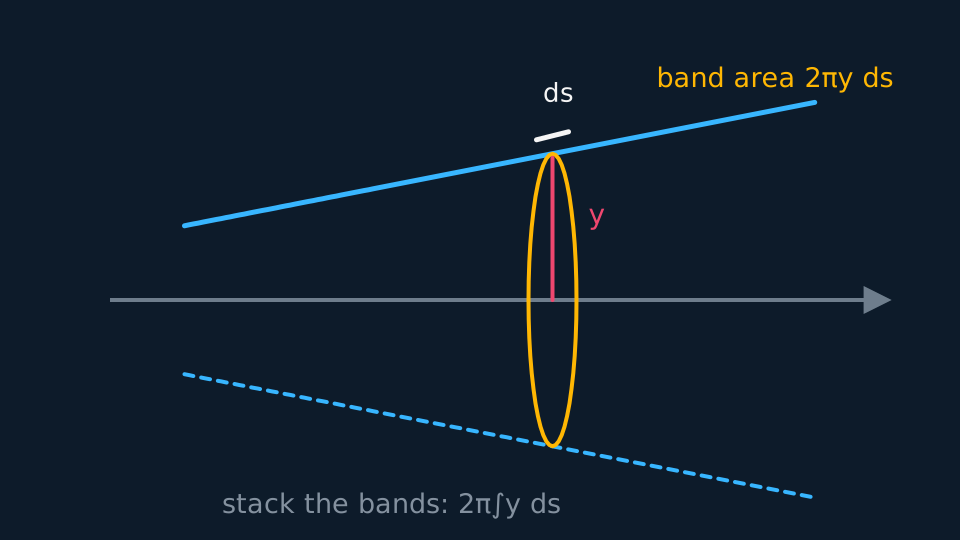
Rotate the arc about the x-axis and each element sweeps a thin band whose radius is the distance |y| from the axis and whose width is ds, so its area is 2π|y| ds. About the x-axis, therefore, S = 2π∫|y| ds; if the curve is known to satisfy y ≥ 0, this becomes 2π∫y ds. Here ds carries the same square root as before. About the y-axis the radius is |x| instead, so identify the axis of rotation before writing the integral.
WORKED EXAMPLE
The surface of a sphere, from scratch
Find the surface area generated by rotating y = √(a² − x²) about the x-axis, from x = −a to a.
The positive square root is taken, so y ≥ 0 throughout and the modulus can be dropped.
dy/dx = −x/y, so 1 + (dy/dx)² = (y² + x²)/y² = a²/y².
So ds = (a/y) dx, and the integrand 2πy ds becomes 2πa dx, with the y cancelling entirely.
Area = 2πa × 2a = 4πa², the familiar formula, derived instead of quoted. That cancellation is also why bands of equal width along the axis on a sphere have equal area whatever their latitude.
Sanity checks and the polar case
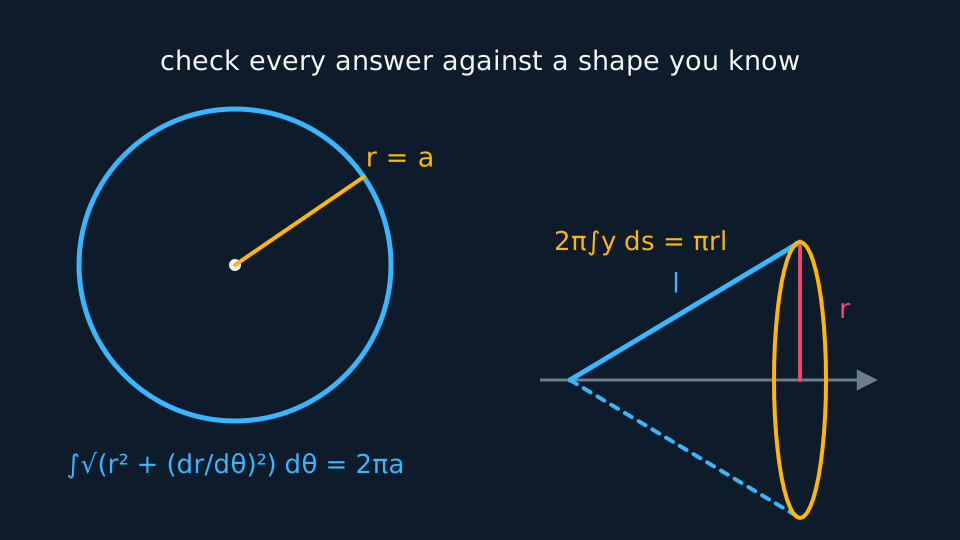
Check each answer against a known result. A circle of radius a in polar form has r = a and dr/dθ = 0, so the integrand is a and the length over a full turn is 2πa. Rotating a straight line through the origin about the x-axis must give the curved surface area of a cone, πrl. Where such a check fails, compare the integrand against the formula term by term, checking the square root and the choice of radius separately.
Describe the drawing
On the left, the circle r equals a with one amber radius: the polar arc length integrand collapses to the constant a, so a full turn integrates to two pi a, the circumference. On the right, a line through the origin spun about the axis into a cone of base radius r and slant l: the surface integral comes out as pi r l exactly. Any dropped square root or wrong radius fails one of these checks immediately.
Watch the limits in polar work as well. A curve traced twice over 0 ≤ θ ≤ 2π gives twice the length it should, so look at the sketch and decide the range before integrating.
GUIDED PRACTICE
An arc that hyperbolic functions tidy
Find the length of the catenary y = cosh x from x = 0 to x = 1.
Show the working
dy/dx = sinh x, so 1 + sinh²x = cosh²x by the hyperbolic identity.
The square root is therefore just cosh x, with no surd left.
s = ∫cosh x dx from 0 to 1 = sinh 1 ≈ 1.1752. The catenary is one of the few curves whose arc length integral collapses this cleanly.
ASSESSMENT FOCUS
- Quote the formula for the coordinate system in use before differentiating anything.
- Simplify under the square root before integrating; a set question is usually arranged so that the surd cancels.
- For a surface of revolution the radius is the non-negative distance to the axis, so write 2π∫|y| ds and drop the modulus only after stating that y ≥ 0 on the arc.
- Check the answer against a known solid: a circle, a cone or a sphere.
CHECK YOURSELF
A curve is given parametrically by x = 5 cos t, y = 5 sin t. Write down the integrand for its arc length, and hence its total length for 0 ≤ t ≤ 2π.
Show a hint
Differentiate both, square, add, and take the root.
Show the answer
dx/dt = −5 sin t and dy/dt = 5 cos t, so the integrand is √(25 sin²t + 25 cos²t) = 5. The length is 5 × 2π = 10π, the circumference of a circle of radius 5.
Arc length integrates the hypotenuse: √(1 + (dy/dx)²) dx, or the parametric and polar equivalents.
About the x-axis, S = 2π∫|y| ds, which becomes 2π∫y ds when the curve satisfies y ≥ 0; ds is the same element as in the arc-length integral.
Check every answer against a circle, a cone or a sphere before moving on.
WORKBOOK
Printable practice for this topic: original exam-style questions with room to work, and a fully worked answer book. Free to use; please do not redistribute or sell.
Or read them with their worked answers on the arc length and surface area questions page.
CHECK YOUR PROGRESS
Rate how confident you feel with each objective for this lesson. Ratings are saved in this browser, on this device, unless you sign in.
- Apply the arc length formula in cartesian, parametric and polar form.
- Compute the area of a surface of revolution as 2π times the integral of the non-negative distance from the axis with respect to arc length.
- Choose the correct radius when the axis of rotation changes.
- Check answers against circles, cones and spheres.
Open the full revision checklist to see every objective in the course in one place.