Maths › Trigonometry › Trigonometric graphs and equations
Trigonometric graphs and equations
Beyond 90 degrees, sine and cosine are defined as coordinates on the unit circle, and their graphs become waves. A calculator returns one principal value, and periodicity, symmetry and the stated interval give the full solution set.
Builds on Triangles and the sine and cosine rules.
IN THIS TOPIC
- Sketch sine, cosine and tangent, and use their symmetry and period.
- Quote exact values at the standard angles, and extend them past 90° by symmetry.
- Use tan θ = sin θ/cos θ and sin²θ + cos²θ = 1 to reshape an equation.
- Find every solution in a stated interval, multiple angles and hidden quadratics included.
COMMON MISCONCEPTION
To solve sin x cos x = cos x, divide both sides by cos x.
Collect the terms on one side and factorise: cos x (sin x − 1) = 0. Then cos x = 0 gives x = 90° and 270°, and sin x = 1 gives x = 90° again. Dividing by cos x loses x = 270°, where cos x is zero and the division is not valid. Factorising retains every solution; dividing by an expression that can be zero can remove some.
Sine and cosine as coordinates
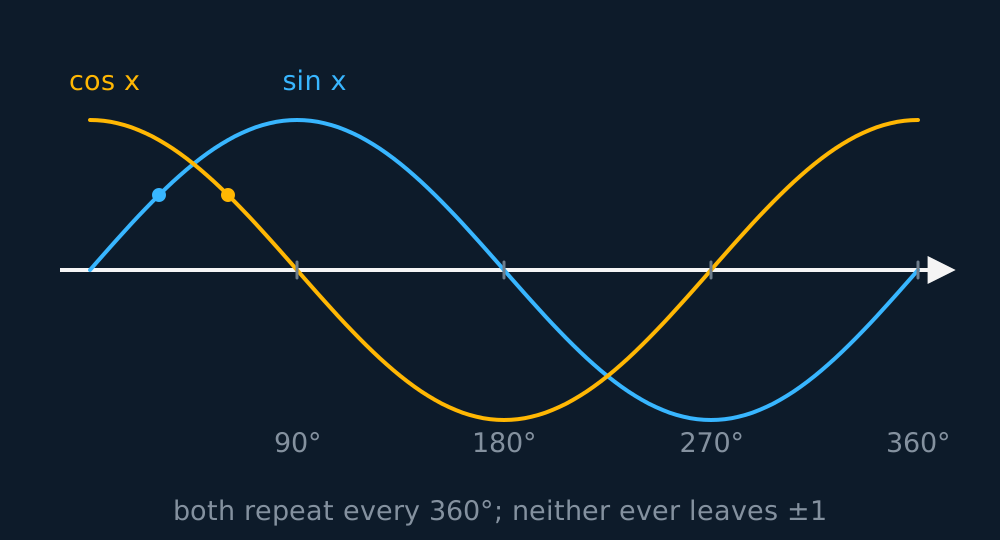
For angles beyond a triangle's reach, sine and cosine are defined by a circle. Measure an angle x anticlockwise from the positive horizontal axis, mark where it meets a circle of radius 1, and that point is (cos x, sin x). Below 90° this agrees with the triangle definitions. Above 90° the definition continues around the circle, so both graphs repeat every 360° and both take values between −1 and 1. Tangent is defined as sin/cos, so it repeats every 180° and is undefined wherever cos x = 0, where its graph has vertical asymptotes.
Exact values worth learning
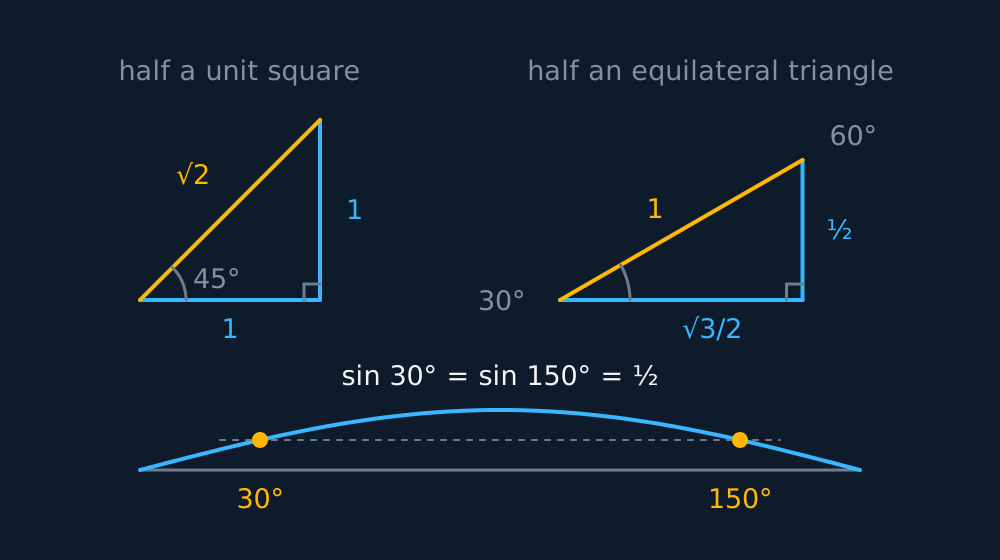
Two triangles generate all the exact values you need. Halve a unit square for 45°, halve an equilateral triangle for 30° and 60°.
| x | sin x | cos x | tan x |
|---|---|---|---|
| 0° | 0 | 1 | 0 |
| 30° | 1/2 | √3/2 | 1/√3 |
| 45° | √2/2 | √2/2 | 1 |
| 60° | √3/2 | 1/2 | √3 |
| 90° | 1 | 0 | undefined |
| 180° | 0 | −1 | 0 |
Past 90° the graphs extend the table by symmetry. Sine is symmetric about 90°, so sin 150° = sin 30° = ½. Cosine is symmetric about 180° and negative through the second and third quadrants, so cos 240° = −cos 60° = −½. Learn the six values in the table and obtain the others from the symmetry of the graphs.
Describe the drawing
Two right triangles drawn to scale, half a unit square with legs 1 and hypotenuse root 2, and half an equilateral triangle with hypotenuse 1, base root 3 over 2 and height one half, above a sine curve carrying dots of equal height at 30 and 150 degrees: the six learnable values and the symmetry that extends them.
Two identities
Two identities do most of the algebraic work in this topic and neither appears in the booklet,
The first converts a mixed sin-and-cos equation into a tan equation. The second is the unit circle's Pythagoras, and it lets you replace sin² by cos², or the reverse, whenever a question turns out to be a quadratic underneath.
WORKED EXAMPLE
Factorise rather than divide
Solve sin x cos x = cos x for 0 ≤ x < 360°.
Do not divide both sides by cos x. Collect the terms on one side and factorise: cos x (sin x − 1) = 0.
cos x = 0 gives x = 90° and 270°. sin x = 1 gives x = 90° again.
Solutions: x = 90° and 270°.
Dividing through by cos x removes the solution x = 270°, because cos 270° = 0 and the division is not valid there. Factorising retains every solution; dividing by an expression that can be zero can remove some.
Every solution in the interval
Your calculator's inverse button returns one principal value. The graph supplies the rest. For sine a second solution sits at 180° minus the principal value, and adding or subtracting whole periods generates the others.
When the angle inside the function is not simply x, use the same routine every time. Substitute θ for the whole bracket, widen the interval to whatever θ now runs over, solve there, and translate back at the end.
WORKED EXAMPLE
A shifted angle
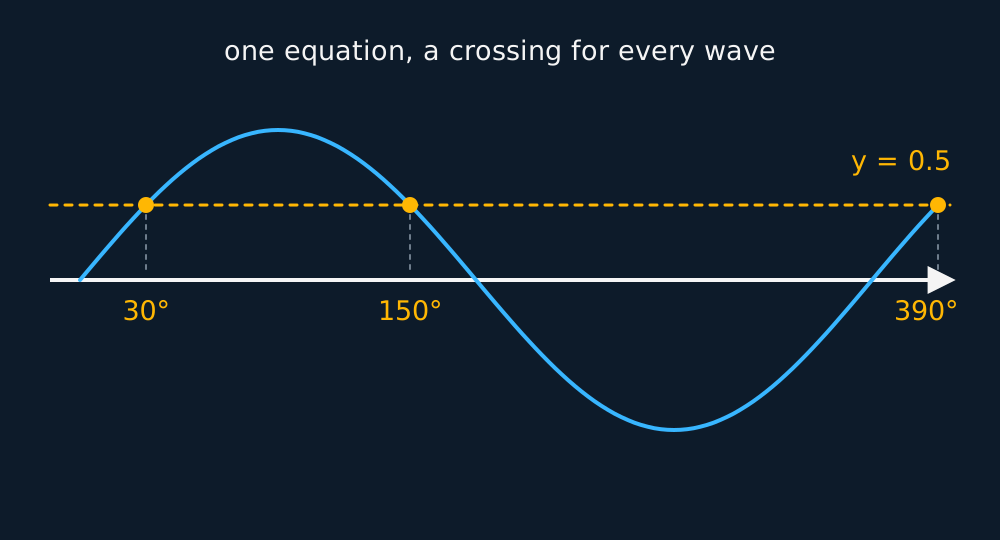
Solve sin (x + 70°) = 0.5 for 0 < x < 360°.
Let θ = x + 70°. As x runs over its interval, θ runs from 70° to 430°.
sin θ = 0.5 at θ = 30°, 150°, 390°, … and inside (70°, 430°) that leaves θ = 150° or 390°.
Translate back. x = 80° or 320°.
The solution 30° lies outside the widened interval and is rejected; 390°, one period later, lies inside it and gives x = 320°. Widening the interval before solving is what makes both decisions correct.
GUIDED PRACTICE
A doubled angle
Solve 3 + 5 cos 2x = 1 for −180° < x < 180°, before opening the working.
Show the working
Rearranging gives cos 2x = −2/5. Let θ = 2x, so θ runs over (−360°, 360°).
The principal value is cos−1(−0.4) = 113.6°, and cosine's symmetry supplies θ = ±113.6° and ±246.4°.
Halving gives x = ±56.8° and ±123.2°. Four solutions.
Doubling the angle doubles the number of solutions, since 2x covers two periods while x covers one. Solving in the x-interval without widening it to the 2x-interval gives only half of them.
INDEPENDENT PRACTICE
A hidden quadratic, trig edition
Solve 6 cos2 x + sin x − 5 = 0 for 0 ≤ x < 360°.
Show the working
Trade cos² for sin². 6(1 − sin2 x) + sin x − 5 = 0, which tidies to 6 sin2 x − sin x − 1 = 0.
Factorise with s = sin x: (3s + 1)(2s − 1) = 0, so sin x = 1/2 or −1/3.
sin x = 1/2 gives x = 30°, 150°. sin x = −1/3 has principal value −19.5°, outside the range; the solutions in range are x = 199.5° and 340.5°.
Four solutions: 30°, 150°, 199.5°, 340.5°. The identity reduced two trig ratios to one, and the rest is the substitution routine from the algebra unit.
ASSESSMENT FOCUS
- Sketch the relevant graph across the widened interval first, count the crossings, and then solve for each.
- For sin the partner solution is 180° − θ. For cos it is −θ, or equivalently 360° − θ. For tan, add 180°. Name the rule you are using.
- Substitute θ for the whole bracket, widen the interval to match, solve there, and translate back. Omitting the widening step gives an incomplete solution set.
- Do not divide by cos x, sin x or any expression that can be zero: collect the terms on one side and factorise.
- Where a question asks for an exact value, give the surd: sin 60° = √3/2 rather than 0.866.
- Give as many solutions as the sketch shows crossings: three crossings and two solutions means one has been missed.
CHECK YOURSELF
Solve tan x = √3 for 0 ≤ x < 360°, giving exact answers.
Show a hint
One exact value, then tangent's period.
Show the answer
The exact-value table gives the principal value x = 60°.
Tangent repeats every 180°, so the other solution in range is 60° + 180° = 240°.
Solutions: x = 60° and 240°. The graph shows two branches of tan crossing √3 in the interval, which confirms the count.
The unit circle defines sin and cos for every angle; the graphs repeat and the table of exact values covers the rest.
Widen the interval with the substituted angle, find every crossing in it, then translate back.
WORKBOOK
Printable practice for this topic: original exam-style questions with room to work, and a fully worked answer book. Free to use; please do not redistribute or sell.
Or read them with their worked answers on the trigonometric graphs and equations questions page.
CHECK YOUR PROGRESS
Rate how confident you feel with each objective for this lesson. Ratings are saved in this browser, on this device, unless you sign in.
- Sketch sine, cosine and tangent, and use their symmetry and period.
- Quote exact values at the standard angles, and extend them past 90° by symmetry.
- Use tan θ = sin θ/cos θ and sin²θ + cos²θ = 1 to reshape an equation.
- Find every solution in a stated interval, multiple angles and hidden quadratics included.
Open the full revision checklist to see every objective in the course in one place.