Maths › Integration › Integrating rational functions
Integrating rational functions
A quotient of polynomials is rewritten before integrating. Partial fractions split it into terms that integrate to logarithms (or, over a repeated factor, a negative power), while other integrands match the f'/f pattern or a negative power. Decide which case applies from the numerator and the factorised denominator.
Builds on Partial fractions and Integration by substitution and by parts.
IN THIS TOPIC
- Split a rational integrand into partial fractions and integrate each piece.
- Recognise f'/f numerators and negative-power forms that need no split at all.
- Compare the degrees before choosing a method, and divide an improper integrand down before splitting what is left.
- Evaluate definite integrals of rational functions, compressing the answer with log laws.
COMMON MISCONCEPTION
∫ 1/f(x) dx = ln|f(x)| + c.
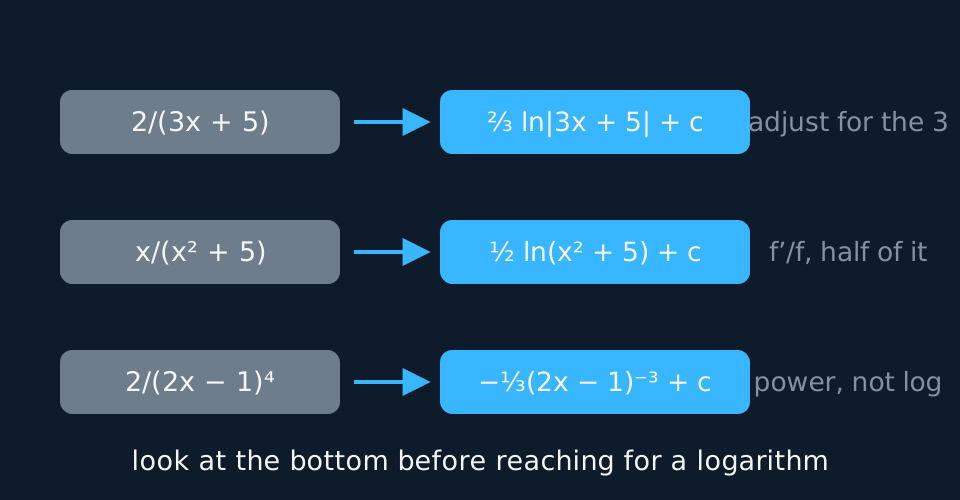
A logarithm arises only from the f'/f form, where the numerator is the derivative of the denominator up to a constant factor. Differentiating ln(x2 + 5) gives 2x/(x2 + 5), so ∫x/(x2 + 5) dx = ½ ln(x2 + 5) + c, while 1/(x2 + 5) is a different integrand altogether.
Split, then integrate
A general quotient of polynomials is not a standard integral, so rewrite it algebraically first. Partial fractions decompose it into terms with linear denominators, and each such term integrates to a logarithm, divided by the coefficient of x in the denominator.
Differentiating that result gives a factor of 3 from the chain rule, which cancels the 3 in ⅔; that is why the coefficient divides.
WORKED EXAMPLE
Two logs from one fraction
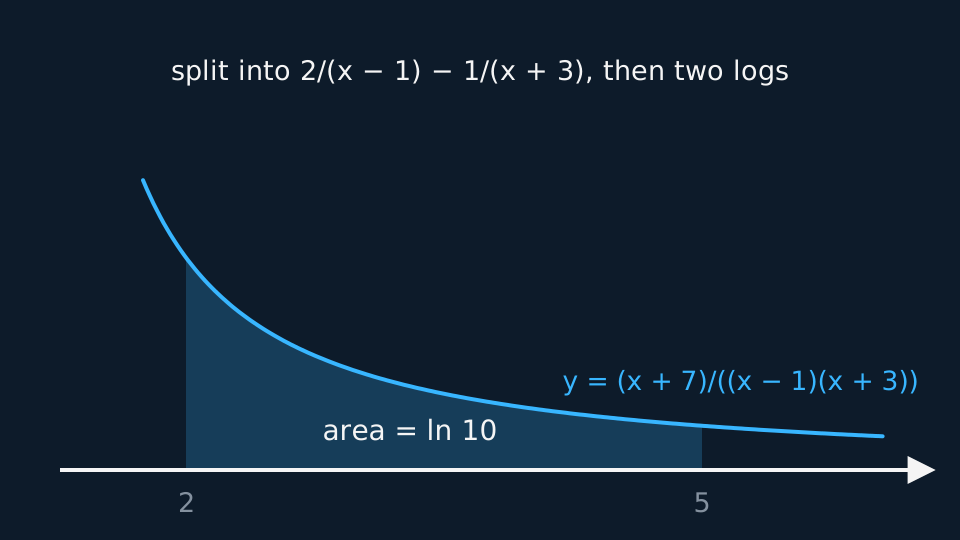
Find ∫(x + 7)/((x − 1)(x + 3)) dx.
Split first. (x + 7)/((x − 1)(x + 3)) = A/(x − 1) + B/(x + 3), and the cover-up method gives A = 2 and B = −1.
Each piece is a log: ∫(2/(x − 1) − 1/(x + 3)) dx.
The integral is 2 ln|x − 1| − ln|x + 3| + c.
The integration is one line; the decomposition before it is the substantial step, so show it in full.
GUIDED PRACTICE
The definite version
Using the split above, find the exact value of ∫25 (x + 7)/((x − 1)(x + 3)) dx, before opening the working.
Show the working
The brackets are [2 ln(x − 1) − ln(x + 3)] from 2 to 5. No modulus is needed, since x − 1 and x + 3 stay positive across the interval.
At 5: 2 ln 4 − ln 8 = ln 16 − ln 8 = ln 2. At 2: 2 ln 1 − ln 5 = −ln 5.
Subtracting, ln 2 + ln 5 = ln 10.
Where a question asks for the answer in the form ln k, use the logarithm laws to combine the terms into a single logarithm.
Choosing the method
Four cases cover the rational integrands set at this level. If the degree of the numerator is at least that of the denominator, divide first. If the numerator is the derivative of the denominator up to a constant factor, use the f'/f pattern. If the denominator factorises into distinct or repeated linear factors, decompose into partial fractions. If the integrand is a constant over a power of a linear expression, rewrite it as a negative power.
For example, ∫x/(x2 + 5) dx = ½ ln(x2 + 5) + c because the numerator is half the derivative of the denominator. Without the x in the numerator the pattern does not apply: differentiating ln(x2 + 5) gives 2x/(x2 + 5), not 1/(x2 + 5). Logarithms can still arise after a decomposition, once each term has the f'/f form.
GUIDED PRACTICE
Two without a split
Find ∫x/(x2 + 5) dx and ∫2/(2x − 1)4 dx.
Show the working
The first is f'/f with a factor missing: ½ ln(x2 + 5) + c, no modulus required because x2 + 5 is never negative.
The second rewrites as 2(2x − 1)−4, a power, and reversing the power rule with the inner 2 dividing gives −1/(3(2x − 1)3) + c.
Neither required partial fractions. Compare the numerator with the derivative of the denominator to decide which case applies.
INDEPENDENT PRACTICE
A repeated factor
Find ∫(3x + 1)/(x + 1)2 dx.
Show the working
The repeated-factor template applies: (3x + 1)/(x + 1)2 = A/(x + 1) + B/(x + 1)2, and matching gives A = 3, B = −2.
The first term integrates to a logarithm. The second is a negative power, integrating to +2/(x + 1).
The integral is 3 ln|x + 1| + 2/(x + 1) + c, for x ≠ −1.
The decomposition produced one logarithm and one power: a term integrates to a logarithm only where its numerator is the derivative of its denominator up to a constant.
ASSESSMENT FOCUS
- Decompose into partial fractions before integrating, and show the decomposition as working.
- A linear denominator gives a logarithm divided by the coefficient of x. Differentiate back to check that factor.
- A logarithm arises only where the numerator is the derivative of the denominator up to a constant; otherwise the term is a negative power.
- Keep the modulus in ln|x − a| unless the interval of integration keeps the bracket positive, and state that condition where the modulus is dropped.
CHECK YOURSELF
Find the exact value of ∫02 2/((x + 1)(x + 3)) dx, giving the answer as a single logarithm.
Show a hint
Cover-up gives 1/(x + 1) − 1/(x + 3); then log laws.
Show the answer
The split is 2/((x + 1)(x + 3)) = 1/(x + 1) − 1/(x + 3).
The brackets give [ln(x + 1) − ln(x + 3)] from 0 to 2 = (ln 3 − ln 5) − (0 − ln 3).
That is 2 ln 3 − ln 5 = ln(9/5).
The method is decompose, integrate each term, then combine the logarithms.
Decompose a rational integrand into partial fractions; each term with a linear denominator integrates to a logarithm.
A logarithm arises only from the f'/f form; other terms are powers written in fraction notation.
WORKBOOK
Printable practice for this topic: original exam-style questions with room to work, and a fully worked answer book. Free to use; please do not redistribute or sell.
Or read them with their worked answers on the integrating rational functions questions page.
CHECK YOUR PROGRESS
Rate how confident you feel with each objective for this lesson. Ratings are saved in this browser, on this device, unless you sign in.
- Split a rational integrand into partial fractions and integrate each piece.
- Recognise f'/f numerators and negative-power forms that need no split at all.
- Compare the degrees before choosing a method, and divide an improper integrand down before splitting what is left.
- Evaluate definite integrals of rational functions, compressing the answer with log laws.
Open the full revision checklist to see every objective in the course in one place.