Maths › Algebra and functions › Partial fractions
Partial fractions
Partial fractions decompose one rational expression into a sum of terms with simpler denominators and unknown constants in the numerators. Find the constants by substituting values of x or by comparing coefficients. The decomposition is used in integration and in series expansions.
Builds on Polynomials and the factor theorem.
IN THIS TOPIC
- Split a fraction whose denominator is two or three distinct linear brackets.
- Handle a repeated linear factor with the two-fraction template.
COMMON MISCONCEPTION
A squared bracket in the denominator needs just one fraction.
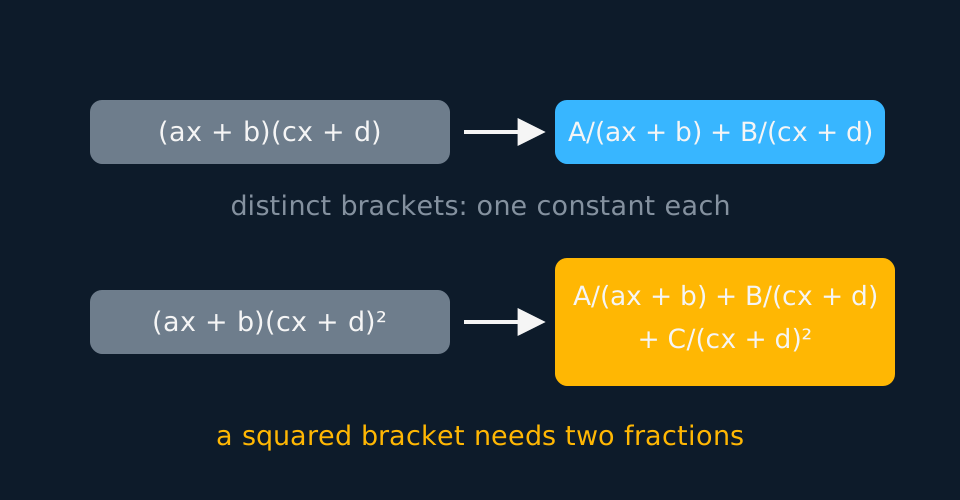
A squared bracket takes two terms, one over the bracket and one over its square, and in general both constants are non-zero. So (x + 4)/((x + 1)(x − 2)2) has the template A/(x + 1) + B/(x − 2) + C/(x − 2)2. No value of x isolates B, so compare coefficients once A and C are known.
Un-adding fractions
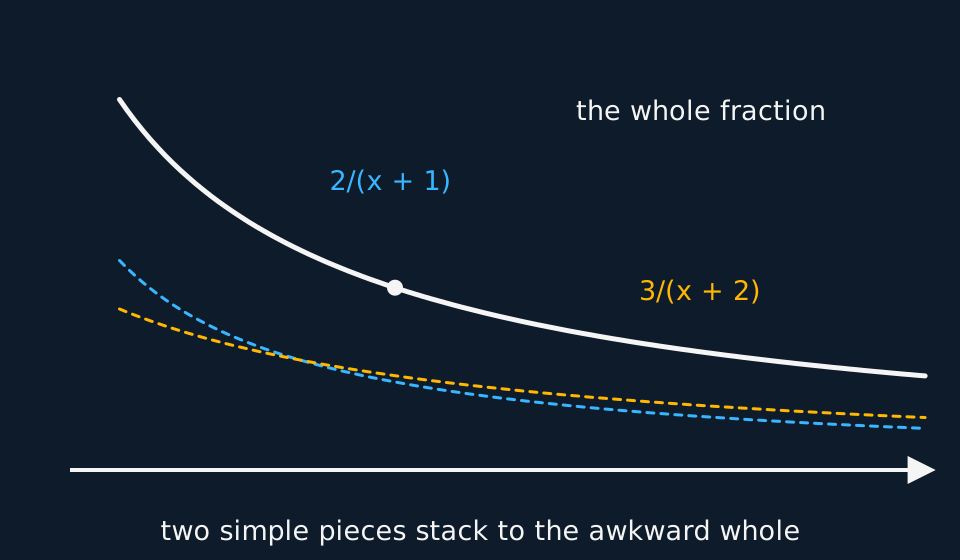
Adding 2/(x + 1) and 3/(x + 2) over a common denominator gives (5x + 7)/((x + 1)(x + 2)). Partial fractions reverses that calculation: write the decomposition with unknown constants, multiply by the denominator, and substitute values of x that make one bracket zero at a time.
Describe the drawing
The solid curve of the full rational function with the two dashed partial-fraction curves beneath it: at the marked point, and at every computed sample, the heights of the simple pieces add to the height of the whole, which is what the decomposition claims wherever all three expressions are defined, so away from x equals minus 1 and minus 2.
WORKED EXAMPLE
Two brackets, two constants
Express (5x + 7)/((x + 1)(x + 2)) in partial fractions.
Set (5x + 7)/((x + 1)(x + 2)) = A/(x + 1) + B/(x + 2) and multiply up to get 5x + 7 = A(x + 2) + B(x + 1).
Substitute x = −1 to eliminate the B bracket, giving 2 = A. Substitute x = −2 to eliminate the A bracket, giving −3 = −B, so B = 3.
So the fraction is 2/(x + 1) + 3/(x + 2).
Any other value of x, except −1 and −2, checks the answer. At x = 0 the left side is 7/2 and the right side is 2 + 3/2, which agree.
GUIDED PRACTICE
Three brackets, three constants
Express (6x2 + 5x − 2)/(x(x − 1)(2x + 1)) in partial fractions, before opening the working.
Show the working
The template is A/x + B/(x − 1) + C/(2x + 1), and multiplying up gives 6x2 + 5x − 2 = A(x − 1)(2x + 1) + Bx(2x + 1) + Cx(x − 1).
x = 0 gives −2 = −A, so A = 2. x = 1 gives 9 = 3B, so B = 3. x = −½ gives −3 = ¾C, so C = −4.
The fraction is 2/x + 3/(x − 1) − 4/(2x + 1).
Each substituted value is a root of one bracket, which makes the other two terms zero and leaves one constant.
The repeated factor
A squared bracket requires two terms rather than one. A denominator (cx + d)2 needs a term over the bracket and a term over its square, and in general both constants are non-zero.
INDEPENDENT PRACTICE
A squared bracket, in full
Express (x + 4)/((x + 1)(x − 2)2) in partial fractions.
Show the working
Template: A/(x + 1) + B/(x − 2) + C/(x − 2)2, so x + 4 = A(x − 2)2 + B(x + 1)(x − 2) + C(x + 1).
x = −1 gives 3 = 9A, so A = ⅓. x = 2 gives 6 = 3C, so C = 2.
No value of x eliminates B alone, so compare a coefficient instead. The constant terms give 4 = 4A − 2B + C, and with A and C known, B = −⅓.
The fraction is ⅓/(x + 1) − ⅓/(x − 2) + 2/(x − 2)2. Substituting x = 1 into the multiplied-up identity gives 5 on both sides, which confirms it.
Substituting a root of a bracket gives the constant over that bracket. The remaining constant is found by comparing coefficients or by one further substitution.
ASSESSMENT FOCUS
- Write the template first: one fraction per distinct bracket, and two for a squared bracket. Show that line before the arithmetic.
- Multiply up and substitute each bracket's root, which picks the constants off one at a time. When a constant survives every substitution, compare coefficients; the constant term is usually quickest.
- Give the constants as exact fractions rather than decimals. Substituting any further value of x in the common domain checks them.
CHECK YOURSELF
Express (7x − 1)/((x − 1)(x + 3)) in partial fractions.
Show a hint
Two brackets, two constants, two substitutions.
Show the answer
Template and multiply up. 7x − 1 = A(x + 3) + B(x − 1).
x = 1 gives 6 = 4A, so A = 3/2. x = −3 gives −22 = −4B, so B = 11/2.
The fraction is 3/(2(x − 1)) + 11/(2(x + 3)), and x = 0 checks it, since 1/3 = −3/2 + 11/6.
One fraction per distinct bracket, and a squared bracket takes a term over the bracket and a term over its square.
Substitute each bracket's root to find the corresponding constant, then compare coefficients for any constant that remains.
WORKBOOK
Printable practice for this topic: original exam-style questions with room to work, and a fully worked answer book. Free to use; please do not redistribute or sell.
Or read them with their worked answers on the partial fractions questions page.
USED LATER IN
CHECK YOUR PROGRESS
Rate how confident you feel with each objective for this lesson. Ratings are saved in this browser, on this device, unless you sign in.
- Split a fraction whose denominator is two or three distinct linear brackets.
- Handle a repeated linear factor with the two-fraction template.
Open the full revision checklist to see every objective in the course in one place.