Physics › Mechanics › Moments and equilibrium
Moments and equilibrium
The moment of a force is the force times the perpendicular distance from the pivot to its line of action, measured in newton metres. In equilibrium the clockwise moments about any point balance the anticlockwise ones, so taking moments about the point where an unknown force acts removes it from the equation. The moment of a couple is one force times the separation of its two lines of action.
Choose your exam board to show the notes and questions relevant to your specification. You can change this setting at any time, and content for other boards remains available.
Builds on Scalars and vectors.
The maths behind it: Moments on InkMaths.
IN THIS TOPIC
- Calculate the moment of a force as force times perpendicular distance from the point to the line of action.
- Recognise a couple, and give its torque as one force times the separation of the lines of action.
- Apply the principle of moments, choosing the pivot that deletes an unknown force.
- Place an object's weight at its centre of mass, which for a uniform regular solid is its geometric centre.
- Separate centre of mass from centre of gravity, and for OCR, find the centre of gravity of an irregular lamina with a plumb line.
COMMON MISCONCEPTION
If the forces are equal, it balances.
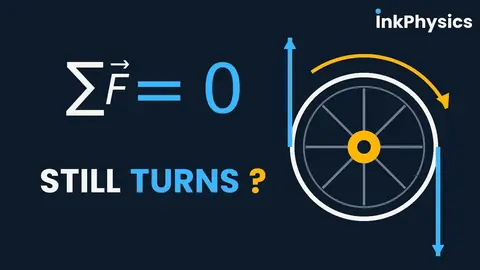
Equal forces can still turn an object: a couple has zero resultant force and a definite moment. Balance needs both resultant force and resultant moment to be zero.
The moment of a force
The turning effect of a force about a point is its moment.
Here d is the perpendicular distance from the point to the line of action of the force, and the unit is the newton metre, N m. A complete definition includes both “perpendicular” and “line of action”; a distance measured along the beam instead gives a different, incorrect value.
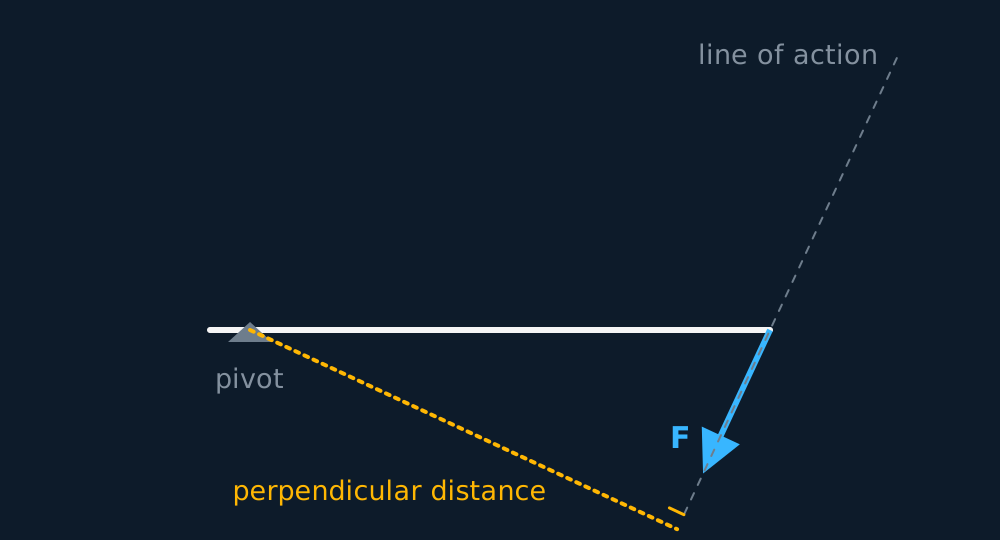
When a force is applied at an angle, extend its line of action as a construction line and drop a perpendicular from the pivot onto it. That perpendicular length, equal to L sin θ for a force at θ to the beam, is the d in Fd. Pushing along a line that passes through the pivot gives a moment of zero, however hard you push.
Couples
A couple is a pair of equal and opposite coplanar forces whose lines of action do not coincide, such as the push and pull of two hands turning a steering wheel. The forces cancel, so a couple produces no resultant force and no acceleration of the centre of mass. Turning is all it produces.
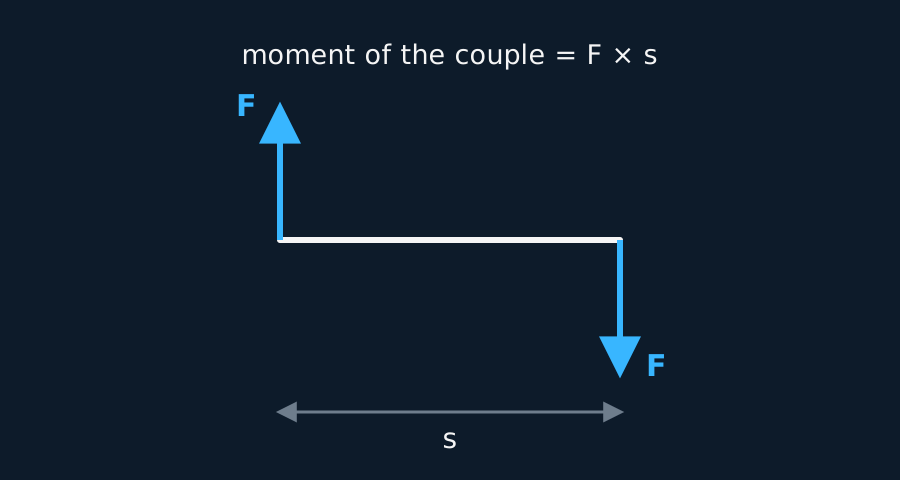
Its moment is force times the perpendicular distance between the two lines of action, F × s, taking one of the forces and not both. That moment is also called the torque of the couple. Counting both forces doubles the answer.
The principle of moments
An object in equilibrium obeys the principle of moments. About any point, the sum of the clockwise moments equals the sum of the anticlockwise moments. Equal forces are neither necessary nor sufficient. It is the products Fd that balance.
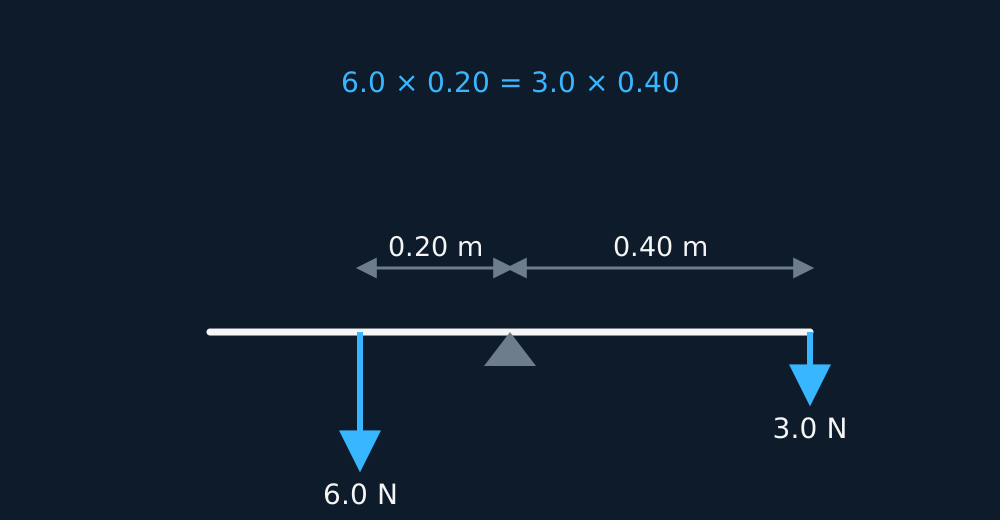
Moments may be taken about any point. Taking them about the point where an unknown force acts gives that force zero distance from the pivot, therefore zero moment, so it does not appear in the equation. This leaves one unknown instead of two.
WORKED EXAMPLE
Balancing a seesaw
A child weighing 400 N sits 1.5 m from a seesaw's pivot. Where must an adult weighing 600 N sit to balance it?
Take moments about the pivot, so the support force there vanishes from the start.
Balancing gives 400 × 1.5 = 600 × d, so d = 600/600 = 1.0 m on the other side.
Check the result: the heavier person sits closer to the pivot, in inverse proportion to the weights, because it is the product Fd that balances rather than the force alone.
GUIDED PRACTICE
Lifting a wheelbarrow
A loaded wheelbarrow carries 300 N acting 0.50 m from the wheel's axle; the handles are 1.2 m from the axle. Choose the pivot that removes the unknown ground force, then find the lift needed at the handles.
Show the working
Put the pivot at the axle, where the wheel's contact force acts and therefore vanishes.
Moments then give F × 1.2 = 300 × 0.50, so F = 150/1.2 = 125 N. The lift is less than half the load because the handles are more than twice as far from the axle as the load is.
INDEPENDENT PRACTICE
A trapdoor held open
A uniform trapdoor of weight 60 N is hinged along one edge and held horizontal by a vertical force applied three quarters of the way from the hinge to the far edge. Find the holding force.
Show the working
Uniform means the weight acts at the centre, half the length from the hinge. Take moments about the hinge to eliminate its unknown force.
Call the length L. Then F × 0.75L = 60 × 0.5L, so F = 30/0.75 = 40 N. The L cancels, so the length is not needed. Only the ratio of the two distances affects the answer.
Centre of mass and centre of gravity
An object's weight is spread through it, but for moments it behaves as if all its weight acts at one point, the centre of mass. For a uniform regular solid, the centre of mass is at its geometric centre, so a uniform 4.0 m beam carries its weight at the 2.0 m mark. Mark the weight at that point on the diagram before taking moments.
The centre of gravity is the corresponding point for weight rather than mass: the single point at which the whole weight of the body may be taken to act. Where the gravitational field is uniform across the object the two points sit on top of one another, and everything in this course is small enough for that to hold, so in practice the two names label one point. They part company only for something tall enough that g measurably differs from its top to its bottom.
Exam-board note, OCR A only. OCR A requires the experimental determination of the centre of gravity of an irregular lamina (3.2.3).
For an irregular lamina the apparatus is a pin and a plumb line. Hang the lamina from a small hole near its edge and let it settle. It can only come to rest with its centre of gravity vertically below the pin, because in any other position the weight has a moment about the pin and turns it further. Hang a plumb line from that same pin, mark two points along the thread, and rule the line joining them across the lamina. The centre of gravity lies somewhere on that line, though one hanging alone does not fix the position along it.
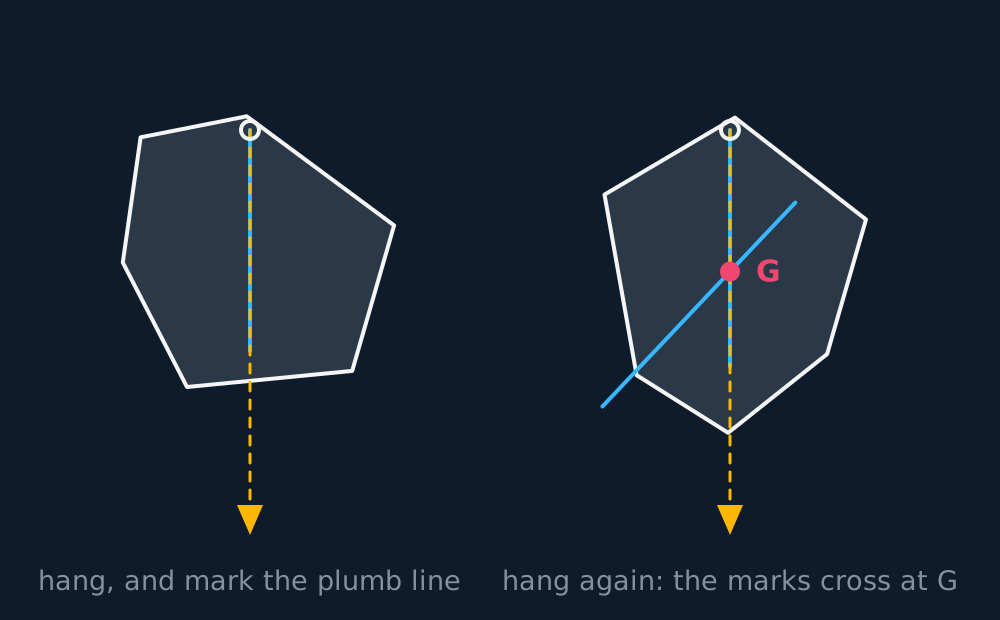
Repeat from a second hole well away from the first and rule a second line. The centre of gravity is the point where the two lines cross, since it has to lie on both. A third hole is the check worth doing, because its line should pass through that same crossing, and a line that misses it indicates that a hole was binding on the pin rather than hanging freely.
ASSESSMENT FOCUS
- Define the moment as force multiplied by the perpendicular distance from the point to the line of action. A definition that omits either phrase is incomplete.
- Take moments about the point where an unknown force acts, and that unknown does not appear in the equation, reducing the number of unknowns by one.
- A uniform beam's weight acts at its centre. Omitting the beam's own weight, or placing it at an end, gives a wrong moment sum.
- A couple's moment is one force times the full separation, not both forces. And a couple cannot be balanced by a single force, only by another couple.
- AQA calls that moment the torque of the couple, so use their word when the paper does.
- Check both conditions when asked whether a body is in equilibrium: resultant force zero and resultant moment zero. Each can hold without the other.
- OCR A asks for the plumb-line determination together with the reason it works. A freely suspended body hangs with its centre of gravity below the point of suspension, because anywhere else the weight has a moment about that point. Two hangings give two lines, and the crossing is the answer.
CHECK YOURSELF
A uniform 4.0 m beam of weight 200 N rests on supports at each end. A 600 N load sits 1.0 m from the left support. Find the force from the left support.
Show a hint
Take moments about the right support, so its unknown force vanishes.
Show the answer
Take moments about the right support. Clockwise there is Rleft × 4.0. Anticlockwise there are two, the beam's own weight of 200 N acting at its centre 2.0 m away, giving 400 N m, and the load of 600 N sitting 3.0 m from the right, giving 1800 N m.
So 4.0 Rleft = 400 + 1800 = 2200, giving Rleft = 550 N.
Taking moments about the right support removed its unknown force, leaving one equation with one unknown.
Moments balance, not forces.
Use the perpendicular distance to the line of action.
Choose the pivot that eliminates the unknown.
WORKBOOK
Printable practice for this topic: original exam-style questions with room to work, and a fully worked answer book. Free to use; please do not redistribute or sell.
Or read them with their mark schemes on the moments and equilibrium questions page.
WHERE TO GO NEXT
- Trigonometry and resolving vectors is the maths this lesson leans on, worked through step by step.
USED LATER IN
CHECK YOUR PROGRESS
Rate how confident you feel with each objective for this lesson. Ratings are saved in this browser, on this device, unless you sign in.
- Calculate the moment of a force as force times perpendicular distance from the point to the line of action.
- Recognise a couple, and give its torque as one force times the separation of the lines of action.
- Apply the principle of moments, choosing the pivot that deletes an unknown force.
- Place an object's weight at its centre of mass, which for a uniform regular solid is its geometric centre.
- Separate centre of mass from centre of gravity, and for OCR, find the centre of gravity of an irregular lamina with a plumb line.
Open the full revision checklist to track your progress across the whole unit.