Maths › Sequences and series › The general binomial expansion
The general binomial expansion
For a negative or fractional exponent the binomial expansion is an infinite series, convergent only on an interval of values of x. Find that interval of validity, expand (a + bx)n by factorising out an first, and use the series to approximate square roots and reciprocals.
Builds on The binomial expansion and Partial fractions.
IN THIS TOPIC
- Expand (1 + x)n for negative and fractional n, as far as a stated power.
- State the range of validity, and why the series does not represent the function outside it.
- Handle (a + bx)n by taking an out of the bracket first.
- Combine expansions with partial fractions, and state the interval of validity of the combined expansion.
COMMON MISCONCEPTION
The expansion of (1 + x)−1 works for every x.
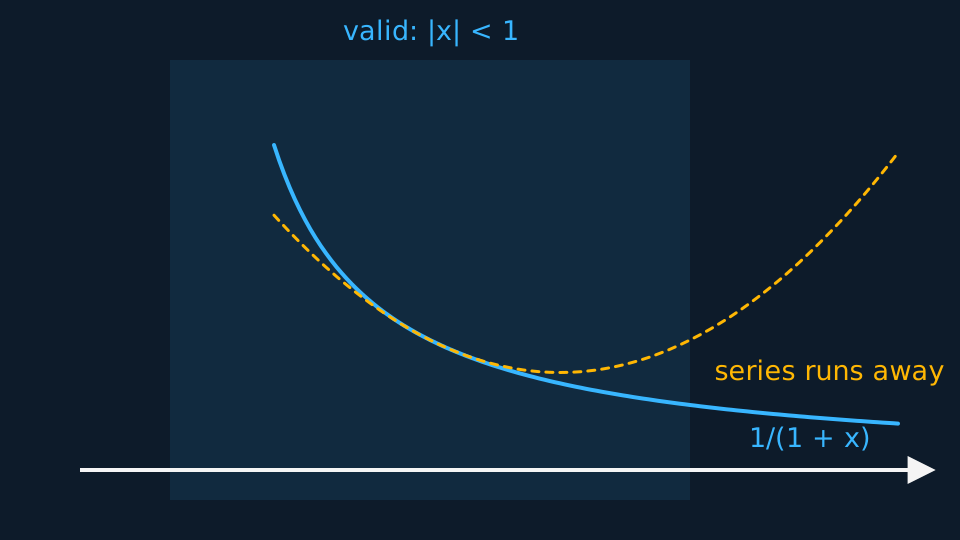
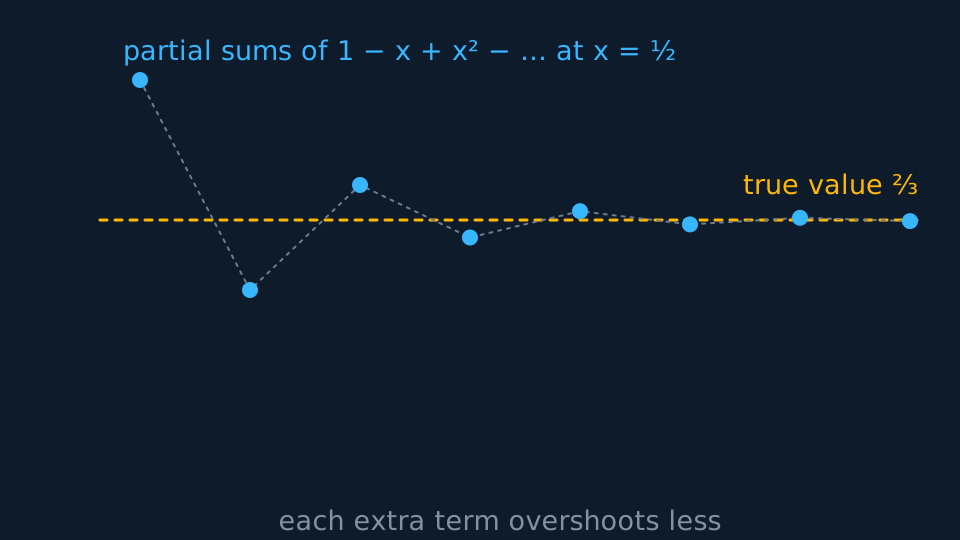
The series converges only for |x| < 1. Outside that interval the terms eventually increase in size and the series diverges, and the endpoints x = ±1 depend on n and need checking separately. At x = 1 the partial sums of the expansion of (1 + x)−1 run 1, 0, 1, 0, 1, …, which never settle on the value ½.
An infinite series, and its interval of validity
For a positive integer n the expansion terminates, because one coefficient becomes zero and every later term is zero. For negative or fractional n no coefficient is ever zero, so the same formula from the booklet gives an infinite series,
which converges for |x| < 1. For |x| > 1 the terms eventually increase in size and the series diverges; at the endpoints x = ±1 the behaviour depends on n and must be checked separately. The condition is not a formality: at x = 1 the partial sums of the expansion of (1 + x)−1 are 1, 0, 1, 0, 1, …, which do not converge to the value ½.
WORKED EXAMPLE
A square root, expanded
Expand (1 − 2x)1/2 in ascending powers of x up to the x2 term, and state the range of validity.
Use the formula with n = ½ and x replaced by −2x throughout. That gives 1 + ½(−2x) + [½ × (−½)/2](−2x)2.
The terms tidy to 1 − x − x2/2.
Validity needs |−2x| < 1, so |x| < ½.
Substitute the whole of −2x into the formula, sign and coefficient together, and apply the same substitution to the validity condition.
Brackets that do not start at 1
The formula needs a 1 at the front, so produce one. Pull an outside and expand what is left over,
which is valid for |bx/a| < 1. The constant is raised to the power n when it is taken out, and it then multiplies every term of the expansion.
GUIDED PRACTICE
Factor out, then expand
Expand (4 + x)1/2 up to the x2 term, stating the validity, before opening the working.
Show the working
Factor first. (4 + x)1/2 = 41/2(1 + x/4)1/2 = 2(1 + x/4)1/2.
Expand: 2[1 + ½(x/4) + (½ × (−½)/2)(x/4)2] = 2 + x/4 − x2/64.
Validity: |x/4| < 1, so |x| < 4.
The factorised constant is raised to the power n, giving 41/2 = 2 rather than 4, and it then multiplies every term of the expansion.
Partial fractions and the combined interval of validity
Partial fractions extend the method to rational functions: decompose a rational function into terms with linear denominators, expand each term by the formula above, and add the results term by term. Each term has its own interval of validity, and the combined expansion is valid only where all of them hold, so the narrowest interval applies.
INDEPENDENT PRACTICE
Partial fractions feed the series
Using the decomposition (5x + 7)/((x + 1)(x + 2)) = 2/(x + 1) + 3/(x + 2), expand the original fraction up to the x2 term and state the validity.
Show the working
Each piece expands separately. 2(1 + x)−1 = 2 − 2x + 2x2 − …, and 3/(x + 2) = (3/2)(1 + x/2)−1 = 3/2 − 3x/4 + 3x2/8 − ….
Adding gives 7/2 − 11x/4 + 19x2/8.
The two intervals of validity are |x| < 1 and |x| < 2, and the sum converges only where both hold, so the expansion is valid for |x| < 1.
A numerical check at x = 0.05 gives 3.368 to 4 significant figures on both sides. If one term diverges the sum diverges, so the narrowest interval applies.
ASSESSMENT FOCUS
- Quote the general formula before substituting, and put the whole of bx in, sign and coefficient together.
- Stop at the power the question names; further terms are not required.
- Take an out of (a + bx)n first, and remember it multiplies every term afterwards.
- State the validity: solve |bx/a| < 1 and give the answer as an inequality in x.
- For a combined expansion, give the narrowest of the intervals of validity, and say that it is the narrowest.
CHECK YOURSELF
Expand (1 + 3x)−2 in ascending powers up to x2, state the validity, and use the expansion to estimate 1.03−2.
Show a hint
n = −2, and the replacement is 3x; then x = 0.01.
Show the answer
1 + (−2)(3x) + [(−2)(−3)/2](3x)2 = 1 − 6x + 27x2, valid for |x| < ⅓.
At x = 0.01 the truncation gives 1 − 0.06 + 0.0027 = 0.9427.
The true value is 0.94260…, so the first three significant figures agree and the fourth differs by one, the difference being the discarded cubic and later terms.
A negative or non-integer exponent makes the expansion infinite; a positive integer exponent makes it terminate. |bx/a| < 1 is where the infinite one converges, with the endpoints needing their own check.
Factorise out an, expand the remaining bracket, and state the interval of validity with the expansion.
WORKBOOK
Printable practice for this topic: original exam-style questions with room to work, and a fully worked answer book. Free to use; please do not redistribute or sell.
Or read them with their worked answers on the general binomial expansion questions page.
USED LATER IN
CHECK YOUR PROGRESS
Rate how confident you feel with each objective for this lesson. Ratings are saved in this browser, on this device, unless you sign in.
- Expand (1 + x)n for negative and fractional n, as far as a stated power.
- State the range of validity, and why the series does not represent the function outside it.
- Handle (a + bx)n by taking an out of the bracket first.
- Combine expansions with partial fractions, and state the interval of validity of the combined expansion.
Open the full revision checklist to see every objective in the course in one place.