Maths › Trigonometry › Triangles and the sine and cosine rules
Triangles and the sine and cosine rules
The sine and cosine rules solve non-right-angled triangles. Choose the rule from the information given, use ½ab sin C for area, and test both inverse-sine angles in the ambiguous case against the angle sum and side lengths.
IN THIS TOPIC
- Use the sine rule to find sides and angles, pairing each side with the angle facing it.
- Use the cosine rule from two sides and the included angle, or from all three sides.
- Handle the ambiguous case, and find areas from two sides and the included angle.
COMMON MISCONCEPTION
If sin B = 0.83, then B = sin−1 0.83 and that settles it.
An inverse sine gives two candidate angles, because sin θ = sin (180° − θ). For sin B = 0.83 they are B = 56.1° and B = 123.9°, and both must be tested against the stated sides and the angle sum, since a candidate is valid only if it leaves a positive third angle. A diagram in a question is not drawn to scale, so it settles nothing.
The sine rule
Label every side with the lower-case letter of the angle facing it, a opposite A and so on. The sine rule then says the ratio of a side to the sine of its opposite angle stays the same all the way round the triangle,
and it applies whenever the given quantities include an opposite pair, one side together with the angle facing it, plus one further piece of information.
WORKED EXAMPLE
Solving a triangle from two angles and a side
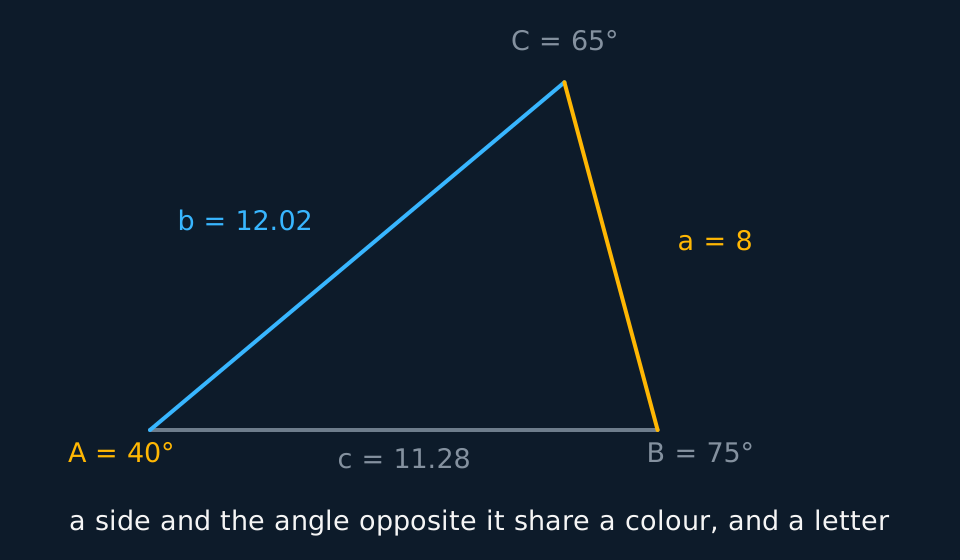
In triangle ABC, A = 40°, B = 75° and a = 8 cm. Find the remaining angle and sides.
Angles first. C = 180° − 40° − 75° = 65°.
The known opposite pair is a and A, so b = 8 sin 75°/sin 40° = 12.0 cm and c = 8 sin 65°/sin 40° = 11.3 cm, both to 3 significant figures.
The largest side is opposite the largest angle, which checks the result.
The cosine rule and the area formula
Sometimes the given pieces do not form an opposite pair. Two sides with the angle between them, say, or three sides and no angle at all. The cosine rule covers those cases,
which reduces to Pythagoras' theorem when A = 90°, since cos 90° = 0. Alongside it is the area formula,
where C is the angle between the sides a and b. Neither formula is in the formulae booklet, so both must be learnt.
WORKED EXAMPLE
Two sides and the angle between them
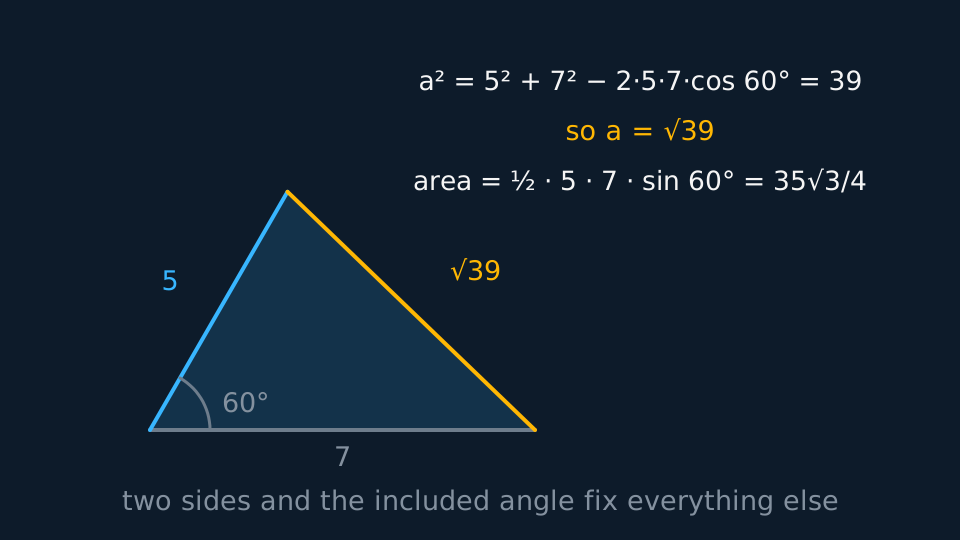
A triangle has sides of 5 cm and 7 cm meeting at 60°. Find the third side and the triangle's area.
Cosine rule first. a2 = 52 + 72 − 2 × 5 × 7 × cos 60° = 25 + 49 − 35 = 39, so a = √39 = 6.24 cm.
Area = ½ × 5 × 7 × sin 60° = 15.2 cm2.
Keep a2 = 39 exact until the final line: rounding to 6.24 and squaring it back changes the value. Give the exact value √39 unless the question requests a decimal approximation.
GUIDED PRACTICE
Three sides, no angles
A triangle has sides 4 cm, 6 cm and 8 cm. Find its largest angle, before opening the working.
Show the working
The largest angle faces the longest side, 8. Rearranged, the cosine rule gives cos θ = (42 + 62 − 82)/(2 × 4 × 6) = −12/48 = −0.25.
θ = cos−1(−0.25) = 104.5°.
A negative cosine identifies an obtuse angle. The sign of the cosine distinguishes acute from obtuse; the sine does not, since sin θ = sin (180° − θ).
The ambiguous case
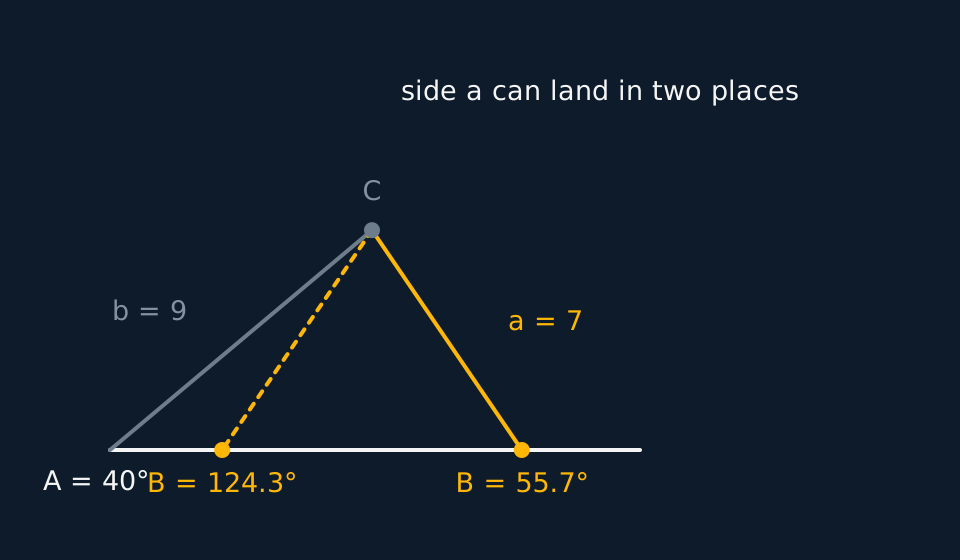
Sine does not distinguish an angle from its supplement, because sin θ = sin (180° − θ). So when the sine rule gives sin B = 0.83, there are two candidates, B = 56.1° or 123.9°. Test both against the stated sides and the angle sum: a candidate is valid only if it leaves a positive third angle, and where the side opposite the given angle is at least as long as the other given side, only the acute candidate is valid. A diagram in a question is not drawn to scale, so it does not settle which candidate applies.
INDEPENDENT PRACTICE
Both triangles, in full
In triangle ABC, A = 40°, b = 9 cm and a = 7 cm. Find the two possible values of B, and the two possible values of C.
Show the working
Sine rule: sin B = 9 sin 40°/7 = 0.826, so B = 55.7° or its supplement 124.3°.
Now test each. 40° + 55.7° leaves C = 84.3°, and 40° + 124.3° leaves C = 15.7°. Both are positive, so both triangles exist.
B = 55.7° or 124.3°, C = 84.3° or 15.7°. The side a = 7 is shorter than b = 9 but longer than b sin 40°, which is the condition allowing two triangles.
Had a been 9 or more, only the acute B would satisfy the angle sum. Include the test of both candidates in the answer.
ASSESSMENT FOCUS
- Label the sides and angles in opposite pairs before quoting a rule: the sine rule relates a side to the angle facing it, so a mispaired ratio gives a wrong equation.
- Choose the rule from the information given. An opposite pair with one further piece of information gives the sine rule; two sides with the included angle, or all three sides, gives the cosine rule.
- After an inverse sine, write down the supplement as well, and test both against the angle sum and the stated side lengths.
- Keep squared lengths exact while you work, a2 = 39 and not a = 6.244997…, then round once at the end.
- In ½ab sin C the angle must be the one between the two sides you have used. If it is not, find it first.
CHECK YOURSELF
A triangle has sides 5 cm and 7 cm meeting at an angle of 60°. Without a calculator, find the exact length of the third side and the exact area.
Show a hint
cos 60° = ½ and sin 60° = √3/2 are exact values.
Show the answer
Cosine rule: a2 = 25 + 49 − 70 × ½ = 39, so the third side is exactly √39 cm.
Area = ½ × 5 × 7 × √3/2 = 35√3/4 cm2.
Both answers are exact because cos 60° and sin 60° have exact values.
Use the sine rule for opposite pairs, and the cosine rule for two sides with the included angle or for three sides.
An inverse sine gives two possible angles; test both against the angle sum and the stated side lengths rather than against the diagram.
WORKBOOK
Printable practice for this topic: original exam-style questions with room to work, and a fully worked answer book. Free to use; please do not redistribute or sell.
Or read them with their worked answers on the triangles and the sine and cosine rules questions page.
USED LATER IN
CHECK YOUR PROGRESS
Rate how confident you feel with each objective for this lesson. Ratings are saved in this browser, on this device, unless you sign in.
- Use the sine rule to find sides and angles, pairing each side with the angle facing it.
- Use the cosine rule from two sides and the included angle, or from all three sides.
- Handle the ambiguous case, and find areas from two sides and the included angle.
Open the full revision checklist to see every objective in the course in one place.