Physics › Astrophysics › Reflecting telescopes
Reflecting telescopes
A Cassegrain reflector collects light on a concave parabolic primary mirror and folds it back through a hole in it with a convex secondary. The fold puts a long focal length inside a short tube. Reflection is independent of wavelength, so mirrors show no chromatic aberration, and a parabolic surface removes the spherical kind.
Choose your exam board to show the notes and questions relevant to your specification. You can change this setting at any time, and content for other boards remains available.
Telescopes and image formation, part 2 of 2. Part 1 is The astronomical refracting telescope.
Builds on The astronomical refracting telescope and Refraction and Snell's law.
IN THIS TOPIC
- Draw the Cassegrain arrangement and explain what each mirror contributes.
- Weigh reflectors against refractors, including chromatic and spherical aberration.
COMMON MISCONCEPTION
A good telescope is one with the biggest magnification.
Magnification is not what matters: the objective's diameter fixes the light gathered and the detail resolved, and magnifying a blurred image only gives a bigger blur.
The Cassegrain reflector
Serious telescopes use mirrors, and the classic layout is the Cassegrain. A large concave primary mirror collects the light. Its surface is ground to a parabola, because a parabolic mirror brings every ray parallel to its axis to one sharp focus, however far from the axis the ray strikes. Before the light reaches that focus, a small convex secondary mirror intercepts it and reflects it back down the tube, through a central hole in the primary, to a focus just behind the main mirror where the eyepiece or camera sits.
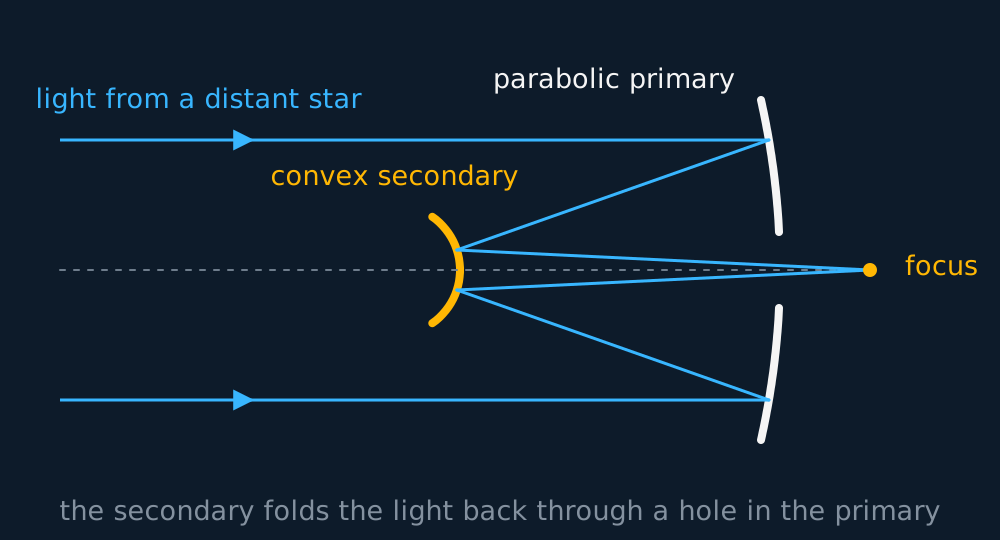
The fold is the point. Reflecting the beam back on itself packs a long effective focal length into a short, stiff, steerable tube, and the eyepiece ends up in the most convenient place possible, behind the telescope where an observer or an instrument can sit. The angular magnification works exactly as before, with the effective focal length of the mirror pair playing the part of .
GUIDED PRACTICE
The folded focal length
A Cassegrain has an effective focal length of 2.0 m folded into a tube about half a metre long, and takes a 20 mm eyepiece. Find the magnification, and state the advantage the fold has bought.
Show the working
M = = 2.0 / 0.020 = 100.
A refractor with the same magnification and the same eyepiece would need a tube over two metres long. The fold delivers that focal length in a quarter of the tube, so the mount can be smaller and stiffer.
Reflector or refractor
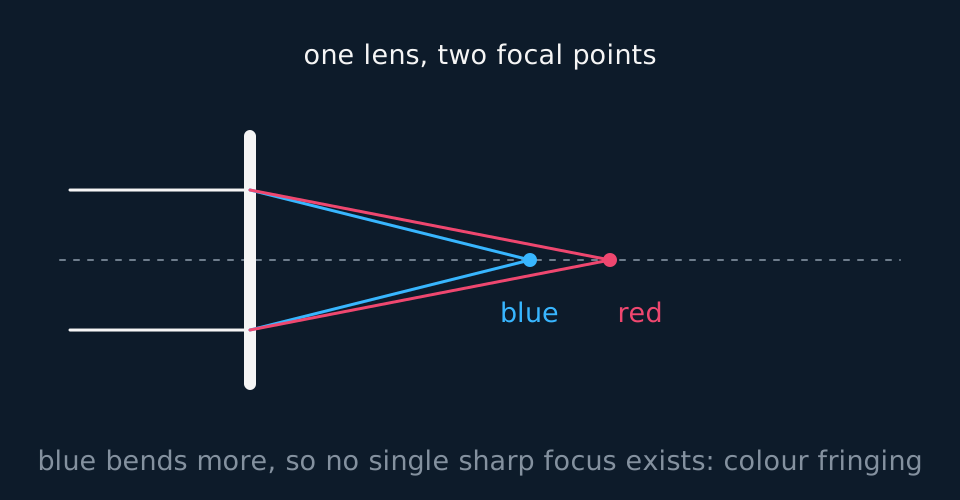
Lenses carry two built-in flaws, and both are examinable by name. Chromatic aberration comes first. Glass refracts blue light more strongly than red, so a single lens gives each colour its own focal length and no one sharp focus exists. A bright star therefore shows a faint coloured fringe.
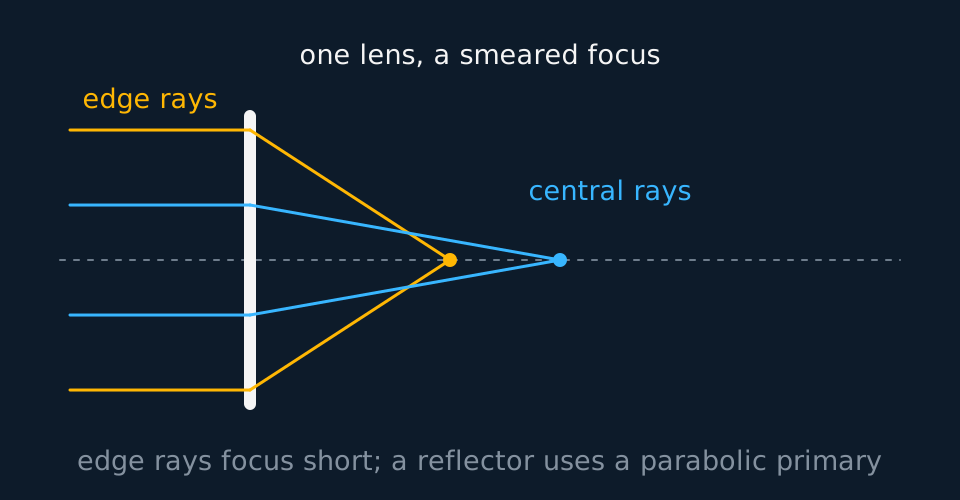
Then spherical aberration. A lens or mirror ground to a spherical surface focuses rays through its edge slightly short of rays through its centre, smearing the focus along the axis. Mirrors escape both problems more cheaply than lenses do. Reflection is independent of wavelength, so a mirror has no chromatic aberration at all, and grinding the primary to a parabola removes the spherical error for light arriving parallel to the axis.
| Refractor | Cassegrain reflector | |
|---|---|---|
| chromatic aberration | present, so each colour has its own focus | absent, because mirrors treat all colours alike |
| spherical aberration | present unless expensively corrected | removed by the parabolic primary |
| size limit | a lens can only be held by its rim, and a large one sags under its own weight | a mirror is supported across its whole back, so it can be built enormous |
| light lost | some absorbed crossing the glass | little lost at a coated surface |
| upkeep | sealed tube, little maintenance | mirror coatings need occasional renewal |
A large magnification alone is not a measure of a telescope. Magnification enlarges the angular size of an image that has already been formed, so enlarging a dim, blurred image gives a larger dim, blurred image. What determines performance is how much light the telescope gathers and how fine the detail it can resolve, and both depend on the objective's diameter.
INDEPENDENT PRACTICE
Designing backwards
A refractor in normal adjustment magnifies 50 times and its tube is 1.02 m long. Find both focal lengths.
Show the working
Two facts, two unknowns. = 1.02 and = 50.
Substituting gives 51 = 1.02, so = 0.020 m and = 1.0 m.
The sanity check is built in. Your two answers must add back to the tube length, and 1.00 + 0.02 does.
ASSESSMENT FOCUS
- The Cassegrain diagram has four marked features, so draw all four. A concave parabolic primary with a central hole, a convex secondary placed before the primary's focus, the beam folded back through the hole, and the final focus just behind the primary.
- Magnification sums still run M = ; for a Cassegrain, is the effective focal length of the mirror pair, which the fold makes several times the tube length.
- Aberration answers want the mechanism named, then the cure. Chromatic, blue refracted more, so the colours focus apart, cured by using a mirror. Spherical, edge rays focus short, cured by a parabolic surface. A merits question is a comparison, so answer in pairs, refractor then reflector.
CHECK YOURSELF
A Cassegrain telescope has an effective focal length of 2.4 m in a tube 0.60 m long, and takes a 12 mm eyepiece. Find its angular magnification, state which feature of the design fits that focal length into that tube, and explain why the image carries no chromatic aberration.
Show a hint
The usual ratio, with the effective focal length playing the objective's part.
Show the answer
M = = 2.4 / 0.012 = 200.
The convex secondary folds the beam back down the tube, so the light path is far longer than the instrument: a 2.4 m focal length fits inside a 0.60 m tube.
Reflection is independent of wavelength, so the mirrors bring every colour to the same focus. Chromatic aberration comes from refraction in glass, and no glass takes part in forming this image.
A Cassegrain collects with a concave parabolic primary and folds the beam back through it with a convex secondary, to a focus behind the mirror.
Mirrors have no chromatic aberration, a parabola cures the spherical kind, and a mirror supported across its back can be built enormous.
Or read them with their mark schemes on the astronomical refracting telescope questions page.
CHECK YOUR PROGRESS
Rate how confident you feel with each objective for this lesson. Ratings are saved in this browser, on this device, unless you sign in.
- Draw the Cassegrain arrangement and explain what each mirror contributes.
- Weigh reflectors against refractors, including chromatic and spherical aberration.
Open the full revision checklist to track your progress across the whole unit.