Physics › Astrophysics › Telescopes beyond the visible
Telescopes beyond the visible
The atmosphere is transparent only to visible light and radio waves, so infrared telescopes sit on high dry summits and X-ray telescopes orbit. Radio dishes work at ground level through cloud and daylight, infrared detectors are cooled so the instrument does not glow in its own band, and X-rays are focused at grazing incidence.
Choose your exam board to show the notes and questions relevant to your specification. You can change this setting at any time, and content for other boards remains available.
Telescopes across the spectrum, part 1 of 2. Part 2 is Resolving power, collecting power and the CCD.
Builds on Reflecting telescopes and Polarisation and electromagnetic waves.
IN THIS TOPIC
- Compare radio, infrared, ultraviolet and X-ray telescopes with optical ones in structure, siting and use.
COMMON MISCONCEPTION
Observatories sit on mountaintops to be closer to the stars.
The altitude gain is negligible against astronomical distances: mountaintop sites sit above most of the turbulent, absorbing atmosphere, giving steadier images and access to infrared wavelengths.
Where to stand
Stars, galaxies and everything between them radiate right across the electromagnetic spectrum, and each band carries different information. Cold dust glows in the infrared. Hot gas emits in X-rays, while cool hydrogen emits weakly at radio wavelengths. The limiting factor is the atmosphere. Air is transparent to visible light and to radio waves, and opaque to almost everything else, so only two broad windows open clear to sea level, with partial infrared access from high, dry sites.
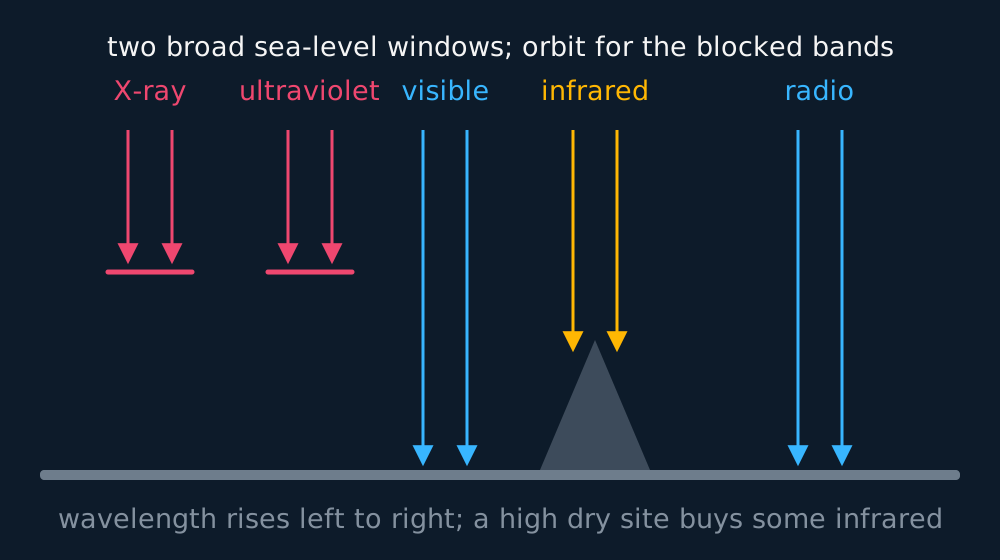
That single fact dictates where every telescope lives. Radio dishes work at ground level, day and night, straight through cloud. A big steerable dish is a reflecting telescope scaled up, and because the wavelength is so long its surface can even be open mesh. Infrared telescopes climb high, dry mountains, above as much water vapour as possible, and their detectors are cooled so the instrument's own warmth does not glow in the very band it is observing. Ultraviolet and X-ray telescopes must orbit above the atmosphere entirely. X-rays then raise a further problem, since they pass straight into an ordinary mirror, so they are focused by skimming off nested metal surfaces at grazing incidence.
A few kilometres of altitude is nothing against interstellar distances. Observatories climb instead to get above water vapour and the shimmering turbulence of warm air, which is also why the sharpest visible-light images come from orbit.
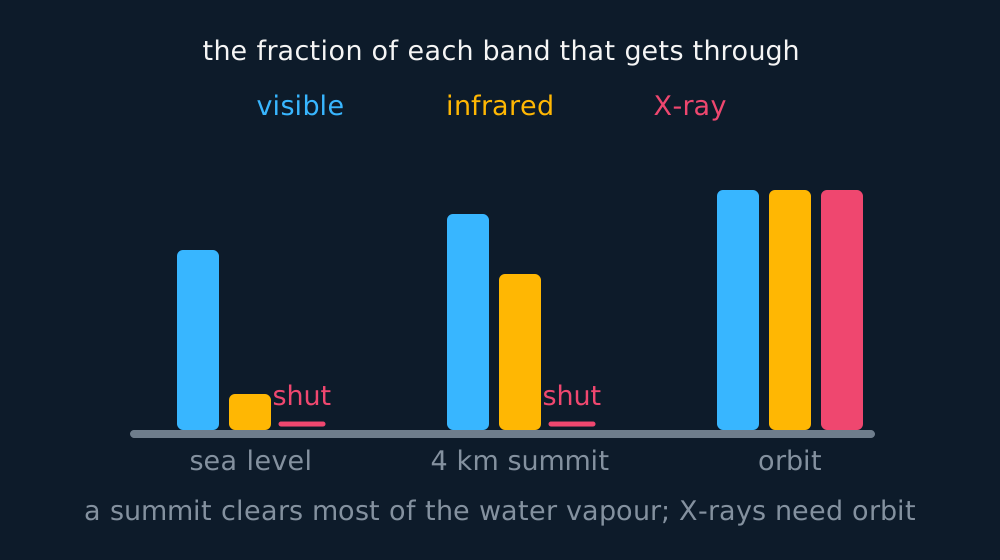
Describe the drawing
Nine bars in three groups, one group per site. At sea level the visible bar stands tall, the infrared bar is short and the X-ray slot is marked shut; at a 4 km summit the infrared bar has grown severalfold and the X-ray slot is still shut; in orbit all three bars reach full height. No bar ever shrinks as the site climbs.
| Band | Where it works | Why |
|---|---|---|
| radio | ground level | the atmosphere is transparent to it; cloud and daylight do not matter |
| infrared | high, dry summits, or space | water vapour absorbs it, and warm equipment glows in it |
| visible | ground, better in orbit | a clear window, but turbulence blurs fine detail |
| ultraviolet | orbit | absorbed high in the atmosphere, much of it by ozone |
| X-ray | orbit, grazing-incidence mirrors | the atmosphere absorbs it, and it penetrates ordinary mirrors |
How sharp: the Rayleigh criterion has moved to the next part of this lesson.
How deep: collecting power, and what detects the light has moved to the next part of this lesson.
ASSESSMENT FOCUS
- A siting answer must name the atmospheric reason: either the band the air absorbs or the turbulence that blurs fine detail. Altitude on its own is not a reason.
- Comparison answers go band by band, and every band needs its reason attached. Radio works from the ground, through cloud and daylight; infrared needs altitude above the water vapour; ultraviolet and X-rays need orbit, and X-rays need grazing-incidence mirrors because they pass into ordinary ones.
- The infrared answer has two separate halves. The site is high and dry because water vapour absorbs the band, and the detector is cooled so the telescope's own warmth does not glow in the band it is observing.
CHECK YOURSELF
An infrared telescope is built on a high, dry mountain summit with its detectors cooled to a few tens of kelvin, while an X-ray telescope for the same survey must be put in orbit and focused by nested grazing-incidence mirrors. Justify each of the four design decisions.
Show a hint
Each choice answers either what the atmosphere does to the band or what the instrument itself would do to the signal.
Show the answer
Water vapour absorbs infrared, and most of the vapour sits in the low, wet part of the atmosphere, so a high, dry summit rises above most of the absorber.
A warm telescope glows in the very band it is observing, swamping faint sources, so the detectors are cooled until their own emission is negligible.
X-rays are absorbed high in the atmosphere, so no mountain is high enough and the telescope must orbit above it entirely.
X-rays pass straight into an ordinary mirror instead of reflecting, so they are focused by skimming off nested metal surfaces at grazing incidence.
Only visible light and radio reach sea level; infrared wants a high, dry summit and cold detectors, and ultraviolet and X-rays want orbit.
Observatories climb to get above water vapour and turbulence, not to get nearer the stars.
WORKBOOK
Printable practice for this topic: original exam-style questions with room to work, and a fully worked answer book. Free to use; please do not redistribute or sell.
Or read them with their mark schemes on the telescopes beyond the visible questions page.
USED LATER IN
CHECK YOUR PROGRESS
Rate how confident you feel with each objective for this lesson. Ratings are saved in this browser, on this device, unless you sign in.
- Compare radio, infrared, ultraviolet and X-ray telescopes with optical ones in structure, siting and use.
Open the full revision checklist to track your progress across the whole unit.