Physics › Astrophysics › Resolving power, collecting power and the CCD
Resolving power, collecting power and the CCD
Diffraction at the aperture limits angular resolution, and the Rayleigh criterion puts the smallest resolvable angle at θ ≈ λ/D radians. Collecting power grows as the square of the diameter, so both figures of merit follow the aperture rather than the magnification. A charge-coupled device registers about 80 per cent of arriving photons; the eye manages 1 per cent.
Choose your exam board to show the notes and questions relevant to your specification. You can change this setting at any time, and content for other boards remains available.
Telescopes across the spectrum, part 2 of 2. Part 1 is Telescopes beyond the visible.
Builds on Telescopes beyond the visible and Diffraction and the single slit.
IN THIS TOPIC
- Use the Rayleigh criterion θ ≈ λ/D, in radians, to compare resolving powers.
- Compare collecting powers through diameter squared, and the CCD with the eye.
COMMON MISCONCEPTION
Doubling a telescope's mirror diameter doubles the light it gathers.
Collecting power follows area, not diameter: doubling D quadruples the light gathered, and halves the Rayleigh limit θ ≈ λ/D as well, so the image is brighter and sharper at once.
How sharp: the Rayleigh criterion
Every telescope has a sharpness limit it cannot exceed, and diffraction sets it. The aperture is a hole that light waves must squeeze through, so a point star never images to a point. It becomes a small bright disc ringed by faint fringes, the aperture's diffraction pattern. Two stars close together in angle mean two overlapping patterns, and if the overlap is too great no instrument behind the telescope can untangle them.
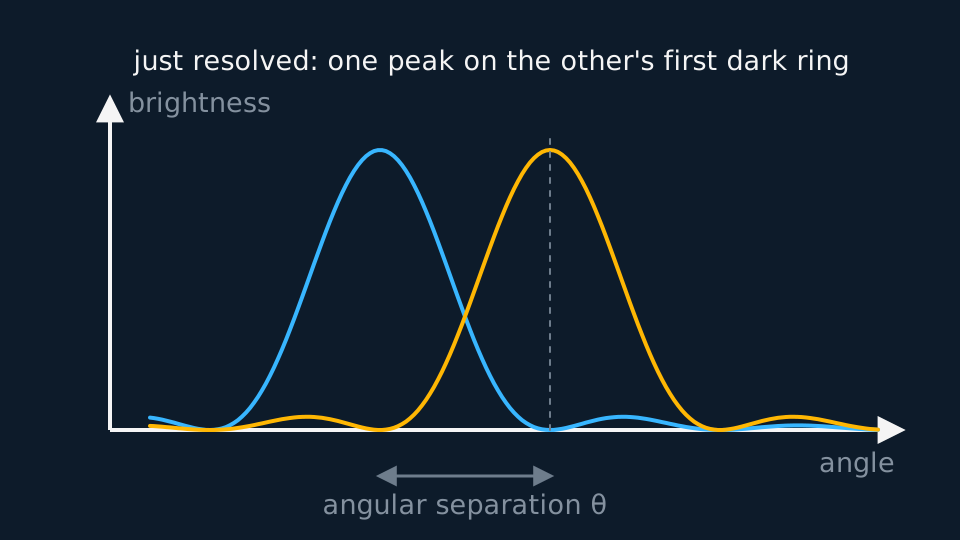
The Rayleigh criterion makes the judgement precise. Two sources are just resolved when the centre of one pattern sits on the first minimum of the other, which happens at an angular separation of about
with θ in radians, λ the wavelength observed and D the aperture diameter. Smaller θ means finer detail, so the resolving power improves with a bigger aperture and a shorter wavelength. The equation explains a real difficulty for radio astronomy:
WORKED EXAMPLE
Comparing a radio dish with the eye
The Lovell radio telescope has a 76 m dish and observes the hydrogen line at λ = 0.21 m. Your dark-adapted pupil is about 5.0 mm across, working at λ ≈ 5.0 × 10⁻⁷ m. Compare their resolving powers.
Lovell: θ ≈ λ/D = 0.21 / 76 = 2.8 × 10⁻³ rad.
The eye: θ ≈ 5.0 × 10⁻⁷ / (5.0 × 10⁻³) = 1.0 × 10⁻⁴ rad.
The unaided eye resolves detail nearly thirty times finer than a 76-metre national instrument, because its wavelength is nearly half a million times shorter. Radio astronomers claw the sharpness back by linking dishes many kilometres apart, which makes D effectively enormous.
GUIDED PRACTICE
A tale of two dishes
One radio dish is 64 m across, another 32 m, observing the same 0.21 m line. Compare their resolving powers and say which sees finer detail.
Show the working
θ for the 64 m dish is 0.21/64 = 3.3 × 10⁻³ rad; for the 32 m dish, 0.21/32 = 6.6 × 10⁻³ rad.
Doubling D halves θ, so the 64 m dish resolves detail twice as fine. Smaller θ is better, because the number is the angle at which two sources stop being separable.
How deep: collecting power, and what detects the light
Most objects astronomers care about are desperately faint, so a telescope's second figure of merit is its collecting power, the rate at which the aperture gathers light. That is proportional to the aperture's area, and hence to the square of its diameter:
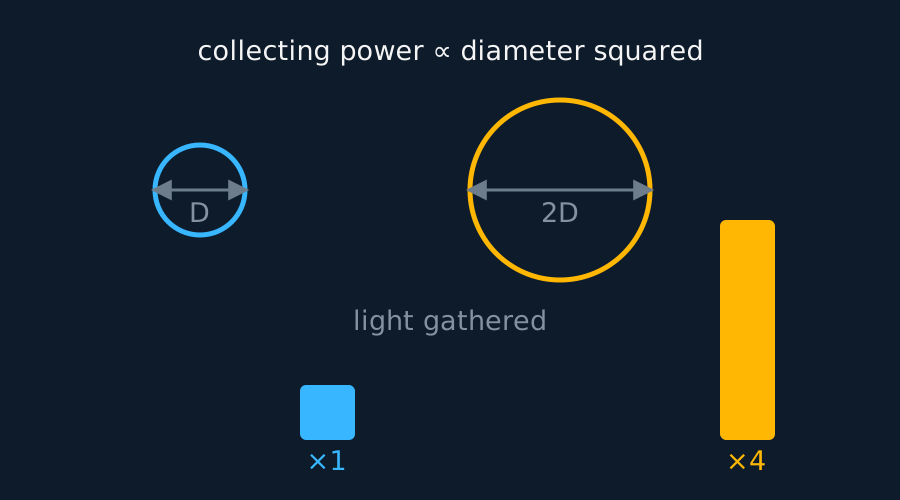
An 8.2 m mirror against your 5.0 mm pupil is a diameter ratio of 1640, so it gathers 16402 ≈ 2.7 × 10⁶ times the light. Both figures of merit depend on the diameter of the aperture rather than on the magnification.
The detector matters as much as the mirror. For a century that meant the eye, then photographic plates. Now it means the charge-coupled device, the CCD at the heart of every astronomical camera.
You are asked for a basic account of how one works, so learn this chain. A CCD is a silicon chip divided into millions of picture elements, or pixels. Light falling on a pixel frees electrons inside the silicon by the photoelectric effect, and the number freed is proportional to the intensity of the light that struck it. Those electrons stay trapped in a potential well at the pixel for as long as the exposure lasts, so charge builds up in a pattern matching the image. When the shutter closes, the charge is shifted pixel by pixel to the edge of the chip, measured, and turned into a number for each pixel.
Comparisons with the eye usually open on quantum efficiency, the fraction of photons arriving at the detector that are actually registered. A CCD detects roughly 80% of them. Your eye manages about 1%.
| CCD | the eye | |
|---|---|---|
| quantum efficiency | about 80% | about 1% |
| exposure | can accumulate light for hours | refreshes many times a second |
| resolution | set by the pixel spacing, a few micrometres | set by the retina, coarser in the dark |
| record | permanent, shareable, measurable | none |
| wavelengths | visible and into the infrared and ultraviolet | visible only |
| convenience | needs power, cooling and a computer | always with you |
Convenience is the eye's remaining advantage. A detector that stores light for hours, records it permanently and measures it in numbers does a different job. That is why a modest amateur telescope with a CCD now reaches objects the great Victorian refractors never saw.
INDEPENDENT PRACTICE
Could Hubble read a number plate on Mars?
The Hubble telescope's mirror is 2.4 m across, observing at 5.0 × 10⁻⁷ m. Mars at its closest is about 5.6 × 10¹⁰ m away. Estimate the smallest detail Hubble can resolve on the Martian surface.
Show the working
θ ≈ λ/D = 5.0 × 10⁻⁷ / 2.4 = 2.1 × 10⁻⁷ rad.
At distance d the smallest separable detail is s ≈ θd = 2.1 × 10−7 × 5.6 × 1010 ≈ 1.2 × 10⁴ m.
About twelve kilometres: whole craters, not rovers. Small angle times huge distance is the working pattern for every question of this shape.
ASSESSMENT FOCUS
- θ ≈ λ/D answers live in radians. If a question supplies degrees or arcseconds, convert before comparing.
- To compare resolving powers, compute θ for both instruments and then say explicitly that the smaller angle resolves the finer detail. The comparison sentence completes the answer.
- Collecting power comparisons square the diameter ratio. Show the ratio first, then square it: the comparison is in D2, not D.
- A CCD question can ask for the mechanism, so do not stop at the numbers. Photons free electrons in the silicon, the electrons are held in a potential well at each pixel, the count is proportional to intensity, and the pattern is read out at the end of the exposure.
- Quantum efficiency has a one-sentence definition, the percentage of incident photons the detector registers. Start the CCD-versus-eye comparison there, then take resolution and convenience in turn.
CHECK YOURSELF
What diameter would a radio telescope observing at 0.21 m need to match the resolving power of a 10 cm optical telescope working at 5.0 × 10⁻⁷ m? Comment on the answer.
Show a hint
Find the optical telescope's θ first, then ask what D gives the radio dish the same θ.
Show the answer
Optical, θ ≈ λ/D = 5.0 × 10⁻⁷ / 0.10 = 5.0 × 10⁻⁶ rad.
Radio, D = λ/θ = 0.21 / (5.0 × 10⁻⁶) = 4.2 × 10⁴ m.
A single dish 42 km across is not buildable, and that is the point of the comment. Matching even a small optical telescope at radio wavelengths takes networks of dishes spread across the countryside, acting together as one giant aperture.
θ ≈ λ over D, in radians, and smaller is sharper.
The light gathered grows as the diameter squared: double the mirror and it collects four times the light.
A CCD registers about 80 per cent of the photons that reach it. Your eye manages one.
Or read them with their mark schemes on the telescopes beyond the visible questions page.
CHECK YOUR PROGRESS
Rate how confident you feel with each objective for this lesson. Ratings are saved in this browser, on this device, unless you sign in.
- Use the Rayleigh criterion θ ≈ λ/D, in radians, to compare resolving powers.
- Compare collecting powers through diameter squared, and the CCD with the eye.
Open the full revision checklist to track your progress across the whole unit.