Physics › Waves › Diffraction and the single slit
Diffraction and the single slit
Diffraction is the spreading of a wave at an edge or a gap, and the spreading is greatest when the gap is about one wavelength across. Huygens' construction accounts for it: the wavelet at each edge has no neighbour to bury its outer flank. A single slit gives a central maximum twice as wide as the fringes beside it.
Choose your exam board to show the notes and questions relevant to your specification. You can change this setting at any time, and content for other boards remains available.
Builds on Progressive waves.
IN THIS TOPIC
- Describe diffraction at a gap, and state when the spreading is greatest.
- Use Huygens' construction, secondary wavelets and their envelope, to explain what a wave does at a slit and at an obstacle.
- Sketch the single-slit intensity pattern for monochromatic and for white light, and say how slit width and wavelength change it.
COMMON MISCONCEPTION
Waves only diffract when the gap is smaller than the wavelength.
Diffraction happens at every gap, whatever its size, not only below the wavelength. The spreading is greatest when the gap width is comparable to the wavelength.
Spreading at a gap
Pass a wave through a gap in a barrier and the wavefronts beyond it curve at the edges. The wave bends into the region that straight-line travel would leave empty. This spreading is diffraction, and it happens at every gap and every edge; the only question is how much.

Describe the drawing
One wavelength, three gaps. Through a gap much wider than the wavelength the wave carries straight on and only its edges bend. Narrow the gap to about a wavelength and the whole front bows. Narrow it further and the gap behaves like a single source, sending the wave out across the whole opening angle. Nothing about the wave changes between the three; only the gap does.
The controlling comparison is gap size against wavelength. A gap much larger than lets the wave through nearly unchanged. As the gap narrows, the angular spreading grows, becoming conspicuous once gap and wavelength are comparable; by the time the gap is about a wavelength across, the wave is spreading into nearly every forward direction. You can hear a conversation through an open door without seeing the speakers for exactly that reason. Sound wavelengths run to about a metre, comparable to the doorway, while light wavelengths are millions of times smaller and the light simply passes straight through.
Huygens' construction, and why a gap spreads a wave
Huygens' construction gives the mechanism behind that spreading. Edexcel examines the construction itself; on the other specifications it is the explanation behind the figure above rather than an examinable method.
Christiaan Huygens' idea was to stop treating a wavefront as one object. Take any wavefront and imagine every point on it as a source of its own tiny circular wave, a secondary wavelet, spreading forwards at the wave speed. Let a short time pass, so that every wavelet has grown to the same radius, and then draw the surface that just touches all of them. That surface, the envelope of the wavelets, is where the wavefront has got to. Repeat and you have propagated the wave.
In open water the construction does nothing surprising, which is the point of trying it there first. The wavelet centres lie along a straight line and every wavelet has the same radius, so their common tangent is another straight line, parallel to the first and one radius further on. A plane wave stays plane, and it stays plane because each wavelet's sideways bulge is buried inside its neighbours' circles and never reaches the envelope.
Describe the drawing
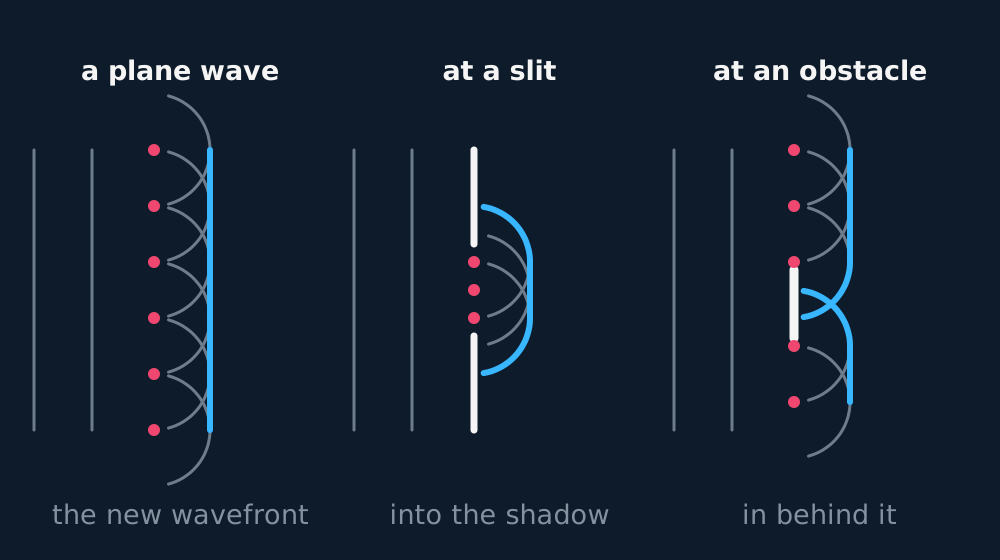
Three panels. In the first, a plane wavefront carries a row of dots, each with a wavelet arc drawn round it, and the arcs share a straight tangent one radius further on, which is the next wavefront. In the second, a barrier leaves only a narrow gap, so the tangent curves round the two edge wavelets and into the region the barrier shades. In the third, an obstacle blocks the middle of the wavefront, and the wavelets from its two edges curl in behind it and overlap.
Now put a barrier with a gap in the way. The barrier does one thing to the construction: it deletes every wavelet source it covers, leaving only those inside the gap. Across the middle of the gap nothing has changed, because those wavelets still have neighbours on both sides and their envelope is still flat. At each edge, though, the last surviving wavelet has no neighbour beyond it, and so nothing buries its outer flank. The envelope has no choice but to wrap round that flank, into the region straight-line travel would have left dark. That wrapping is diffraction, and it is happening at the edges, which is why an edge on its own diffracts a wave just as a gap does.
As the aperture narrows towards one wavelength, fewer secondary wavelets contribute across it and the angular spread increases. When the aperture is comparable to the wavelength, diffraction is large. A gap many wavelengths across holds a long row of wavelet sources, most of them with neighbours on both sides, so the envelope has a long flat middle and only a slight curl at each edge and the wave carries on nearly straight. At a gap about one wavelength wide the envelope is close to a single circular wavelet, and the wave spreads into nearly every forward direction.
An obstacle is the same argument with the deletion in the middle instead of at the sides. The obstacle removes the wavelets across its own width, so the wavefront either side of it advances as usual, but the wavelets at the two exposed edges have nothing further in to bury their inner flanks and each curls into the shadow. If the obstacle is small compared with the two curls meet behind it and the shadow closes over completely, which is why a mooring post leaves no strip of still water downstream of it and why long-wave radio reaches around a hill.
The single-slit pattern
Shine monochromatic light, light of a single wavelength, through a slit not much wider than the wavelength, and the screen beyond shows more than a simple smear: a bright central maximum, then darkness, then much fainter fringes alternating with dark minima on each side.
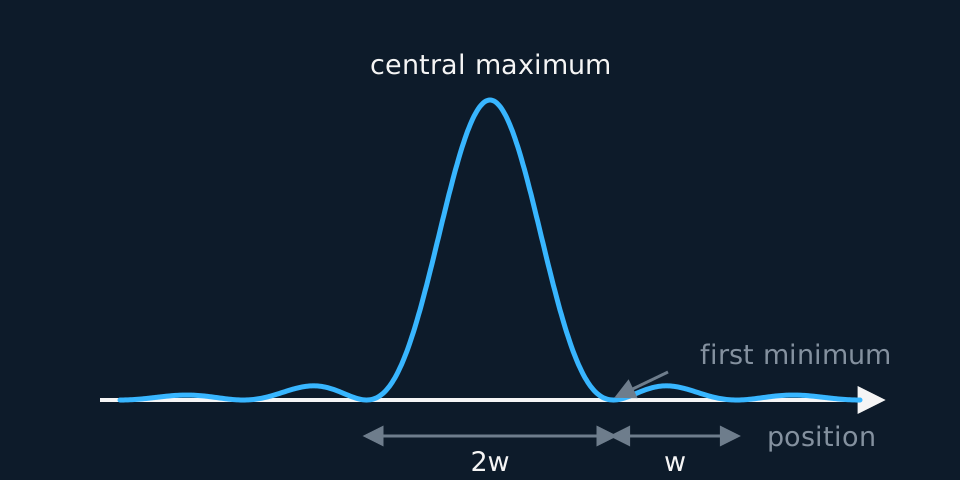
Two features identify the pattern in an exam. The central maximum is twice the width of every other maximum, and it is far brighter than any of them. No equation is required here; what you need is the shape and how it responds when something changes.
Make the slit narrower and the pattern spreads wider, though dimmer, because less light gets through. Use a longer wavelength and the pattern also spreads wider, since the gap is now closer to . Red light therefore makes a wider pattern than blue through the same slit.
White light
White light is every visible wavelength at once, and each wavelength builds its own pattern with its own width. All of them share the middle of the screen, so the centre stays white. Away from the centre the patterns separate: each side fringe becomes a little spectrum, with violet on its inner edge, closest to the centre, and red on its outer edge, because the longer wavelengths spread more. Further out still, the overlapping spectra wash out.
ASSESSMENT FOCUS
- “Explain when diffraction is most noticeable” asks for the comparison: the gap is about the same size as the wavelength. “A small gap” alone gives no comparison, since small compared with the wavelength and small compared with the apparatus are different conditions.
- Edexcel only: a Huygens answer scores in three moves. Every point on the wavefront is a source of secondary wavelets, the new wavefront is the envelope of those wavelets, and at an edge the outermost wavelet has no neighbour beyond it so the envelope bends into the shadow. Draw the wavelets as arcs of equal radius and the envelope as the curve touching them, and label both. The other boards want the spreading described, not constructed.
- A sketch of intensity against angle is judged on its shape. A central maximum twice the width of the side maxima and far brighter, dark minima between them, and the side peaks only a few per cent as tall. Narrow the slit and the whole pattern widens and dims. Lengthen the wavelength and it widens too.
- For white light, name both ends. A white central maximum, and side fringes drawn out into spectra with violet nearest the centre. Nothing here needs an equation, and the AQA booklet carries no single-slit formula, so a question that sends you hunting for one is a qualitative question.
CHECK YOURSELF
A red laser and a blue laser shine in turn through the same narrow slit. Which produces the wider central maximum, and why?
Show a hint
Which colour has the longer wavelength?
Show the answer
The red laser. Red light has a longer wavelength than blue, so the slit width is closer to for red light, and the diffraction is stronger.
Stronger diffraction means the light spreads through a larger angle beyond the slit, so every feature of the pattern, including the central maximum, is wider for red than for blue.
Every gap diffracts, and a gap near λ diffracts most.
WORKBOOK
Printable practice for this topic: original exam-style questions with room to work, and a fully worked answer book. Free to use; please do not redistribute or sell.
Or read them with their mark schemes on the diffraction and the single slit questions page.
USED LATER IN
CHECK YOUR PROGRESS
Rate how confident you feel with each objective for this lesson. Ratings are saved in this browser, on this device, unless you sign in.
- Describe diffraction at a gap, and state when the spreading is greatest.
- Use Huygens' construction, secondary wavelets and their envelope, to explain what a wave does at a slit and at an obstacle.
- Sketch the single-slit intensity pattern for monochromatic and for white light, and say how slit width and wavelength change it.
Open the full revision checklist to track your progress across the whole unit.