Physics › Astrophysics › Supernovae, neutron stars and black holes
Supernovae, neutron stars and black holes
A star several times the Sun's mass ends as a red supergiant whose core collapses at iron, leaving a neutron star or a black hole. A type Ia supernova is a different event, a detonating white dwarf whose peak absolute magnitude near −19.3 makes it a standard candle. The Schwarzschild radius 2GM/c² fixes the event horizon.
Choose your exam board to show the notes and questions relevant to your specification. You can change this setting at any time, and content for other boards remains available.
The HR diagram and stellar evolution, part 2 of 2. Part 1 is The HR diagram and the life of Sun-like stars.
Builds on The HR diagram and the life of Sun-like stars and Gravitational potential.
IN THIS TOPIC
- Describe the evolution of a massive star through the red supergiant and supernova stages to a neutron star or a black hole.
- Explain why a type Ia supernova works as a standard candle, read its light curve, and say what standardises it.
- Compare a gamma-ray burst's energy output with the Sun's.
- Recall neutron star properties and use the Schwarzschild radius for black holes.
COMMON MISCONCEPTION
Every supernova is the death of a star far heavier than the Sun.
A type Ia supernova is a white dwarf of about a solar mass, pushed past the Chandrasekhar limit by accretion from a companion. That standard trigger, not a giant star, is what makes its peak luminosity standard enough to survey distances with.
Supernovae and the standard candle
A sufficiently massive star evolves from the main sequence to a red supergiant. When fusion can no longer provide enough pressure to support the core, it collapses and the outer layers are expelled in a core-collapse supernova. A star several times the Sun's mass swells past the red giant stage into a red supergiant, at the cool end of the supergiant band on the HR diagram, while its core fuses on through carbon, oxygen and silicon as far as iron, where fusion stops releasing energy and the support fails. What the collapse leaves behind is a neutron star, or a black hole if the surviving core is heavy enough.
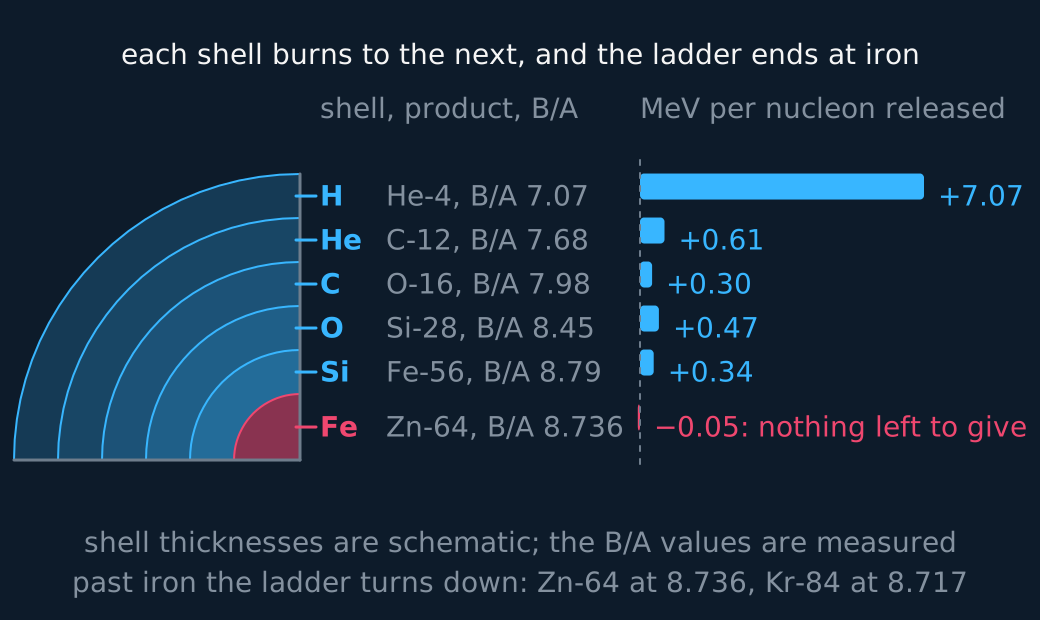
The explosion is what an observer actually sees of all that. The star brightens with astonishing speed, its absolute magnitude dropping by ten or more on the backwards scale within weeks, and for a while it outshines its entire galaxy. Keep the core-collapse label attached: the type of supernova used to measure distances has an entirely different origin.
Some collapsing giants also fire off gamma-ray bursts, flashes of gamma radiation lasting seconds to minutes and detectable across most of the observable universe. The spec asks you to set that output beside the Sun's, so carry the two numbers. A burst radiates of order 1045 J in a few seconds, quoting the isotropic-equivalent energy, the figure computed as if the burst shone equally in every direction when in reality it is beamed. The Sun pours out 3.9 × 1026 W, so across its whole ten-billion-year life it will manage roughly 1044 J. One burst therefore radiates more in a few seconds than the Sun radiates in its whole lifetime.
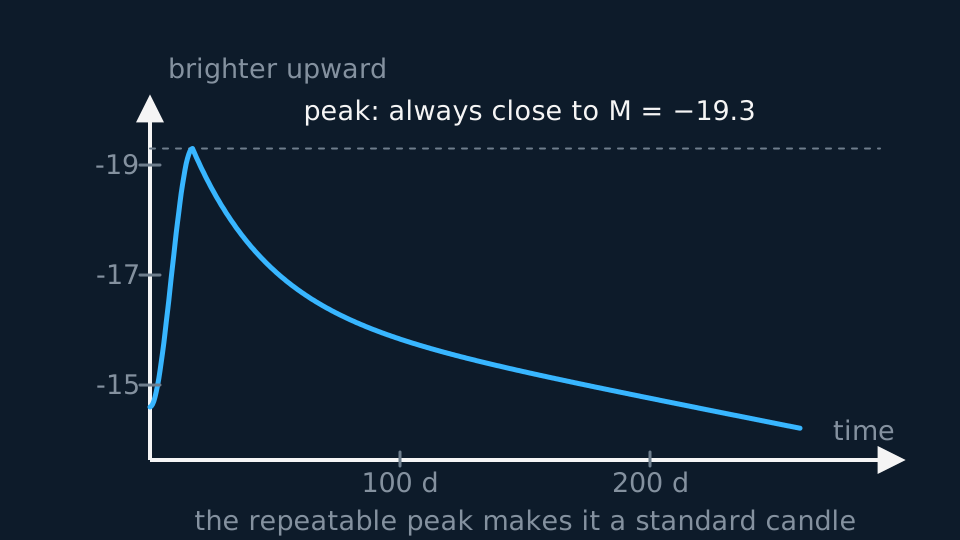
A type Ia supernova has a different origin. No massive star is involved at all. A white dwarf in a binary system detonates as a runaway thermonuclear explosion, and the fuel is broadly similar every time, a carbon-oxygen dwarf igniting through a limited set of routes, more than one of which is still argued over. That is why the peaks come out alike, near absolute magnitude −19.3, without being identical. Any object of known absolute magnitude is a standard candle. Measure its apparent magnitude, run the distance modulus, and out comes the distance.
Two qualifications belong with that. The trigger is not settled. A dwarf may pull matter from an ordinary companion until it approaches the limit, or two white dwarfs may spiral together and merge, or a dwarf below the limit may be set off by a detonating skin of helium, and which route dominates is still argued over. Nor are the peaks identical. They scatter by a few tenths of a magnitude, and the fix comes from the light curve itself, since the brighter explosions fade the more slowly.
The decline rate over the first fortnight or so after the peak gives the true peak brightness of that particular explosion, which is how astronomers pull the scatter down to around a tenth of a magnitude. Type Ia supernovae are therefore standardisable candles rather than perfectly identical ones, and they are bright enough to serve as distance markers across billions of light years.
The same measurements produced a further result. In the late 1990s distant type Ia supernovae came out consistently fainter than their red shifts predicted, and within the standard cosmological model that means the expansion of the universe is accelerating, driven by something now labelled dark energy. The claim leans on type Ia explosions behaving the same way across cosmic history, once corrected, and questioning that uniformity is the heart of the controversy. The candle is only as reliable as that assumption.
WORKED EXAMPLE
The candle as a ruler
A type Ia supernova peaks at apparent magnitude +16.7. Taking its peak absolute magnitude as −19.3, find the distance to its galaxy.
m − M = 16.7 − (−19.3) = 36.0.
5 log(d/10) = 36.0, so log(d/10) = 7.2 and d = 10 × 107.2 = 1.6 × 10⁸ pc.
A hundred and sixty million parsecs, from one photometric measurement. Real work would first correct that −19.3 using the measured decline rate, which shifts the answer by a few per cent. This is how the accelerating universe was discovered, one exploding white dwarf at a time.
Neutron stars and black holes
Heavier cores leave denser remnants. Stars born with more than roughly eight solar masses, a model-dependent boundary rather than a sharp line, are the ones whose cores collapse this way. If the collapsing core is too massive to settle as a white dwarf, gravity crushes its protons and electrons together into neutrons, leaving a neutron star. Picture one or two solar masses compressed into a sphere roughly ten kilometres in radius, made almost entirely of neutrons, at the density of an atomic nucleus.
GUIDED PRACTICE
Nuclear matter by the teaspoon
A neutron star has mass 2.8 × 1030 kg, 1.4 solar masses, and radius 10 km. Find its density, and the mass of one teaspoonful, 5.0 × 10⁻⁶ m3.
Show the working
ρ = M / (4/3 πr3) = 2.8 × 1030 / (4.19 × 10¹²) = 6.7 × 10¹⁷ kg m−3.
One teaspoon holds 6.7 × 1017 × 5.0 × 10−6 ≈ 3 × 10¹² kg, three billion tonnes.
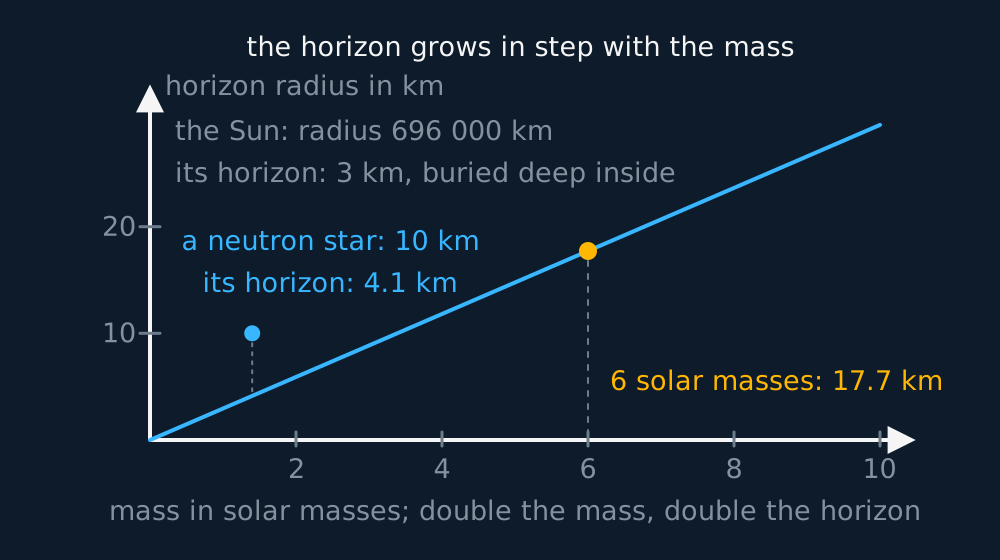
Past even that, nothing holds. If the remnant is massive enough, its escape velocity, from the gravitational fields unit, reaches the speed of light at a finite radius. Inside that boundary nothing, light included, can leave, and the object is a black hole. The boundary is the event horizon, and its radius, the Schwarzschild radius, follows from a Newtonian shortcut, setting the escape velocity equal to c, a heuristic that happens to land on the answer general relativity gives:
WORKED EXAMPLE
The Sun, hypothetically crushed
Find the Schwarzschild radius for one solar mass, 1.99 × 1030 kg.
Rs = 2GM/c2 = (2 × 6.67 × 10−11 × 1.99 × 1030) / (3.0 × 10⁸)2 = 3.0 km.
The Sun will never collapse this far, but the number sets the scale: to make any mass a black hole, squeeze it inside its Schwarzschild radius, about three kilometres per solar mass.
INDEPENDENT PRACTICE
The monster at the centre
Observations of stars orbiting the centre of our galaxy reveal a supermassive black hole of about 4 × 10⁶ solar masses. Find its Schwarzschild radius.
Show the working
Rs scales in direct proportion to M, so Rs = 3.0 km × 4 × 106 = 1.2 × 10¹⁰ m.
About seventeen times the radius of the Sun, for four million solar masses. Supermassive black holes like this one appear to sit at the centre of most large galaxies, ours included.
ASSESSMENT FOCUS
- The heavy-star path is the other half of the same question, so name each stage. Main sequence, red supergiant, core-collapse supernova, then a neutron star, or a black hole if the remnant core is heavy enough.
- Type Ia as a standard candle is a three-step argument, and all three steps score. A carbon-oxygen white dwarf detonating in a narrow range of conditions, so a peak absolute magnitude near −19.3, standardised by the light curve, so apparent magnitude plus distance modulus gives the distance. A type Ia is not a core-collapse event, so keep massive stars out of that answer.
- If a question asks how good the candle is, state the limitation. The peaks scatter by a few tenths of a magnitude, and the decline rate of the light curve is used to correct each one, so type Ia supernovae are standardisable rather than identical.
- For gamma-ray bursts, quote the comparison rather than waving at it. Around 1045 J in seconds against the Sun's 1044 J over its whole lifetime.
- Rs ≈ 2GM/c2 questions are usually substitution plus commentary. Quote the radius, then say what the event horizon is, the boundary from inside which not even light escapes.
CHECK YOURSELF
A supernova leaves a remnant core of mass 4.0 × 1030 kg, about 2.0 solar masses. If it settles as a neutron star of radius 11 km, find its density. If it instead collapses past its event horizon, find its Schwarzschild radius. Comment on each number.
Show a hint
Density needs a sphere's volume; the Schwarzschild radius is 2GM/c² straight in.
Show the answer
V = (4/3)πr3 = (4/3)π × (1.1 × 104)3 = 5.6 × 10¹² m3, so ρ = M/V = 4.0 × 1030 / (5.6 × 10¹²) ≈ 7 × 10¹⁷ kg m−3, the density of an atomic nucleus.
Rs ≈ 2GM/c2 = (2 × 6.67 × 10−11 × 4.0 × 1030) / (3.0 × 10⁸)2 = 5.9 km.
Both answers pack Sun-scale masses into city-scale sizes. The neutron star holds two solar masses at nuclear density, and squeezing that same core inside six kilometres would leave an object nothing can escape, light included.
Heavier stars die as core-collapse supernovae and leave a neutron star or a black hole.
A type Ia is a detonating white dwarf, standardised by its rate of decline.
Or read them with their mark schemes on the hr diagram and the life of sun-like stars questions page.
CHECK YOUR PROGRESS
Rate how confident you feel with each objective for this lesson. Ratings are saved in this browser, on this device, unless you sign in.
- Describe the evolution of a massive star through the red supergiant and supernova stages to a neutron star or a black hole.
- Explain why a type Ia supernova works as a standard candle, read its light curve, and say what standardises it.
- Compare a gamma-ray burst's energy output with the Sun's.
- Recall neutron star properties and use the Schwarzschild radius for black holes.
Open the full revision checklist to track your progress across the whole unit.