Physics › Gravitational fields › Gravitational potential
Gravitational potential
Gravitational potential is the work done per kilogram to bring a mass in from infinity. Gravity only attracts, so V = −GM/r is always negative. No work is done moving along an equipotential, which is why a circular orbit needs no thrust. Field strength is minus the gradient of V, and the area under g against r is ΔV.
Choose your exam board to show the notes and questions relevant to your specification. You can change this setting at any time, and content for other boards remains available.
Builds on Newton's law of gravitation and Conservation of energy.
IN THIS TOPIC
- Define gravitational potential with its zero at infinity, and use ΔW = mΔV.
- Use V = −GM/r and explain the significance of the negative sign.
- Explain why no work is done moving along an equipotential surface.
- Connect the g and V graphs, with g the negative gradient of V and the size of ΔV the area under g against r.
COMMON MISCONCEPTION
It takes energy to move anywhere in a gravitational field.
Only moving to a different potential costs or releases energy. Moving along an equipotential, at constant r, needs no work; work done equals mass times the change in potential.
Potential, measured from infinity
The gravitational potential V at a point is the work done per unit mass to bring a small mass from infinity to that point. The zero is at infinity, far from everything. In the radial field of a mass M,
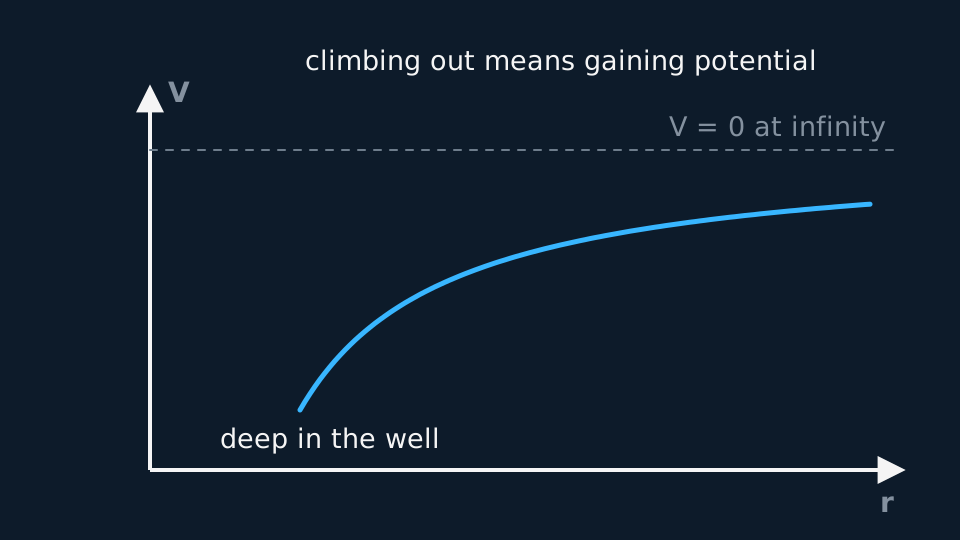
The negative sign follows from the definition. Gravity is attractive, so the field does the work as a mass moves in from infinity and no external energy is required; every point therefore has a potential below the zero at infinity. Moving away from a mass raises V towards zero. The corresponding graph is a potential well: a planet is at the bottom of one, and leaving it requires a change in potential equal to the full depth.
The potential difference between two points sets the energy transferred in moving between them, and for a mass m,
WORKED EXAMPLE
The potential at the Earth's surface
Find the gravitational potential at the Earth's surface (M = 5.97 × 1024 kg, R = 6.37 × 10⁶ m).
V = −GM/r = −(6.67 × 10−11 × 5.97 × 1024)/(6.37 × 106).
V = −6.3 × 10⁷ J kg−1, so each kilogram at the surface is 6.3 × 10⁷ J below the zero at infinity.
The magnitude gives the physical meaning: 6.3 × 10⁷ J is the work per kilogram that would have to be supplied to move a mass from the surface to infinity.
Equipotential surfaces
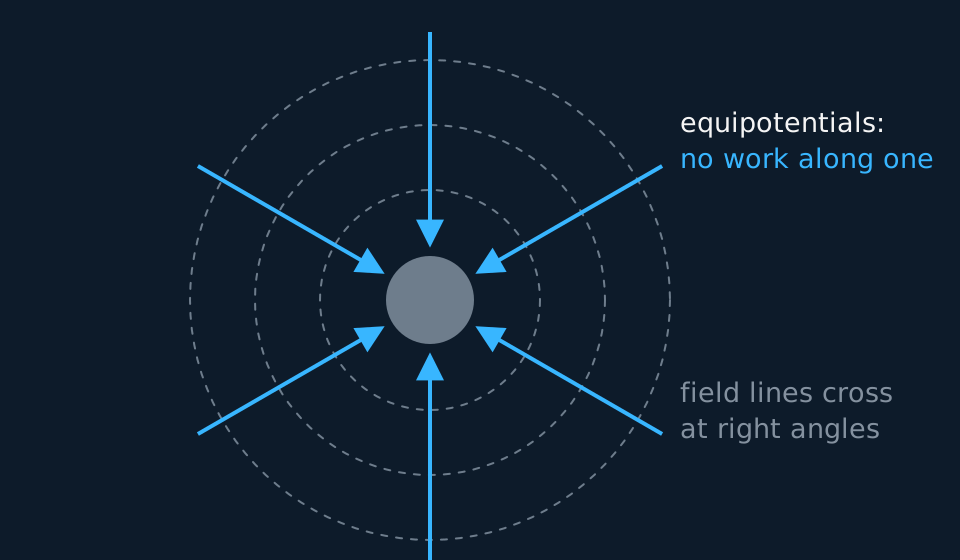
Surfaces of constant potential, equipotentials, surround a mass in the way contour lines surround a hill, and they always cross the field lines at right angles. Moving along an equipotential produces no change in V, so no work is done. A satellite in a circular orbit stays on one equipotential, so gravity does no work on it over an orbit and no thrust is needed to maintain the orbit. Work is done only when a mass moves between equipotentials.
Relating the g and V graphs
Two relations connect the graphs of g and V against r. Field strength is the negative gradient of the potential,
so a steep potential curve corresponds to a strong field, and the minus sign gives the direction: the field points towards decreasing potential. The relation also works in the other direction.
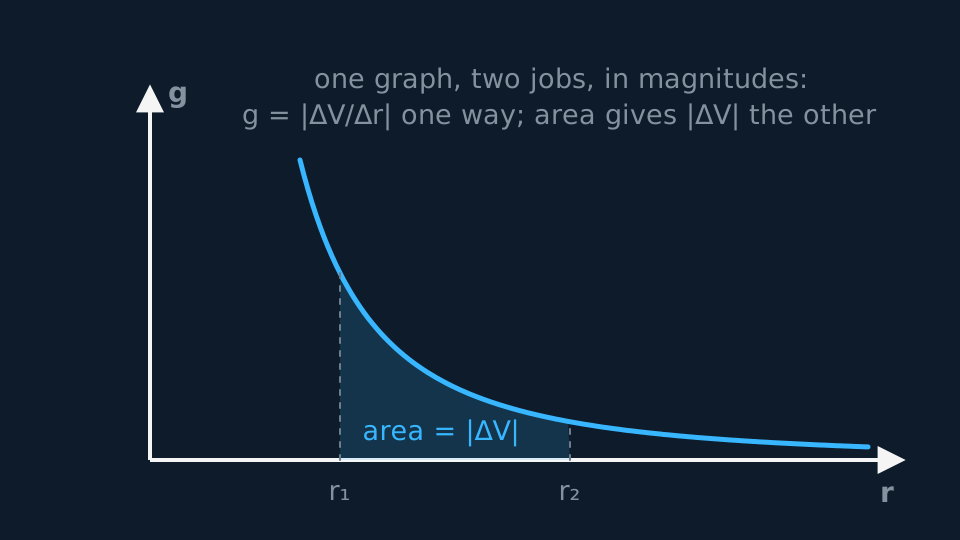
The magnitude of the potential difference between two distances is the area under the g against r graph between them, with g plotted as a positive magnitude. Gradient gives field strength and area gives potential difference, the same pairing as for motion graphs.
GUIDED PRACTICE
Field strength from a potential gradient
Near the surface, the potential changes from −6.253 × 10⁷ to −6.185 × 10⁷ J kg−1 over a climb of 70 km. Find the field strength from the potential gradient.
Show the working
g = |ΔV/Δr| = (6.8 × 10⁵)/(7.0 × 104) = 9.7 N kg−1, the magnitude of the potential gradient.
The value is just below 9.81, as expected for an average taken over a climb above the surface, where the field is weakening with height.
ASSESSMENT FOCUS
- Define V with both parts: work done per unit mass, brought from infinity. Both are required for the mark.
- The negative sign has a standard explanation: gravity attracts and the zero is at infinity, so every real location has a potential below zero. Learn it as one sentence.
- No work is done moving along an equipotential. A circular orbit is the standard example, and “why does the satellite need no fuel to maintain its speed?” is the same fact asked another way.
- ΔW = mΔV carries signs. Moving outward makes ΔV positive, so work must be supplied; moving inward makes it negative, and the field does the work.
- The two graph relations carry structured marks: g is minus the gradient of V against r, and the magnitude of ΔV is the area under g against r. Quote whichever the data supports.
- Potential and potential energy are different quantities. V is per unit mass, in J kg−1; the potential energy of a mass m at that point is mV, in joules. Check the unit of the answer against the quantity asked for.
CHECK YOURSELF
At the Earth's surface V = −6.25 × 10⁷ J kg−1, and at a satellite's orbit V = −0.94 × 10⁷ J kg−1. Find the energy needed to lift a 1200 kg satellite between the two, ignoring its kinetic energy.
Show a hint
The energy needed is m times the potential difference.
Show the answer
ΔV = (−0.94 × 10⁷) − (−6.25 × 10⁷) = +5.31 × 10⁷ J kg−1. The satellite moves outward, so ΔV is positive.
= 1200 × 5.31 × 107 = 6.4 × 10¹⁰ J.
That is 6.4 × 10¹⁰ J for the change in potential energy alone, before any orbital kinetic energy is supplied.
Potential is the work per kilogram to arrive from infinity, and it is always negative.
Gradient gives g from V; area gives ΔV from g.
WORKBOOK
Printable practice for this topic: original exam-style questions with room to work, and a fully worked answer book. Free to use; please do not redistribute or sell.
Or read them with their mark schemes on the gravitational potential questions page.
WHERE TO GO NEXT
- Gradients and areas under graphs is the maths this lesson leans on, worked through step by step.
CHECK YOUR PROGRESS
Rate how confident you feel with each objective for this lesson. Ratings are saved in this browser, on this device, unless you sign in.
- Define gravitational potential with its zero at infinity, and use ΔW = mΔV.
- Use V = −GM/r and explain the significance of the negative sign.
- Explain why no work is done moving along an equipotential surface.
- Connect the g and V graphs, with g the negative gradient of V and the size of ΔV the area under g against r.
Open the full revision checklist to track your progress across the whole unit.