Physics › Electricity › Charge carriers, drift speed and resistance
Charge carriers, drift speed and resistance
Delocalised electrons carry the current in a metal and ions of both signs carry it in an electrolyte, and I = nAvq gives the drift speed. Those carriers crawl at a fraction of a millimetre per second while the field that starts them arrives at nearly the speed of light. Resistance is defined as V/I.
Choose your exam board to show the notes and questions relevant to your specification. You can change this setting at any time, and content for other boards remains available.
Watch Current, charge and the direction problem on the InkPhysics YouTube channel
Current, charge and the direction problem, part 2 of 2. Part 1 is Current, charge and potential difference.
IN THIS TOPIC
- Name the carriers in each case: delocalised electrons in a metal, ions of both signs in an electrolyte.
- State R = V/I as a definition, and distinguish conventional current from electron drift.
- Relate current to carrier number density and drift speed with I = nAvq.
COMMON MISCONCEPTION
The current arrows show which way the electrons go.
Conventional current is defined from + to −, a convention fixed before the electron was known. In a metal the charge carriers are electrons, which drift the opposite way.
The direction problem
In the 1750s Benjamin Franklin named the two kinds of charge long before anyone knew what moved in a wire. The electron was not discovered for another 140 years, and it turned out to carry the charge his scheme calls negative, so in a metal the moving particles drift against the marked direction. By then every rule and diagram had been built on the convention, and it was retained. Conventional current is the defined direction of positive-charge flow, and it applies to every circuit law whatever the carriers are.
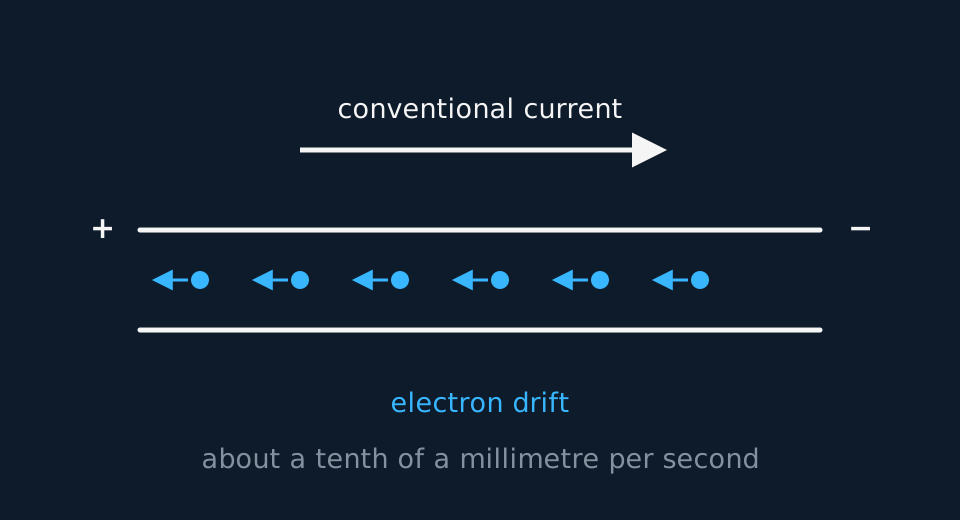
So conventional current runs from + to − around the outside of a circuit, and that is the direction every arrow and every circuit law uses. The electrons, the carriers actually moving in a metal, drift from − to +. Both statements hold at the same time, so label each one with the quantity it describes.
The electrolyte is the place where the marked direction and the moving particles agree. Inside the liquid the positive ions drift towards the negative electrode, which is the direction the current arrow claims, and the negative ions drifting the opposite way count the same way round. It is the metal, with nothing free to move in it but electrons, where the carriers travel against the marked direction.
Drift speed and signal speed are different quantities. Electrons drift at a fraction of a millimetre per second, but the electric field that sets them moving is established around the circuit at close to the speed of light, so a lamp lights as soon as the switch is closed.
The drift equation
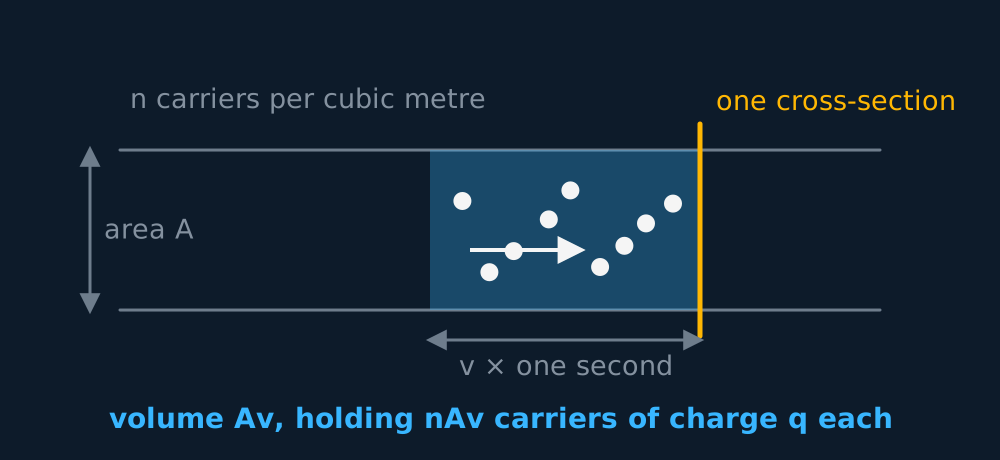
A current of several amperes is possible at drift speeds well below a millimetre per second because the number of carriers is very large: a copper wire holds around 1029 free electrons per cubic metre. The link between drift speed and current is
where n is the number density of charge carriers, the count per cubic metre, A is the cross-sectional area of the wire, v is the drift speed and q is the charge on each carrier. The logic takes one sentence. In one second every carrier within a distance v of a chosen cross-section reaches it, that slab of wire has volume Av and holds nAv carriers, so the charge passing per second is nAvq.
WORKED EXAMPLE
Drift speed in a copper wire
A copper wire of cross-sectional area 1.0 mm2 carries 5.0 A. Copper has n = 8.5 × 1028 m−3. Find the drift speed.
Rearrange to v = I/nAq, and put the area into square metres, A = 1.0 × 10⁻⁶ m2.
v = 5.0 / (8.5 × 1028 × 1.0 × 10−6 × 1.60 × 10−19) = 3.7 × 10⁻⁴ m s−1.
About a third of a millimetre per second. The current is large because n is large, not because the carriers move quickly.
Three consequences follow from the same equation. Halving the area doubles the drift speed needed to carry the same current. A filament reaches a much higher temperature than its leads because the current is the same throughout a series path, so the power I2R is greatest where R is greatest, which is the long thin strand of high-resistivity alloy. In a semiconductor n is smaller by roughly a factor of 109, so the same current requires a drift speed about 109 times greater.
Resistance, defined
Resistance is defined as the pd across a component divided by the current through it.
Its unit is the ohm, one volt per ampere. This is a definition, not a law: it does not require the ratio V/I to stay constant when conditions change, and for most components it does not. The next lesson covers which components keep the ratio fixed.
GUIDED PRACTICE
A heater's resistance
A mains heater draws 8.5 A from a 230 V supply. Find its resistance from the definition.
Show the working
R = V/I = 230/8.5 = 27 Ω.
This ratio applies at one operating point, and here that point is the element at its working temperature. Measured cold, the same element has a much lower resistance.
INDEPENDENT PRACTICE
A lightning bolt's current
A lightning stroke transfers about 5 C of charge in roughly 100 μs. Estimate the current.
Show the working
I = Q/t = 5/(1.0 × 10−4) = 5 × 10⁴ A.
Fifty thousand amperes, from the same definition I = Q/t used for a torch bulb. A current of this size heats the air in the channel so rapidly that it expands outwards, producing thunder.
ASSESSMENT FOCUS
- State each direction with the quantity it belongs to: conventional current runs + to −, electron flow runs − to +. Label the arrow rather than leaving it unmarked.
- When asked what is moving, name the carrier for that material: delocalised electrons in a metal, and ions of both signs drifting in opposite directions in an electrolyte, with the two contributions adding. “Electrons” is not a correct answer for an electrolyte.
- I = nAvq is used by OCR A and CIE and is not on the AQA specification. Give the physical meaning of n as well as substituting into the equation.
- R = V/I is a definition and not a law, so it holds at every operating point of every component. What it does not promise is that the ratio stays the same when the conditions change.
CHECK YOURSELF
A copper wire and a semiconductor strip of the same cross-sectional area carry the same current. Copper has about 1029 free electrons per cubic metre and the semiconductor about 1020 carriers per cubic metre, each of charge e. (a) State which carriers drift faster, and by roughly what factor. (b) A student says the lamp at the end of the copper wire cannot light until an electron has travelled from the switch to it. Say what is wrong with that.
Show a hint
In I = nAvq, which of the four quantities is the same for both and which is not?
Show the answer
(a) I, A and q are the same for both, so nv must be the same, and v is inversely proportional to n. The semiconductor's carriers are about 109 times fewer, so they drift about 109 times faster.
(b) The drift speed is a fraction of a millimetre per second, so a single electron would take hours to cover the distance. What travels quickly is the electric field that sets every electron in the wire moving, established around the circuit at close to the speed of light, so the electrons already sitting in the lamp start to move almost at once.
Drift speed and signal speed are different quantities, and confusing them is what makes the slow crawl of the electrons look impossible.
Conventional current is the direction of positive-charge flow, from + to −.
In a metal the electrons drift in the opposite direction.
Both statements hold at once, so label which quantity each direction describes.
Or read them with their mark schemes on the current, charge and potential difference questions page.
CHECK YOUR PROGRESS
Rate how confident you feel with each objective for this lesson. Ratings are saved in this browser, on this device, unless you sign in.
- Name the carriers in each case: delocalised electrons in a metal, ions of both signs in an electrolyte.
- State R = V/I as a definition, and distinguish conventional current from electron drift.
- Relate current to carrier number density and drift speed with I = nAvq.
Open the full revision checklist to track your progress across the whole unit.