Physics › Magnetic fields › Magnetic flux density and the force on a wire
Magnetic flux density and the force on a wire
The motor effect is the sideways force on a current-carrying wire in a magnetic field, F = BIl for a wire at right angles to the field. Fleming's left-hand rule gives the direction, and rearranging to B = F/Il defines magnetic flux density and the tesla. In the required practical, a top-pan balance measures the force.
Choose your exam board to show the notes and questions relevant to your specification. You can change this setting at any time, and content for other boards remains available.
Builds on The field concept and Current, charge and potential difference.
IN THIS TOPIC
- Use F = BIl for a wire perpendicular to the field.
- Use F = BIl sin θ where the wire lies at an angle θ to the field.
- Apply Fleming's left hand rule to find the direction of the force.
- Define magnetic flux density and the tesla.
- Describe the required-practical measurement of the force with a top-pan balance.
COMMON MISCONCEPTION
Fields always push along their field lines.
The magnetic force does not act along the field lines: it acts at right angles to both the field and the current, as Fleming's left-hand rule shows.
A sideways force
A gravitational field exerts a force on a mass along the field lines, and an electric field exerts a force on a charge along the field lines. A magnetic field differs in two ways: it exerts a force only on moving charge, that is on a current, and that force acts at right angles to both the current and the field. For a straight wire of length l carrying current I across a field of flux density B, the magnitude is
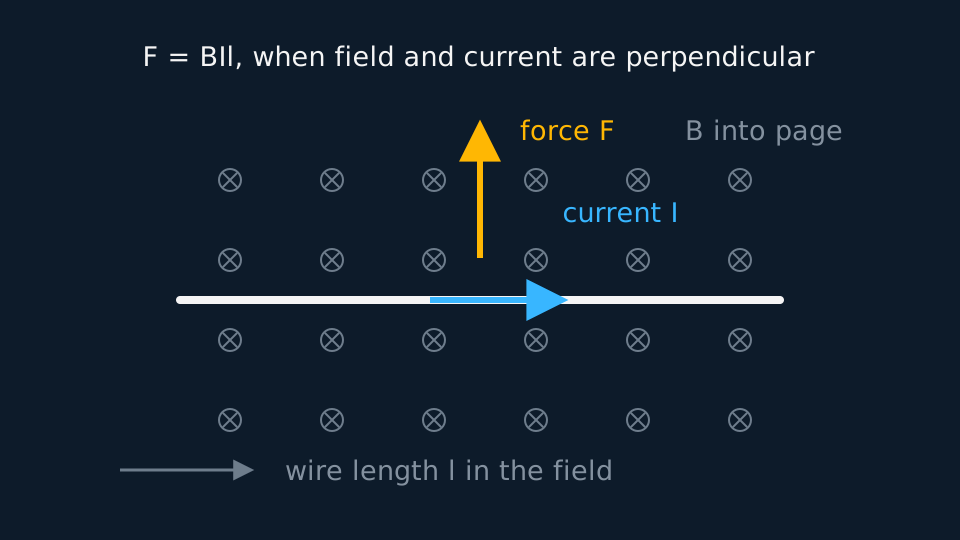
valid when field and current are perpendicular. Direction comes from Fleming's left hand rule. First finger along the Field, seCond finger along the Current, thuMb for the Motion, which is the force, all three held at right angles to one another. Diagrams handle the third dimension with the standard symbols, a circled cross for a field into the page and a circled dot for one coming out.
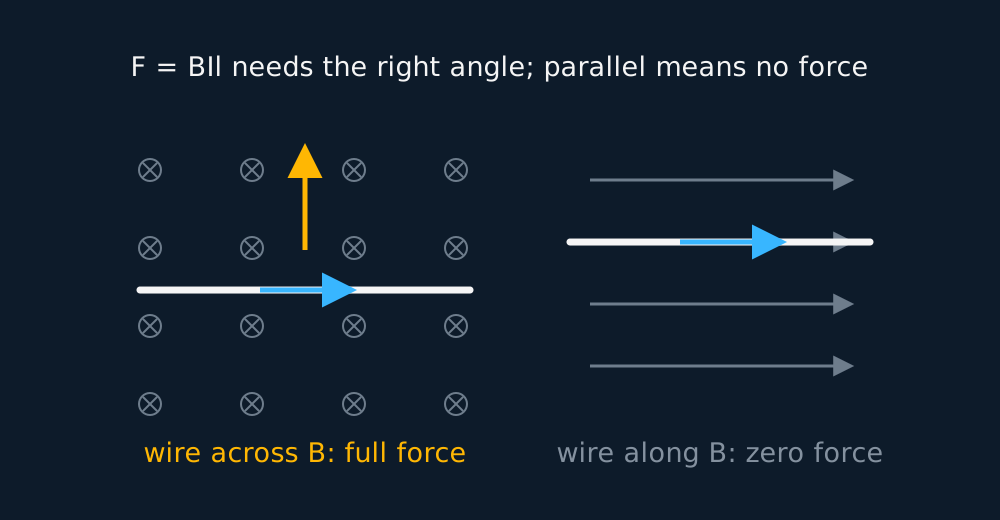
The perpendicular condition is essential. A wire lying along the field experiences no force, and at intermediate angles only the component of the field perpendicular to the wire contributes. A magnetic field never exerts a force along its own field lines.
AQA examines the perpendicular case only, and prints F = BIl on its data booklet. Three boards also require the general case, with θ the angle between the wire and the field,
OCR and Edexcel print this form; CIE does not, so on CIE it is a recall item. It adds no new physics: B sin θ is the component of the field perpendicular to the wire, so θ = 90° gives sin θ = 1 and returns F = BIl, while θ = 0 gives zero for a wire lying along the field.
Flux density, and the tesla
Rearranging the force law defines the field strength. The magnetic flux density B is the force per unit current per unit length of perpendicular wire, B = F/Il, and the unit follows from that definition. One tesla is the flux density that gives a force of one newton on each metre of wire carrying one ampere at right angles to the field. One tesla is a large field: laboratory magnets are in the tens of milliteslas, and the Earth's field is a few hundredths of a millitesla.
WORKED EXAMPLE
Measuring B with a wire
A wire carrying 2.5 A has 8.0 cm inside a magnetic field, at right angles to it, and feels a force of 0.012 N. Find the flux density.
Rearrange the defining equation to B = F/Il.
B = 0.012/(2.5 × 0.080) = 0.060 T.
Sixty milliteslas is typical of a laboratory magnet, and the calculation is the definition of the tesla applied in reverse: one newton per ampere per metre of perpendicular wire.
The patterns currents make
The force law needs a field to exist in the first place, and currents make their own. Two patterns cover nearly everything you will meet, the field of a straight wire and the field of a wire wound into a solenoid.
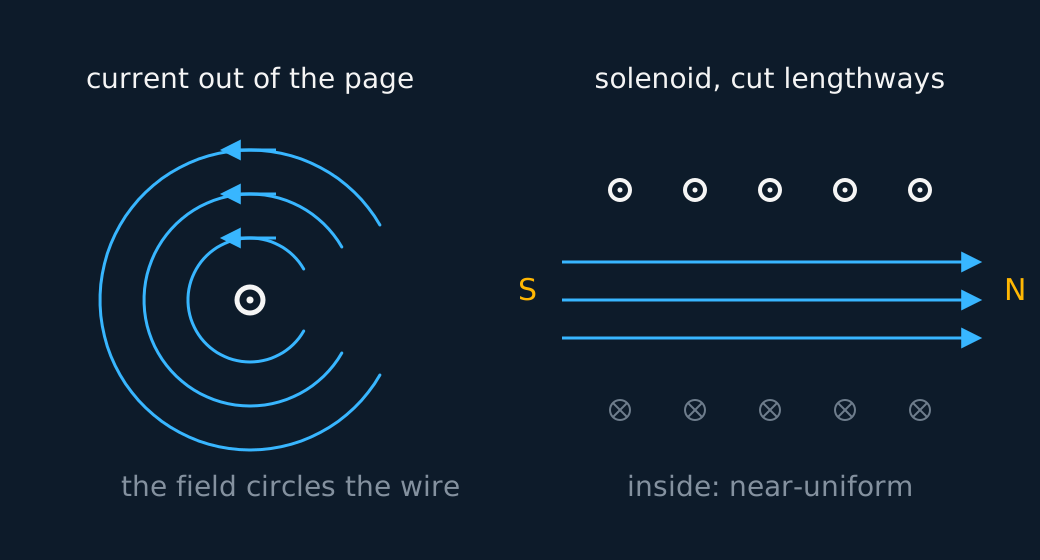
Two parallel current-carrying wires exert forces on each other, and the field patterns explain how. Each wire lies in the circular field of the other, so each experiences F = BIl. Currents flowing the same way attract and opposite currents repel, as applying the left-hand rule to either wire confirms. CIE names this effect, and it was formerly used to define the ampere.
Both patterns are read with the right-hand grip rule. Grip a straight wire with the thumb along the conventional current and the fingers curl the way the field circles it, densest close to the wire and weakening with distance. Curl the fingers the way the current circulates around a solenoid instead, and the thumb points along the core field, out of the north end. An iron core strengthens the field enormously, which is the working principle of the electromagnet.
CIE requires a third pattern to be sketched, the flat circular coil, whose field is intermediate between the other two. Take a single loop lying in the plane of the page. Each short section of the loop has its own circular field by the grip rule, and inside the loop those contributions all point the same way, so the field passes through the centre of the coil, where it is straightest and strongest, then spreads out and returns around the outside. The pattern is that of a short bar magnet, with one face of the coil north and the other south. Curling the fingers in the direction of the current makes the thumb point out of the north face, using the same grip rule.
Required practical 10, weighing a force
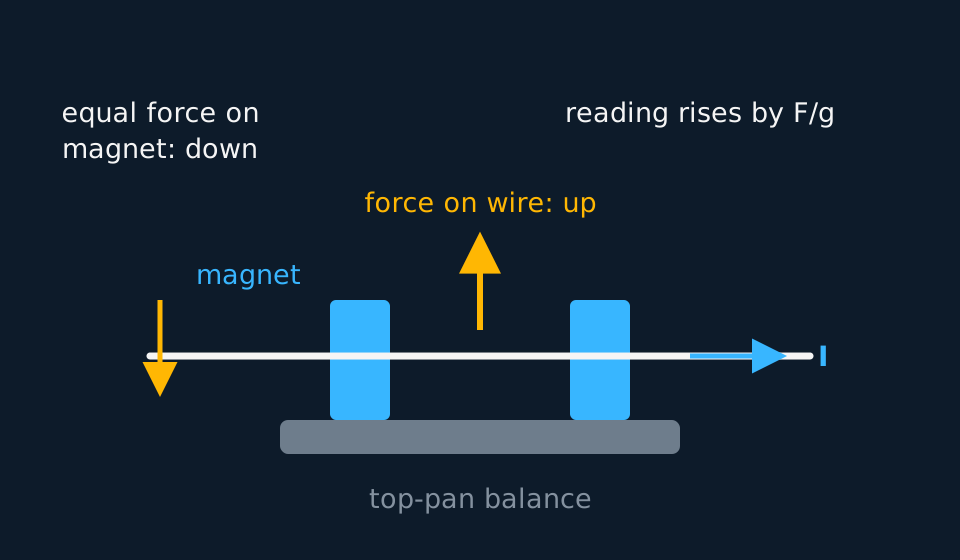
The tenth required practical measures the force with nothing more exotic than a top-pan balance. A magnet sits on the balance and a stiff wire is clamped, separately, between its poles. Switch the current on and the field pushes the wire, say upward; by Newton's third law the wire pushes the magnet downward with an exactly equal force, and the balance reading rises by F/g. Varying the current, the wire length in the field, and the flux density then tests each proportionality in F = BIl in turn, with each change in reading converted from grams back to newtons.
GUIDED PRACTICE
Predict the balance
In the RP10 arrangement, the field is 0.060 T, the wire carries 4.0 A, and 5.0 cm sits in the field. Predict the change in the balance reading, in grams.
Show the working
F = BIl = 0.060 × 4.0 × 0.050 = 0.012 N, pressing on the magnets by Newton's third law.
The balance reads mass, so Δm = F/g = 0.012/9.81 = 1.2 × 10⁻³ kg, a change of 1.2 g, which is readable on a balance resolving 0.01 g.
ASSESSMENT FOCUS
- F = BIl applies to the perpendicular arrangement, so state that condition when quoting it, and give zero force without calculation for a wire lying along the field.
- CIE, Edexcel and OCR all set the general F = BIl sin θ, with θ measured between the wire and the field. OCR and Edexcel print it on their formula sheets; CIE requires it from memory. AQA candidates need only the perpendicular form, which is on the booklet.
- Fleming's left-hand rule uses conventional current. If a question gives the direction of electron flow, reverse it before applying the rule.
- Define the tesla operationally, as one newton per amp per metre of perpendicular wire. The definition is the rearranged force equation put into words.
- Into-page and out-of-page symbols are examinable notation: a circled cross is into the page and a circled dot is out of it. Identify them before reasoning about directions.
- CIE asks for three field patterns from memory, so practise all three: concentric circles round a long straight wire, a field through the hole of a flat circular coil, and the bar-magnet field of a long solenoid. One right-hand grip rule reads every one of them.
- In the balance practical, name Newton's third law: the force on the magnet is the equal and opposite partner of the force on the wire, and the reading changes by F/g.
CHECK YOURSELF
A wire carries 3.0 A at right angles across a field of 0.20 T, with 5.0 cm of the wire in the field. Find the force, and the change in reading of a balance supporting the magnet, in grams.
Show a hint
Use F = BIl in base units, then convert the force to a mass with Δm = F/g.
Show the answer
= 0.20 × 3.0 × 0.050 = 0.030 N.
The magnet feels the equal and opposite partner force, so the reading changes by F/g = 0.030 / 9.81 = 3.1 × 10⁻³ kg, about 3.1 g.
Whether the reading rises or falls depends on the direction of the current; reversing the current reverses the change, which is a check that the effect is magnetic.
F = BIl sin θ; the force is perpendicular to both the current direction and the magnetic field.
One tesla exerts a force of one newton on each metre of a perpendicular wire carrying one ampere.
WORKBOOK
Printable practice for this topic: original exam-style questions with room to work, and a fully worked answer book. Free to use; please do not redistribute or sell.
Or read them with their mark schemes on the magnetic flux density and the force on a wire questions page.
WHERE TO GO NEXT
- Required practical 10: force on a current-carrying wire puts this topic in the lab, and the written papers ask about it.
- Significant figures, units and checking is the maths this lesson leans on, worked through step by step.
USED LATER IN
CHECK YOUR PROGRESS
Rate how confident you feel with each objective for this lesson. Ratings are saved in this browser, on this device, unless you sign in.
- Use F = BIl for a wire perpendicular to the field.
- Use F = BIl sin θ where the wire lies at an angle θ to the field.
- Apply Fleming's left hand rule to find the direction of the force.
- Define magnetic flux density and the tesla.
- Describe the required-practical measurement of the force with a top-pan balance.
Open the full revision checklist to track your progress across the whole unit.