Physics › Electronics › Radio propagation and data security
Radio propagation and data security
A radio wave's frequency sets its path: ground wave along the surface, sky wave refracted by the ionosphere, space wave line of sight. A satellite link needs separate uplink and downlink frequencies. Encryption hides the contents, authentication proves the sender, and a checksum does neither.
Choose your exam board to show the notes and questions relevant to your specification. You can change this setting at any time, and content for other boards remains available.
Data communication, part 2 of 2. Part 1 is Modulation and PCM.
IN THIS TOPIC
- Tell ground, sky and space waves apart by frequency, mechanism and range.
- Explain why a satellite link uses one frequency up and a different one down.
- Compare time-division with frequency-division multiplexing, and copper, fibre and radio as media.
- Say what encryption and what authentication each protect, and why a checksum is neither.
COMMON MISCONCEPTION
Encryption stops anyone sending a message that pretends to come from you.
Encryption hides what a message says, not who sent it. Someone who cannot read the traffic can still transmit their own and claim to be you; only authentication, a keyed check value the receiver recomputes, proves the sender held the key and that not one bit was altered on the way.
Ground wave, sky wave, space wave
Modulated or digitised, a radio signal still has to get there, and how it travels is decided by its frequency rather than by what is written on it. Below about 2 MHz the wave follows the ground. It induces currents in the conducting surface underneath, and that drag tilts the wavefront so the wave leans round the curve of the Earth, while its long wavelength diffracts it round hills and buildings. Those same induced currents are what attenuate it, since the ground takes energy from the wave, and it takes more the higher the frequency. Long wave reaches a thousand kilometres or so by this ground wave, medium wave a few hundred.
Between roughly 3 MHz and 30 MHz the wave leaves the ground and meets the ionosphere, layers of gas that solar ultraviolet has ionised from about 60 km upward. The free electrons there lower the refractive index, and since the ionisation increases with height the wave is refracted progressively, bending further and further until it is turned back towards the ground. It lands hundreds or thousands of kilometres away, and can reflect off the ground for a second hop. That is the sky wave, and it is how short wave crosses an ocean with no repeater in between.
Two consequences follow from where the sky wave comes from. The ionosphere is made by sunlight, so it thins at night and shifts with the solar cycle, and the frequency a station can use moves with it. And between the range where the ground wave fades out and the point where the sky wave first comes back down lies a skip zone that hears nothing at all.
Above about 30 MHz the ionosphere no longer bends the wave enough to return it and the ground wave has long since given up, so what is left travels in a nearly straight line from one aerial to the other. That is the space wave, and the horizon is its limit. Height is the only way to extend it, which is why television and FM masts stand on hills and why a hand-held marine radio reaches tens of kilometres and no further. The same failure to be refracted back is what allows a signal above 30 MHz to be sent straight out through the ionosphere to a satellite.
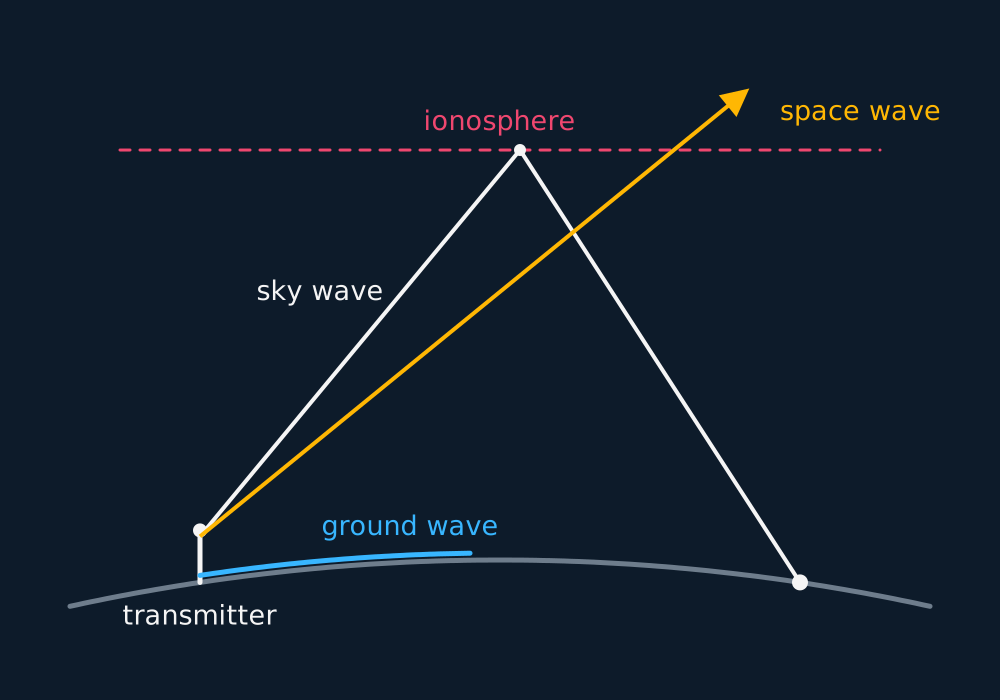
| frequencies | how it travels | range | |
|---|---|---|---|
| ground wave | up to about 2 MHz | follows the surface, diffracting round the curve and losing energy to the ground | hundreds of km, further at lower frequency |
| sky wave | about 3 to 30 MHz | refracted back by the ionosphere, sometimes in several hops | thousands of km, with a skip zone and a day-night change |
| space wave | above about 30 MHz | straight line between aerials, or straight out through the ionosphere | line of sight, so aerial height sets it |
Up to the satellite and back down
A communications satellite is a repeater in orbit. The earth station transmits on the uplink frequency, the satellite's transponder amplifies what it hears, shifts it to a different downlink frequency and sends it back, and both are far above 30 MHz so that the ionosphere lets them through rather than turning them round. Typical pairs are 6 GHz up with 4 GHz down, or 14 GHz up with 11 GHz down.
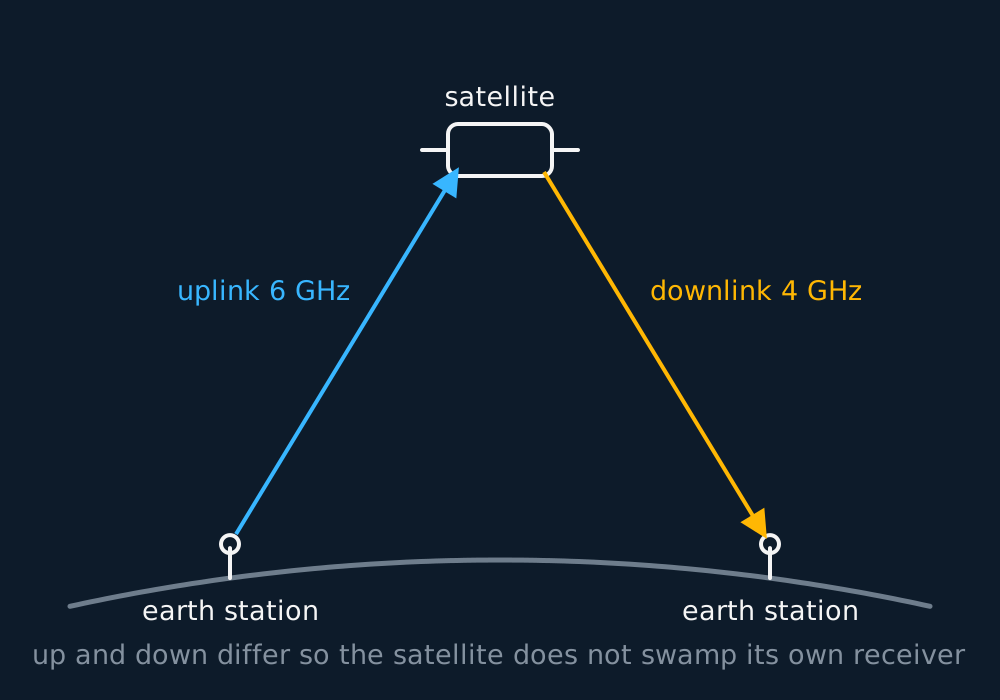
The two frequencies have to differ, and the reason is plain enough. The satellite receives microwatts and transmits watts from the same small structure, so if it retransmitted on the frequency it was listening to, its own output would swamp its own receiver and the transponder would oscillate, in the same way as a microphone placed in front of its own loudspeaker.
Which of the two is made the lower is a separate decision, and power settles it. Atmospheric attenuation depends on the band, and across the microwave bands these links use it worsens towards higher frequency, rain fade above all, while the satellite runs its transmitter on whatever its solar panels supply and the earth station can afford a large dish and a kilowatt. The weaker end of the link, the downlink, is therefore given the lower and less attenuated frequency.
WORKED EXAMPLE
The pause you can hear
A geostationary satellite sits 3.6 × 10⁷ m above the equator. Find the delay between a word leaving one earth station and arriving at another, and the gap a speaker hears before a reply comes back.
The signal climbs to the satellite and comes down again, so it covers 2 × 3.6 × 107 = 7.2 × 10⁷ m at 3.0 × 10⁸ m s−1.
t = (7.2 × 10⁷)/(3.0 × 108) = 0.24 s.
A reply makes the same trip, so the pause before an answer is about 0.48 s. That is long enough to hear, and it is why satellite telephone conversations tread on each other while a fibre call does not.
Sharing the channel, choosing the medium
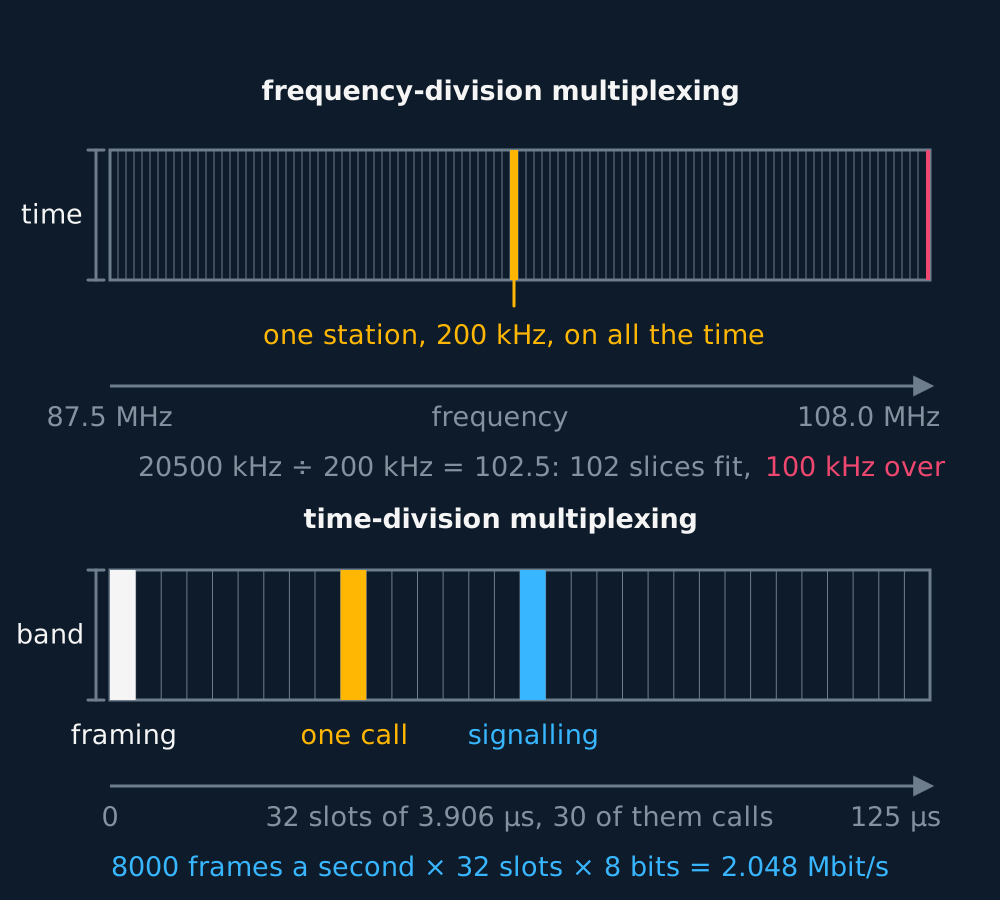
One cable or one band is always shared, and there are two ways to slice it. Frequency-division multiplexing gives each user a permanent slice of the spectrum, every broadcaster transmitting continuously on its own carrier, which is precisely how the radio dial works. Time-division multiplexing gives each user the whole channel for a brief repeating time slot. Digital signals suit TDM perfectly: each user is assigned a short repeating slot in a fixed frame, the calls take strict turns on the one channel, and because digital samples compress into brief bursts, thirty phone calls interleave without colliding.
| medium | attenuation | bandwidth | weaknesses and strengths |
|---|---|---|---|
| copper cable | high, repeaters every few km | modest, tens of MHz | picks up electrical interference and crosstalk; cheap and everywhere |
| optic fibre | very low, repeaters tens of km apart | enormous, many GHz | immune to electrical interference, harder to tap than copper or radio, light and thin |
| radio and microwave link | spreads and fades with distance and weather | limited by the allocated band | no cable to lay, reaches moving and remote users, but shared and interceptable |
Compare the three media through attenuation and bandwidth. Fibre loses least per kilometre, so its repeaters are furthest apart; it carries the most, and being an insulator carrying light it ignores electrical interference completely. Copper is the cheap incumbent for the last mile. Radio is the only choice when the receiver moves, and the drawback is a shared, weather-dependent medium in which whatever you transmit can be received by anyone.
INDEPENDENT PRACTICE
How many stations fit
The FM broadcast band runs from 87.5 MHz to 108.0 MHz, and each station is allocated 200 kHz of it. How many stations fit, and how many 9 kHz AM stations would the same span hold?
Show the working
The band spans 108.0 − 87.5 = 20.5 MHz = 20 500 kHz. At 200 kHz per station that is 20 500/200 = 102.5, so 102 stations.
At 9 kHz per station the same span would hold 20 500/9 ≈ 2277 stations.
Convert the megahertz span into kilohertz before dividing; leaving it in megahertz gives an answer a thousand times too small.
Who else is listening
A radio transmission reaches every receiver in range, a shared cable can be tapped anywhere along its length, and fibre, the hardest of the three to intercept, is difficult rather than impossible. No medium is secure in itself, so confidentiality and integrity have to be provided by the data.
Encryption is the first half of it. Before transmission the bit stream is combined with a key by a reversible rule, and what goes out carries the same information in a form that nobody without the key can read. The receiver holds the matching key and undoes the operation exactly, so the message arrives intact while an interceptor collects every bit and learns nothing from any of them. The security sits in the secrecy of the key, and the method itself is assumed to be public knowledge, since a rule kept secret only stays secret until somebody takes a receiver apart.
Authentication is the other half, and it answers a different question. Encryption stops an eavesdropper reading the traffic; it does nothing to stop somebody transmitting a message of their own and claiming to be you. So the sender computes a short check value from the whole message together with a secret key and sends it alongside, and the receiver recomputes it from what arrived. A match says two things at once: the message came from a holder of that key, and not one bit of it was altered on the way. A mismatch means one of those has failed, and the receiver throws the block away instead of acting on it.
Keep both apart from error checking. A parity bit or a checksum catches the accidental corruption a noisy channel causes, and it is designed to be easy to recompute, so anyone who deliberately alters the message simply recomputes the checksum to match. Only a key nobody else holds makes the check unforgeable, which is the difference between detecting an accident and defeating an opponent.
INDEPENDENT PRACTICE
Which half does which job
A remote sensor sends readings by radio to a control room. Say which of encryption and authentication defeats each of these: a rival who records the transmissions to learn the readings, and a saboteur who transmits false readings of their own. Then say why moving the link to optic fibre is not a substitute for either.
Show the working
The rival is reading traffic that is not theirs, so encryption is the answer: without the key the recorded bits carry nothing they can use.
The saboteur is not reading anything, they are writing. Encryption alone would let their transmission through, so this needs authentication, a keyed check value the control room recomputes and finds wrong.
Fibre only makes interception harder, and it does nothing about a false message injected at either end. It reduces the chance of an attack rather than removing what an attack could achieve, so the medium is a precaution and the key is the protection.
ASSESSMENT FOCUS
- Compare media through attenuation and bandwidth, in pairs. Fibre: least loss, widest band, unaffected by electrical interference. Give all three, each against the medium it is being compared with.
- Each propagation mode needs a frequency band and a mechanism, rather than a range on its own. Ground wave follows the surface below about 2 MHz, sky wave is refracted back by the ionosphere from about 3 to 30 MHz, space wave goes line of sight above 30 MHz.
- Uplink and downlink differ so that the satellite's own transmitter does not swamp its receiver, and the downlink is the lower of the two because the satellite is the weaker transmitter and low frequencies are attenuated less.
- Encryption hides the contents, authentication proves the sender and that nothing was altered. A parity bit or checksum finds accidental corruption and is neither of them.
CHECK YOURSELF
A signal is broadcast on a 200 kHz carrier and, from another mast, on a 95 MHz carrier. Name the propagation mode each relies on and give the rough range of each. The 95 MHz link is then sent instead by geostationary satellite: state why the uplink and downlink use different frequencies, and which is the lower. Finally, the operator wants the traffic kept private from anyone listening and safe from forged messages: name what each of those needs, and say why a checksum provides neither.
Show a hint
Below 2 MHz a wave follows the surface; above 30 MHz it goes line of sight or straight out. A satellite receives microwatts and transmits watts. Encryption and authentication answer two different threats.
Show the answer
At 200 kHz the wave travels as a ground wave, following the Earth's surface for a few hundred kilometres, with a sky wave off the ionosphere after dark. At 95 MHz it travels as a space wave, line of sight, so its range is set by the horizon and the mast's height, a few tens of kilometres.
The satellite's uplink and downlink differ so that its own powerful transmitter does not swamp the microwatts arriving at its receiver. The downlink is the lower frequency, because the satellite is the weaker transmitter and lower frequencies are attenuated less on the way down.
Keeping the traffic unreadable is encryption: the bits are combined with a key, so an interceptor collects them and learns nothing. Stopping a forged message is authentication: a keyed check value the receiver recomputes, which proves the sender held the key and that nothing was altered.
A checksum is designed to be easy to recompute, so anyone who alters the message simply recomputes it to match. Only a key nobody else holds makes the check unforgeable, which is why a checksum catches an accident but never defeats an opponent.
Ground wave follows the Earth's surface, sky wave is refracted back by the ionosphere, and space wave travels approximately line of sight and on out to a satellite.
Fibre loses least and is unaffected by electrical interference; anything transmitted can be intercepted, so confidentiality and integrity come from encryption and authentication rather than from the medium.
Or read them with their mark schemes on the modulation and pcm questions page.
CHECK YOUR PROGRESS
Rate how confident you feel with each objective for this lesson. Ratings are saved in this browser, on this device, unless you sign in.
- Tell ground, sky and space waves apart by frequency, mechanism and range.
- Explain why a satellite link uses one frequency up and a different one down.
- Compare time-division with frequency-division multiplexing, and copper, fibre and radio as media.
- Say what encryption and what authentication each protect, and why a checksum is neither.
Open the full revision checklist to track your progress across the whole unit.