Physics › Engineering physics › Angular momentum and rotational power
Angular momentum and rotational power
With no external torque acting, the angular momentum Iω stays constant, which is why a skater pulling her arms in spins faster than before. A torque acting for a time delivers an angular impulse equal to the change in Iω. Turning a shaft through an angle it does work Tθ, at a power Tω.
Choose your exam board to show the notes and questions relevant to your specification. You can change this setting at any time, and content for other boards remains available.
Torque, angular momentum and rotational power, part 2 of 2. Part 1 is Torque and angular acceleration.
Builds on Torque and angular acceleration and Momentum and impulse.
IN THIS TOPIC
- Use angular momentum Iω, conserve it when no external torque acts, and explain the classic cases.
- Apply angular impulse TΔt = Δ(Iω) when a torque acts for a time.
- Find work and power in rotation from W = Tθ and P = Tω.
COMMON MISCONCEPTION
A skater pulling in her arms spins faster because her muscles give her an extra twist.
No extra twist is added, and none could be: internal forces cannot change angular momentum. Pulling her arms in cuts I, and because Iω is conserved ω must rise. Her muscles supply work, which is why the kinetic energy rises, not momentum.
Angular momentum, and what conserves it
Momentum's rotational twin is angular momentum,
in kg m2 s−1 (equivalently N m s). Its importance comes from its conservation law. With no external torque, the total angular momentum of a system does not change. Internal forces, muscles, clutches, gravity acting at the axis, cannot alter it.
Now the skater. Spinning with arms out, she pulls them in. Her mass moves towards the axis, so I falls, and since Iω must stay fixed, ω rises. No twist was added anywhere. Her spin rate can triple without any torque at all.
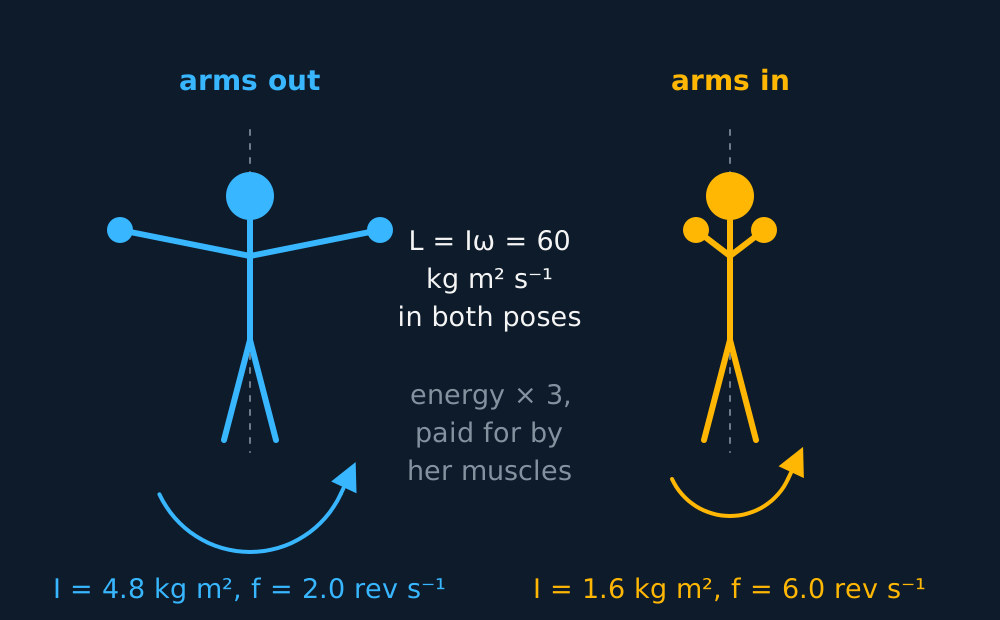
Angular momentum remains constant because no external torque acts. Pulling the arms inward requires work, so the skater's rotational kinetic energy increases. With Iω fixed, ½Iω2 can be written as half Iω times ω, and ω has risen, so the kinetic energy is larger; that extra energy is the work her muscles did pulling her arms inward against the spin. The same physics spins up a collapsing star. When a giant star's core shrinks to a neutron star a hundred thousand times smaller, I collapses, and rotation once a month becomes many times a second.
GUIDED PRACTICE
The skater in numbers
A skater spins at 2.0 rev s−1 with arms out, moment of inertia 4.8 kg m2. She pulls her arms in, reducing it to 1.6 kg m2. Find her new spin rate, and the factor her kinetic energy rises by.
Show the working
Iω conserved: 4.8 × 2.0 = 1.6 × f, so f = 6.0 rev s−1. Revolutions per second serve fine here, because only the ratio matters.
Ek = ½Iω2: the ratio is (1.6 × 6.02)/(4.8 × 2.02) = 3.0. Three times the energy, supplied by her own muscles doing work as they pull her arms in.
When a torque does act, it changes the angular momentum. Acting for a time Δt, it delivers an angular impulse:
the rotational twin of FΔt = Δ(mv). A small torque for a long time or a large torque briefly moves the same angular momentum, the reason a heavy flywheel is stopped gently over seconds rather than snatched to rest.
INDEPENDENT PRACTICE
Braking a flywheel
A flywheel of moment of inertia 0.90 kg m2 spins at 40 rad s−1. A brake pad applies a steady friction torque of 6.0 N m. Find the time it takes to stop.
Show the working
The momentum to remove is Δ(Iω) = 0.90 × 40 = 36 kg m2 s−1.
TΔt = Δ(Iω) gives Δt = 36/6.0 = 6.0 s. Half the torque would take twice as long, delivering the identical angular impulse either way.
Work, power and smoothing
A torque turning a shaft through angle θ does work
and delivered continuously that is a power
the rotational analogue of P = Fv, and the equation used for engine power. It is why a car's power and torque peak at different engine speeds, and why every quoted engine power implies a shaft speed alongside it.
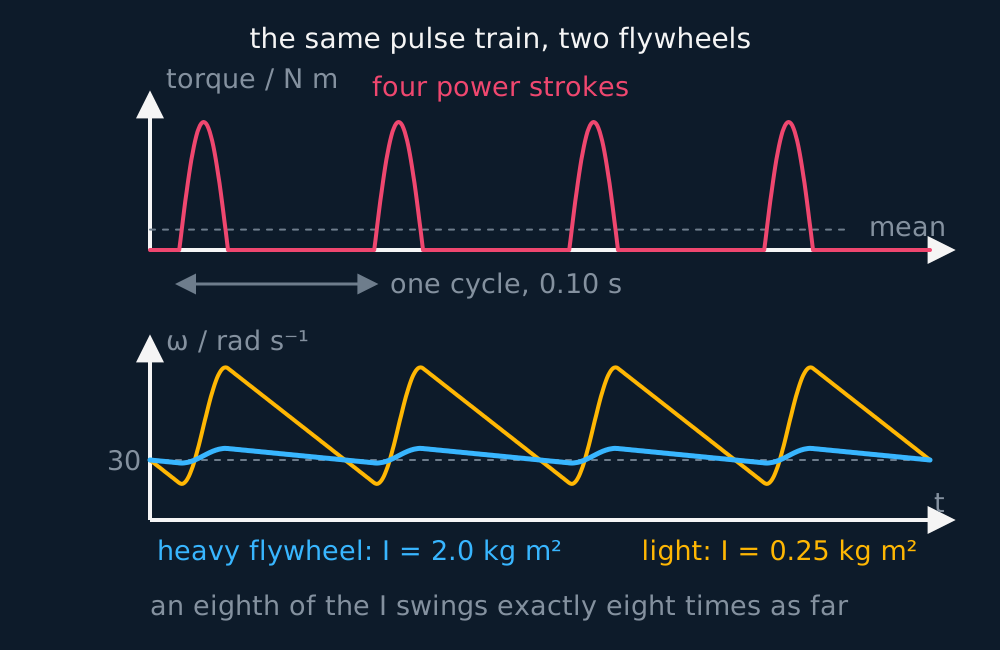
It also explains the flywheel's second job, smoothing. A piston engine delivers torque in pulses, one per power stroke, with gaps between. A flywheel on the crankshaft barely changes speed under these fluctuations, because its large I turns a torque pulse into a small change of ω. It absorbs angular momentum during each pulse and returns it through each gap, so the shaft the machinery drives turns nearly uniformly. The same principle applies to a coupling: connect a spinning shaft to a stationary one and both settle at a shared speed set by conservation of angular momentum, with some kinetic energy lost as heat in the slip.
WORKED EXAMPLE
Reading an engine's badge
An engine delivers 90 kW at 3000 revolutions per minute. Find the torque at that speed.
ω = 3000 × 2π/60 = 314 rad s−1.
T = P/ω = 90 000/314 = 287 N m.
Note the inverse relation. The same 90 kW at half the shaft speed would need double the torque, so gearboxes exist to trade ω for T while P, minus losses, passes through unchanged.
ASSESSMENT FOCUS
- Conservation answers are sentences first. No external torque acts, so Iω stays constant; I falls, so ω rises. Then, if asked about energy, the kinetic energy rises because the skater does work pulling mass inward.
- Angular impulse questions are momentum questions. Find Δ(Iω) first, then divide by the torque for the time or by the time for the torque.
- P = Tω needs ω in rad s−1, so convert rev min−1 before dividing. Finding a torque from a power quoted at a named rpm is the standard calculation here.
- Coupling problems conserve angular momentum, never kinetic energy. Find the shared ω from I1ω1 = (I1 + I2)ω, then show energy was lost if the question asks where it went.
CHECK YOURSELF
A spinning disc of moment of inertia 0.60 kg m2 rotating at 90 rad s−1 is lowered onto an identical-axis stationary disc of moment of inertia 0.30 kg m2, and friction brings them to a common speed. Find that speed, and the kinetic energy lost.
Show a hint
No external torque acts on the pair, so conserve Iω; then compare the two kinetic energies.
Show the answer
Angular momentum before: 0.60 × 90 = 54 kg m2 s−1. Shared afterwards by I = 0.90 kg m2, so ω = 54/0.90 = 60 rad s−1.
Ek before = ½ × 0.60 × 902 = 2430 J. Ek after = ½ × 0.90 × 602 = 1620 J.
Lost: 2430 − 1620 = 810 J, a third of the store, heating the slipping surfaces as they reach a shared speed. Angular momentum is conserved in the coupling; kinetic energy is not.
No external torque means Iω is fixed, whatever internal rearranging happens.
A torque acting for a time delivers TΔt of angular momentum, however the torque and the time trade off.
Work in rotation is Tθ and power is Tω, the rotational analogues of Fs and Fv.
Or read them with their mark schemes on the torque and angular acceleration questions page.
CHECK YOUR PROGRESS
Rate how confident you feel with each objective for this lesson. Ratings are saved in this browser, on this device, unless you sign in.
- Use angular momentum Iω, conserve it when no external torque acts, and explain the classic cases.
- Apply angular impulse TΔt = Δ(Iω) when a torque acts for a time.
- Find work and power in rotation from W = Tθ and P = Tω.
Open the full revision checklist to track your progress across the whole unit.