Physics › Mechanics › Momentum and impulse
Momentum and impulse
Collisions and explosions redistribute momentum (mass times velocity), and in a closed system the total before equals the total after. Kinetic energy is the quantity that need not be conserved, and that is what separates elastic from inelastic. Impulse is force times contact time, so for a given change in momentum, lengthening the contact lowers the force.
Choose your exam board to show the notes and questions relevant to your specification. You can change this setting at any time, and content for other boards remains available.
Builds on Newton's laws and the resultant force.
IN THIS TOPIC
- Calculate momentum as p = mv, and handle it as a signed number in one dimension.
- Apply conservation of linear momentum to collisions and to explosions, and to a two-dimensional collision by resolving into components.
- Derive Ek = p²/(2m) and use it to move between a momentum and a kinetic energy.
- Use F = Δ(mv)/Δt and impulse FΔt = Δ(mv), including the area under a force-time graph.
- Tell elastic from inelastic by comparing total kinetic energy before and after, and by comparing the relative speeds of approach and separation.
- Explain crumple zones, airbags and bent knees through contact time.
COMMON MISCONCEPTION
When something stops, its momentum simply vanishes.
Momentum does not vanish when something stops; it is transferred to another body. Momentum is conserved: only an external force can change the total momentum of a system.
Momentum, and the general second law
The momentum of an object is
a vector pointing along the velocity, measured in kg m s−1. Newton's second law, stated properly, is a statement about momentum. The resultant force equals the rate of change of momentum.
For constant mass this collapses to the familiar F = ma, so the shortcut is safe there. The momentum form is the more general statement, and it applies to a fixed collection of matter, which is where care is needed.
A rocket needs care. Applying F = Δ(mv)/Δt to the rocket alone, with m falling as fuel burns, gives a wrong answer, because the exhaust leaves carrying momentum with it. Take the rocket and its exhaust together instead. That system has no external force on it in deep space, so its total momentum is conserved, and the momentum the exhaust takes backwards is the momentum the rocket gains forwards. Conservation handles the whole problem, and the shrinking mass never has to go into an equation at all.
Conservation
In a closed system, one whose external forces contribute no net impulse over the interval, total momentum is conserved. The total before equals the total after, in every collision and every explosion. In practice the impact forces dwarf anything external, which is why the law holds across the instant of a crash even with friction and gravity still acting.
During a collision, the two bodies exert equal and opposite forces for the same time. Their impulses, and therefore their changes in momentum, are equal and opposite, so total momentum is conserved in a closed system.
Watch Conservation of momentum and collisions on the InkPhysics YouTube channel

Describe the drawing
Above: the 2.0 kg trolley at 1.5 m/s couples with the parked 1.0 kg and the pair moves off at 1.0 m/s, exactly what conservation demands; the amber ledger never flinches. Below, the film in reverse spirit: a resting pair springs apart, the light trolley leaving twice as fast as the heavy one, and the two momentum arrows grow equal and opposite so the sum stays pinned at zero. Kinetic energy is not conserved in the coupling; momentum is, both times.
A one-dimensional collision turns momentum into a signed number. Choose a positive direction in the first line and let the signs do the vector work for you. When a moving object “loses” its momentum by stopping, the momentum is transferred to whatever exerted the stopping force, often the Earth, whose large mass makes the resulting change in velocity negligible.
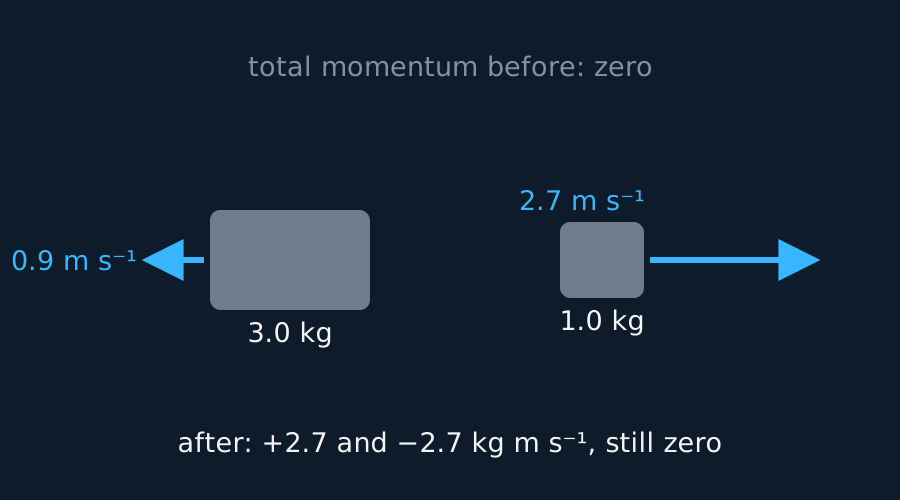
The same law applies to explosions. A stationary system has zero total momentum, so once it flies apart the fragments' momenta still have to sum to zero. Fire a bullet one way and the rifle recoils the other, because zero must stay zero.
WORKED EXAMPLE
A skater's recoil
A stationary 60 kg skater throws a 4.0 kg ball forward at 5.0 m s−1. Find the skater's recoil velocity.
The system starts at rest with zero total momentum, and no external horizontal force acts, so zero is what it must stay.
After the throw, 4.0 × 5.0 + 60 × v = 0, so v = −20/60 = −0.33 m s−1, that is, 0.33 m s−1 backwards.
The negative sign shows that the skater moves in the opposite direction to the ball. The recoil speed is small because the same magnitude of momentum is carried by fifteen times the mass.
Momentum in two dimensions
Momentum is a vector, so in an oblique collision it is conserved along each axis independently. Resolve every momentum into components before and after, then demand that the x-components balance and the y-components balance: two equations from one law. A snooker ball glancing off another leaves at an angle precisely so that the sideways momenta cancel. The method is the one used for projectiles: pick axes, resolve, then treat each axis on its own.
Elastic and inelastic
Momentum is conserved in every collision; kinetic energy is not. An elastic collision conserves kinetic energy too, and it is rare outside colliding gas molecules and good billiard balls. An inelastic collision hands some kinetic energy over to internal energy, sound and deformation. A perfectly inelastic one is where the objects stick together and travel on as one lump.
Total energy is always conserved. Kinetic energy is the quantity that need not be. Testing it is pure arithmetic, so compute ½mv2 before and after and compare the two.
There is a second test. Compare the relative speed of approach with the relative speed of separation. In a perfectly elastic collision the two are equal. Two trolleys closing at 4.0 m s−1 bounce apart at 4.0 m s−1, whatever their masses. Anything less than that on the way out means kinetic energy was lost, and a separation speed of zero is the perfectly inelastic case where they move off together. Use whichever test the question asks for.
Kinetic energy written with momentum
Momentum and kinetic energy are two readings of the same motion, and one substitution converts between them. Both definitions carry the same velocity, and , so eliminating it takes two lines. Rearrange the first to v = p/m, feed that into the second, and ½m × p2/m2 collapses to
with a single power of the mass left in the denominator. Both starting equations are given, so the result can be derived rather than recalled. It also inherits the ½mv2 it was built from, so it is a non-relativistic result and holds only while the speed stays well below the speed of light.
Read it as a statement about a fixed momentum. Share one value of p between a light object and a heavy one and the heavy one ends up with less kinetic energy, in inverse proportion to its mass. That is the skater and the ball above, quantified. Their momenta match in magnitude, and the 4.0 kg ball leaves with 50 J while the 60 kg skater has only 3.3 J, fifteen times less for fifteen times the mass. Turned the other way about, p is the square root of 2mEk, which is the quickest route from a kinetic energy to a momentum and the usual opening move of a de Broglie calculation.
Impulse, and why crumple zones work
Rearranging the second law over a constant force gives the impulse.
The same change in momentum can be produced by a large force acting for a short time or by a smaller force acting for a longer time. Crumple zones and airbags increase the time.
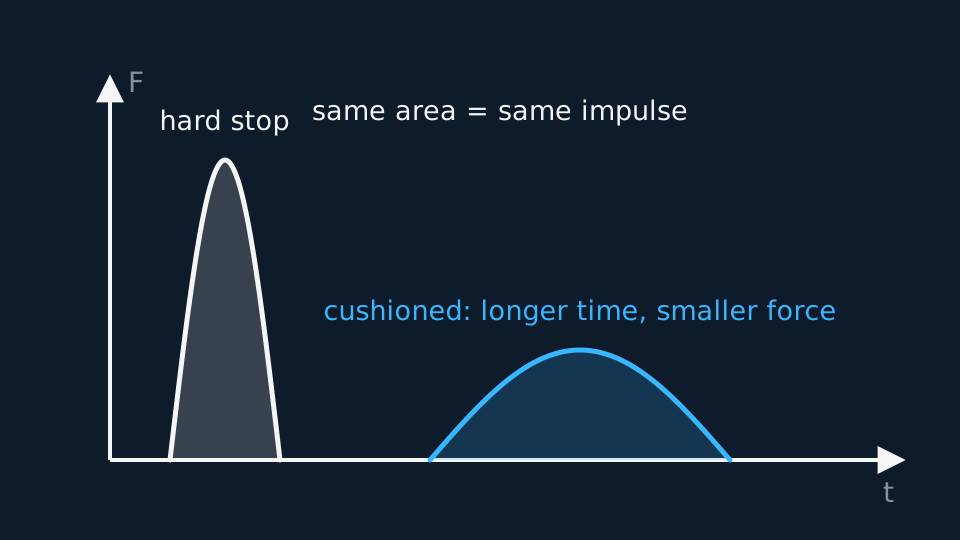
Crumple zones, airbags, crash mats, bending your knees on landing. Not one of them alters Δ(mv), which was fixed the moment you knew how fast you were going. What they stretch is Δt, and with the product pinned, a longer Δt forces a smaller F. Present the argument in exactly that order: the fixed Δ(mv) first, then the stretched Δt, then the smaller F.
On a force-time graph the area beneath the curve is the impulse, which is how questions handle a force that varies through an impact and never settles on a single value of F. For an occupant brought from the crash speed to rest, the momentum change is fixed. Stretching the stopping time lowers the average force, and usually the peak force with it, and that is where the engineering goes.
GUIDED PRACTICE
A cricket ball turned around
A 0.16 kg ball arrives at 30 m s−1 and leaves the bat at 20 m s−1 in the opposite direction, in a contact time of 2.0 ms. Set a sign convention, find the momentum change, then the average force. Work it through on paper before opening the answer.
Show the working
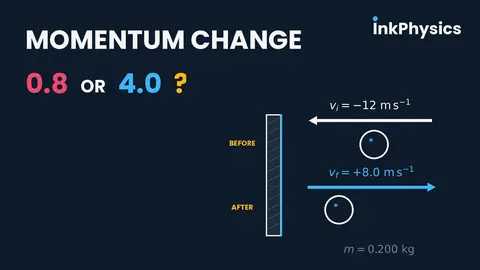
Taking the outgoing direction as positive, the velocity runs from −30 to +20, a change of 50 m s−1 and not 10. Omitting the sign change gives 10 m s−1 and makes the answer five times too small.
Δp = 0.16 × 50 = 8.0 kg m s−1, so F = Δp/Δt = 8.0/0.0020 = 4.0 kN. The force is large because the contact time is short.
INDEPENDENT PRACTICE
The crumple zone's arithmetic
A 75 kg passenger is brought to rest from 13 m s−1. Find the average force if the stop takes 0.15 s with a crumple zone and seatbelt, and if it takes 0.015 s against a rigid structure.
Show the working
The momentum change is fixed at 75 × 13 = 975 kg m s−1, whichever way the stop happens.
Over 0.15 s, F = 975/0.15 = 6.5 kN. Over 0.015 s, F = 65 kN, ten times greater and far past what a ribcage tolerates.
The momentum change cannot be reduced; only the time over which it happens can be increased. Every safety feature of this kind works by lengthening the impact time.
ASSESSMENT FOCUS
- Define a positive direction before you write anything else. Most momentum errors are sign errors, and a one-dimensional collision is a signed-number exercise from the very first line.
- “Show that the collision is inelastic” means one thing. Compute the total kinetic energy before and after and show it fell. Momentum being conserved is no evidence either way, because momentum is conserved in every collision there is.
- The other accepted route is relative speeds. Approach speed equal to separation speed means elastic; separation speed smaller means inelastic. Some mark schemes ask for that phrasing and not the energy sum.
- Write “kinetic energy is transferred to internal energy” rather than “energy is lost”, since total energy is always conserved.
- For an oblique collision, resolve every velocity into components and conserve momentum along each axis separately. That is two equations out of the one law, and neither of them is an energy equation. CIE, OCR and Edexcel all set the two-dimensional case.
- Edexcel asks you to derive , and two lines do it. Substitute v = p/m into ½mv2 and cancel. Edexcel prints it on its own sheet, and it is a non-relativistic result.
- F = Δ(mv)/Δt is a statement about a fixed lot of matter. A rocket question wants rocket plus exhaust treated as one closed system with momentum conserved, never the rocket's shrinking mass fed into the equation on its own.
- The crumple-zone answer runs in a fixed order. Δ(mv) is unchanged, the contact time is increased, and since F = Δ(mv)/Δt the force is reduced. Give the three steps in that order.
- On a force-time graph the area is the impulse, equal to the change in momentum, and it works for any shape of force at all. p = mv is not printed in the AQA booklet, though OCR A's does print it; F = Δ(mv)/Δt and FΔt = Δ(mv) are printed for AQA.
CHECK YOURSELF
A 2.0 kg trolley moving at 3.0 m s−1 collides with a stationary 1.0 kg trolley and they couple together. (a) Find their shared speed. (b) Is the collision elastic?
Show a hint
Momentum settles part (a). For part (b), compare the total kinetic energy before and after, or look at the separation speed.
Show the answer
(a) Momentum before is 2.0 × 3.0 = 6.0 kg m s−1. Afterwards that same 6.0 is carried by 3.0 kg, so v = 6.0 / 3.0 = 2.0 m s−1.
(b) Kinetic energy before is ½ × 2.0 × 3.02 = 9.0 J, and afterwards ½ × 3.0 × 2.02 = 6.0 J. Kinetic energy fell by 3.0 J, so the collision is inelastic, as coupling collisions always are. The missing 3.0 J went to internal energy and sound.
The relative-speed test agrees. They approached at 3.0 m s−1 and separated at 0, and a separation speed of zero is the perfectly inelastic case.
No external force means momentum is conserved.
Kinetic energy is the one you have to check.
Elastic means approach speed equals separation speed.
Impulse is the area under a force-time graph.
WORKBOOK
Printable practice for this topic: original exam-style questions with room to work, and a fully worked answer book. Free to use; please do not redistribute or sell.
Or read them with their mark schemes on the momentum and impulse questions page.
WHERE TO GO NEXT
- Gradients and areas under graphs is the maths this lesson leans on, worked through step by step.
USED LATER IN
CHECK YOUR PROGRESS
Rate how confident you feel with each objective for this lesson. Ratings are saved in this browser, on this device, unless you sign in.
- Calculate momentum as p = mv, and handle it as a signed number in one dimension.
- Apply conservation of linear momentum to collisions and to explosions, and to a two-dimensional collision by resolving into components.
- Derive Ek = p²/(2m) and use it to move between a momentum and a kinetic energy.
- Use F = Δ(mv)/Δt and impulse FΔt = Δ(mv), including the area under a force-time graph.
- Tell elastic from inelastic by comparing total kinetic energy before and after, and by comparing the relative speeds of approach and separation.
- Explain crumple zones, airbags and bent knees through contact time.
Open the full revision checklist to track your progress across the whole unit.