Physics › Engineering physics › Torque and angular acceleration
Torque and angular acceleration
A force applied at a distance from the axis produces a torque, T = Fr in newton metres, and T = Iα is the second law written for rotation. It is the net torque that counts, drive minus friction, so a body turning at a steady angular velocity has no net torque acting on it.
Choose your exam board to show the notes and questions relevant to your specification. You can change this setting at any time, and content for other boards remains available.
Torque, angular momentum and rotational power, part 1 of 2. Part 2 is Angular momentum and rotational power.
Builds on Rotational motion and the angular equations and Moment of inertia and rotational kinetic energy and Moments and equilibrium.
IN THIS TOPIC
- Calculate torque as Fr and link it to angular acceleration through T = Iα.
COMMON MISCONCEPTION
A wheel turning at a steady high speed must have a large net torque keeping it going.
Steady ω means zero net torque, the rotational analogue of Newton's first law. Torque changes angular velocity; it is not needed to sustain it, only to overcome whatever friction would slow the wheel.
Torque and the rotational second law
A force accelerates a body along a line. To accelerate a body around an axis you need a torque, a force applied at a distance from the axis. For a force F applied tangentially at radius r,
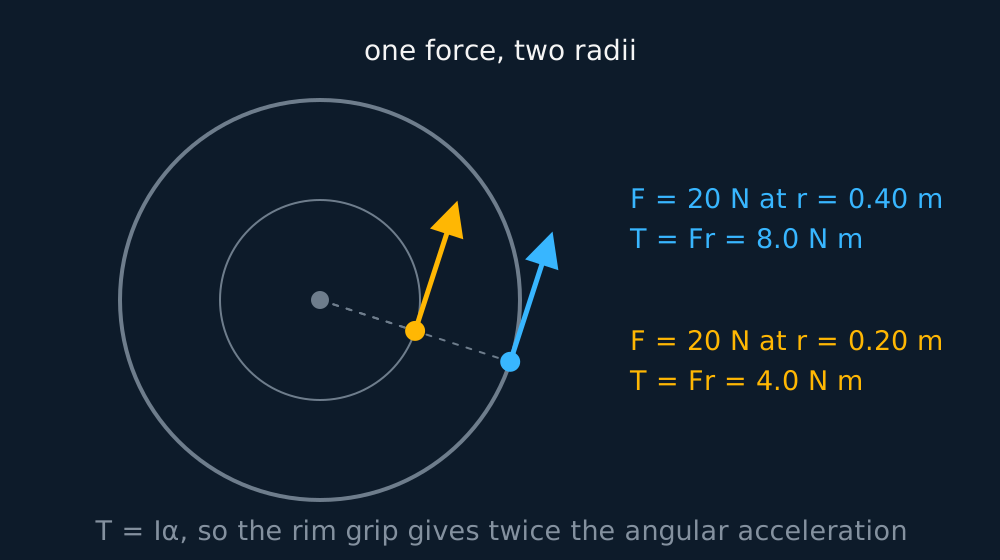
in newton metres. The same force gives a larger torque further from the axis, which is the principle behind spanners, door handles and gear wheels.
Describe the drawing
A wheel with two dashed radius lines, one to the rim and one halfway in. The same twenty newton force is drawn as an equal-length tangential arrow at each point, but at the rim it makes a torque of eight newton metres against four newton metres halfway in, so it produces twice the angular acceleration.
Torque plays force's role in the second law. Where F = ma, rotation has
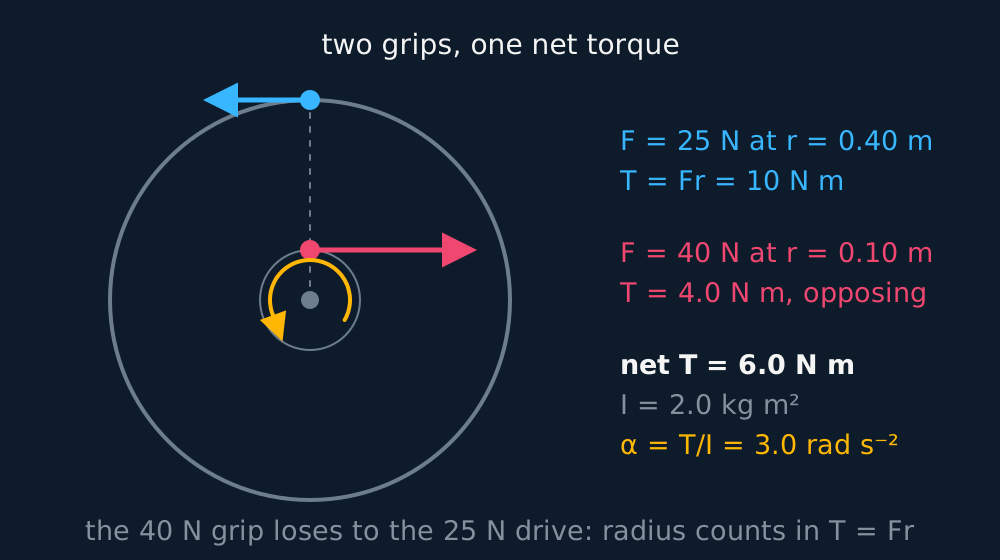
a net torque T giving angular acceleration α = T/I. A large moment of inertia gives a sluggish response, just as a large mass resists acceleration. When several torques act, the net torque is what counts, and a body spinning at constant ω has zero net torque on it, however fast it turns.
Describe the drawing
A drum with two tangential forces on the same radius line. A 25 newton drive at the rim, 0.40 metres out, makes 10 newton metres anticlockwise; a larger 40 newton grip only 0.10 metres from the axis pulls the other way but manages just 4 newton metres. The net 6 newton metres, marked by an amber arc curling anticlockwise, divides by the 2 kilogram metre squared moment of inertia to give an angular acceleration of 3 radians per second squared.
WORKED EXAMPLE
Spinning up a flywheel
A flywheel of moment of inertia 12 kg m2 starts from rest under a constant net torque of 30 N m. Find its angular velocity after 20 s, and the kinetic energy it has gained.
α = T/I = 30/12 = 2.5 rad s−2, so ω = αt = 2.5 × 20 = 50 rad s−1.
Ek = ½Iω2 = ½ × 12 × 502 = 1.5 × 10⁴ J.
The same energy is the work done by the torque. The flywheel turns θ = ½αt2 = ½ × 2.5 × 202 = 500 rad, and W = Tθ = 30 × 500 = 1.5 × 10⁴ J, which agrees exactly.
Angular momentum, and what conserves it has moved to the next part of this lesson.
Work, power and smoothing has moved to the next part of this lesson.
ASSESSMENT FOCUS
- T = Iα takes the net torque. Where a drive torque opposes a friction torque, subtract before dividing by I, and show that step in the working.
- T = Fr takes the distance from the axis, so a quoted diameter must be halved before it enters. Using the diameter doubles the torque.
- Constant angular velocity means zero net torque, however fast the body turns. A torque is needed to change ω, never to maintain it, and the explanation should say so.
- Torque is quoted in N m, never in joules, although both multiply newtons by metres. The metre in a torque is a lever arm, not a distance moved along the force.
CHECK YOURSELF
A grindstone of moment of inertia 1.7 kg m2 is driven by a torque of 5.5 N m while a friction torque of 1.25 N m opposes it. Find the angular acceleration, and the time taken to reach 30 rad s−1 from rest.
Show a hint
Subtract the friction torque before dividing by I, then one angular SUVAT step.
Show the answer
Net torque = 5.5 − 1.25 = 4.25 N m: T = Iα takes the net, not the drive.
α = T/I = 4.25/1.7 = 2.5 rad s−2.
t = (ω2 − ω1)/α = 30/2.5 = 12 s.
Torque is Fr, and it does for rotation what force does for a line: T = Iα.
T = Iα takes the net torque: opposing torques subtract first, and a steady ω means the net is zero.
WORKBOOK
Printable practice for this topic: original exam-style questions with room to work, and a fully worked answer book. Free to use; please do not redistribute or sell.
Or read them with their mark schemes on the torque and angular acceleration questions page.
WHERE TO GO NEXT
- Trigonometry and resolving vectors is the maths this lesson leans on, worked through step by step.
CHECK YOUR PROGRESS
Rate how confident you feel with each objective for this lesson. Ratings are saved in this browser, on this device, unless you sign in.
- Calculate torque as Fr and link it to angular acceleration through T = Iα.
Open the full revision checklist to track your progress across the whole unit.