Physics › Gravitational fields
Gravitational fields
Gravitational forces, field strength and potential, from surface gravity to satellite orbits.
Year 13 · 4 topics.
Practise this unit
What gravitational fields covers
How mass exerts a force across empty space, described first with field strength and then with potential. The unit shares its whole structure with electric fields, so learning one makes the other much faster. It closes with orbits, which combine this material with circular motion.
The main ideas
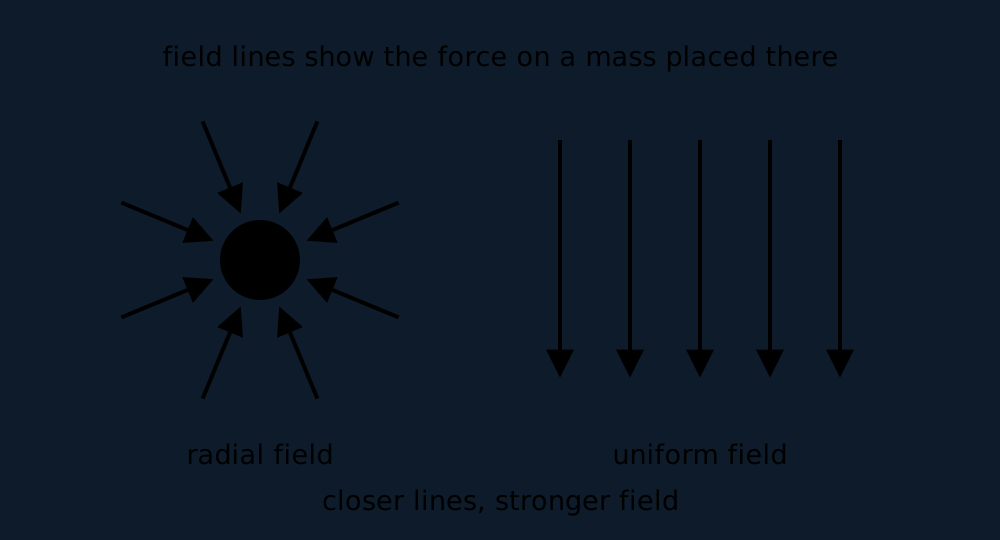
- What a force field is, how field lines are read, and where a field counts as radial and where as uniform.
- Newton's law of gravitation for point masses, and the inverse-square dependence it states.
- Field strength as force per unit mass, and its radial form, with r measured from the centre.
- Potential with its zero at infinity, the meaning of the negative sign, and the work done moving a mass between two potentials.
- Equipotential surfaces, and why moving along one costs no work.
- The link between the graphs: field strength is the negative gradient of potential, and a potential difference is the area under a field-distance graph.
- Orbits: gravity as the centripetal force, Kepler's laws, orbital energy, escape velocity and the geostationary orbit.
Key equations
- the force between two point masses
- field strength in a radial field
- gravitational potential, zero at infinity
- work done moving a mass between potentials
- Kepler's third law, derived from circular motion
- escape velocity, independent of the escaping mass
Every equation the gravitational fields notes display is collected, with its conditions, on the gravitational fields equations page.
Common errors
- The r in every equation is measured from the centre of the planet, so an orbital radius is the planet's radius plus the height. A question quoting a height above the surface is testing exactly that.
- Potential is negative because the zero sits at infinity and gravity attracts. Climbing away makes it less negative, so the change is positive while the value stays below zero.
- Field strength g and the gravitational constant G are different quantities with different units, and g varies with position while G does not.
- Astronauts float because the station and everything in it are in free fall together. At the height of the space station g is still about 89 per cent of its surface value.
Suggested order
The field concept first, since it is short and sets up this unit and electric fields together. Then Newton's law of gravitation, then potential. Leave orbits until last, and cover circular motion from Periodic motion before starting it.