Physics › Gravitational fields › Newton's law of gravitation
Newton's law of gravitation
Newton's law of gravitation makes every pair of masses attract with a force Gm₁m₂/r², so doubling their separation quarters the pull. There is no repulsive case, because mass has one sign. Dividing out the test mass gives the gravitational field strength g = GM/r², with r measured from the centre of the body.
Choose your exam board to show the notes and questions relevant to your specification. You can change this setting at any time, and content for other boards remains available.
Builds on The field concept.
IN THIS TOPIC
- Use Newton's law of gravitation for point masses.
- Define g as force per unit mass and use g = F/m.
- Use g = GM/r² in a radial field, with r measured from the centre.
COMMON MISCONCEPTION
There's no gravity in space.
Gravity follows an inverse square law and never reaches zero; at the ISS it is about 90% of surface g. Astronauts float because they and the station free-fall together.
The universal law
Gravity is a universal attractive force acting between all matter: every mass pulls every other. For point masses, and for spheres treated from outside as points at their centres, the magnitude is
where G, the gravitational constant, is 6.67 × 10⁻¹¹ N m2 kg−2, printed in the data booklet. That tiny number is why gravity between everyday objects goes unnoticed. Two people standing a metre apart attract with well under a millionth of a newton.
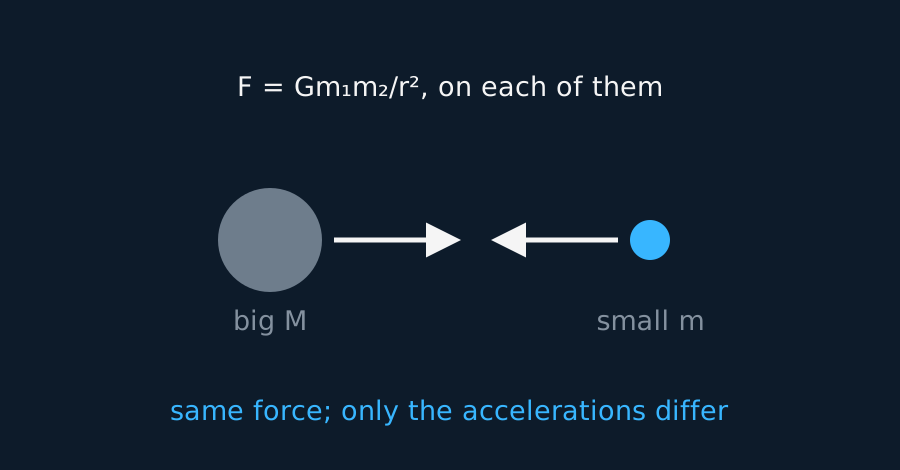
The force is mutual: the Earth pulls on you and you pull on the Earth with forces of equal magnitude. Only the accelerations differ, because the masses differ.
WORKED EXAMPLE
The force between the Earth and the Moon
Find the gravitational force between the Earth (5.97 × 1024 kg) and the Moon (7.35 × 10²² kg), separated by 3.84 × 10⁸ m.
Both bodies are far enough apart to treat as point masses at their centres, which is the condition for using the formula.
F = GMm/r2 = (6.67 × 10−11 × 5.97 × 1024 × 7.35 × 1022)/(3.84 × 108)2 = 2.0 × 10²⁰ N.
The same 2.0 × 10²⁰ N acts on each body, as Newton's third law requires; the Moon has the larger acceleration because it has the smaller mass.
Inverse square
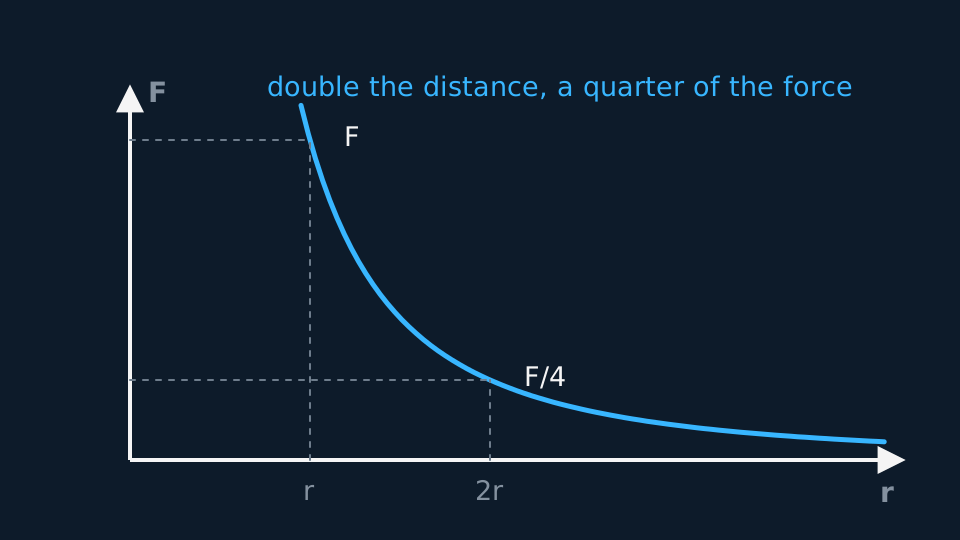
The r2 in the denominator sets the law's behaviour with distance: double the separation and the force falls to a quarter; treble it and the force falls to a ninth. A question comparing forces at two separations is asking for a squared ratio, so set the ratio up before substituting numbers.
GUIDED PRACTICE
g at double the distance
The field strength at the Earth's surface is 9.81 N kg−1. Without touching G or M, find g at a height of one Earth radius above the surface.
Show the working
One radius above the surface is two radii from the centre, the distance the law actually uses.
Doubling r quarters the inverse-square field, so g = 9.81/4 = 2.5 N kg−1. Two points matter here: the field falls to a quarter, not a half, and r is measured from the centre, not the surface.
From force to field strength
The gravitational field strength at a point is the force per unit mass a body placed there would feel:
measured in N kg−1, a unit identical to m s−2: field strength and free-fall acceleration are the same quantity. Substituting Newton's law, the test mass cancels, leaving the field of a mass M at any point in its radial region,
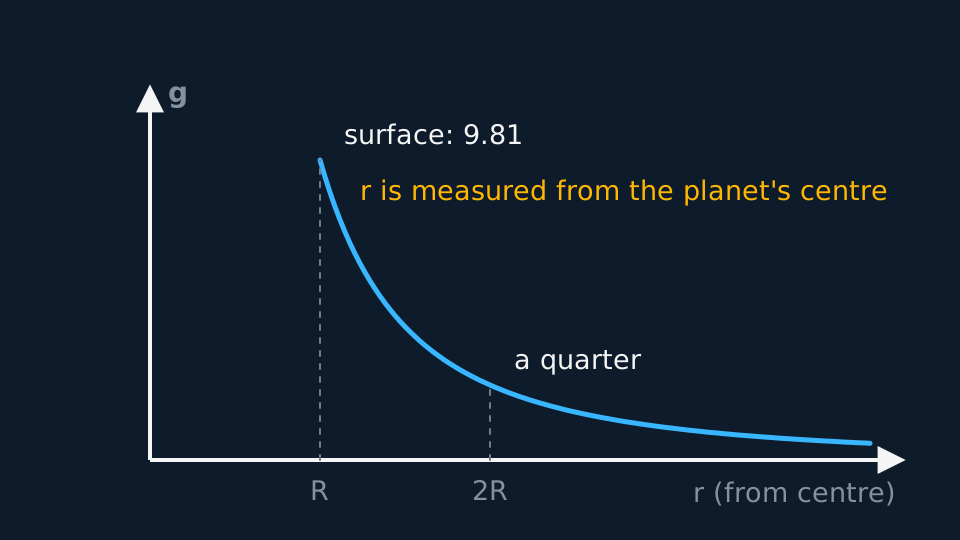
Measure r from the centre of the body, not from its surface. An orbit “400 km up” is at r = 6.37 × 10⁶ + 4.0 × 10⁵ m, so add the planet's radius to any altitude before substituting.
INDEPENDENT PRACTICE
Surface gravity on the Moon
The Moon has mass 7.35 × 10²² kg and radius 1.74 × 10⁶ m. Find the field strength at its surface, and compare it with Earth's.
Show the working
g = GM/r2 = (6.67 × 10−11 × 7.35 × 1022)/(1.74 × 106)2 = 1.6 N kg−1.
That is about one sixth of the Earth's 9.81 N kg−1. The Moon's smaller mass reduces g and its smaller radius increases it, and the two effects combine to give one sixth.
ASSESSMENT FOCUS
- The law applies to point masses, with spherical bodies treated as points at their centres. State that assumption, since it carries credit.
- In a ratio question, square the distance ratio first and reach for numbers second. Doubling r quarters both F and g.
- The force is mutual and equal in magnitude on both bodies, whatever their masses. “The Earth pulls harder on you than you pull on it” contradicts Newton's third law.
- Add the planet's radius to any altitude before squaring. r is measured from the centre.
- g at the International Space Station's altitude is about 89% of the surface value, and astronauts float because they are in free fall, not because gravity has stopped. Papers ask for the calculation and the explanation together.
CHECK YOURSELF
The ISS orbits about 400 km above the Earth's surface. Taking M = 5.97 × 1024 kg and RE = 6.37 × 10⁶ m, calculate g at the station, and explain why astronauts float despite your answer.
Show a hint
Calculate r from the centre first, then consider what free fall means for the astronauts.
Show the answer
r = 6.37 × 10⁶ + 4.0 × 105 = 6.77 × 10⁶ m.
= (6.67 × 10−11 × 5.97 × 1024) / (6.77 × 10⁶)2 = 8.7 N kg−1, about 89% of the surface value.
Astronauts float because the station and the crew are both in free fall, accelerating at the same rate under that g while moving fast enough tangentially to remain in orbit. The gravitational field strength there is nearly the surface value; what is absent is the contact force that would otherwise support them.
Every mass pulls every other with an inverse-square force.
Field strength is force per unit mass.
Measure r from the centre of the body, not from its surface.
WORKBOOK
Printable practice for this topic: original exam-style questions with room to work, and a fully worked answer book. Free to use; please do not redistribute or sell.
Or read them with their mark schemes on the Newton's law of gravitation questions page.
WHERE TO GO NEXT
- Proportional reasoning is the maths this lesson leans on, worked through step by step.
USED LATER IN
CHECK YOUR PROGRESS
Rate how confident you feel with each objective for this lesson. Ratings are saved in this browser, on this device, unless you sign in.
- Use Newton's law of gravitation for point masses.
- Define g as force per unit mass and use g = F/m.
- Use g = GM/r² in a radial field, with r measured from the centre.
Open the full revision checklist to track your progress across the whole unit.