Physics › Gravitational fields › Orbits and satellites
Orbits and satellites
Gravity supplies the centripetal force in an orbit, and equating GMm/r² to mv²/r gives the orbital speed and Kepler's third law. A satellite's kinetic, potential and total energy follow from the same substitution, and escape velocity √(2GM/r) does not depend on the escaping mass. The geostationary orbit is circular and equatorial.
Choose your exam board to show the notes and questions relevant to your specification. You can change this setting at any time, and content for other boards remains available.
Builds on Gravitational potential and Circular motion.
IN THIS TOPIC
- State Kepler's three laws, and use the equal-areas law to compare a planet's speed at the two ends of its orbit.
- Derive T² ∝ r³ from gravity as the centripetal force.
- Find the orbital speed at any radius, and say why lower orbits are faster.
- Account for a satellite's kinetic, potential and total energy.
- Use escape velocity, and explain why the escaping mass drops out of it.
- Describe synchronous, geostationary and low orbits, including the geostationary plane and radius.
COMMON MISCONCEPTION
A satellite needs its engines running to stay in orbit.
An orbit is free fall: gravity alone provides the centripetal force, and with no drag nothing slows the satellite, so no engine thrust is needed to stay in orbit.
Gravity as the centripetal force

Describe the drawing
The dot goes round at constant speed, and the cyan velocity arrow never changes length; but it never stops changing direction, so the velocity is changing and there must be an acceleration. The coral arrow shows it: aimed at the centre at every instant. Restyled, the same motion is a satellite held by gravity or a charge held by a magnetic field.
For an ideal circular orbit with negligible drag, gravity provides the centripetal force, so the satellite needs no continuous thrust to remain in orbit. It is accelerating towards the planet at all times, while its tangential speed keeps its distance from the centre constant. Equating the two expressions for the same force gives
from which the orbital speed at any radius, v = √(GM/r), follows directly. A lower circular orbit has a greater orbital speed.
Kepler's three laws
Nearly a century before Newton stated a force law, Johannes Kepler analysed Tycho Brahe's naked-eye records of the planets and spent twenty years fitting curves to them. The result was three laws. Kepler described the motion; Newton later explained it. All three laws follow from the inverse-square law, and the third is derived below.
The first law is the law of ellipses. Every planet moves in an ellipse with the Sun at one focus. An ellipse has two foci, and the second is empty: nothing occupies it, and the Sun is not at the centre. A circle is the special case in which the two foci coincide. Planetary orbits are ellipses of small eccentricity, which is why the circular treatment above applies well to them: the Earth's distance from the Sun stays within two per cent of its mean value throughout the year.
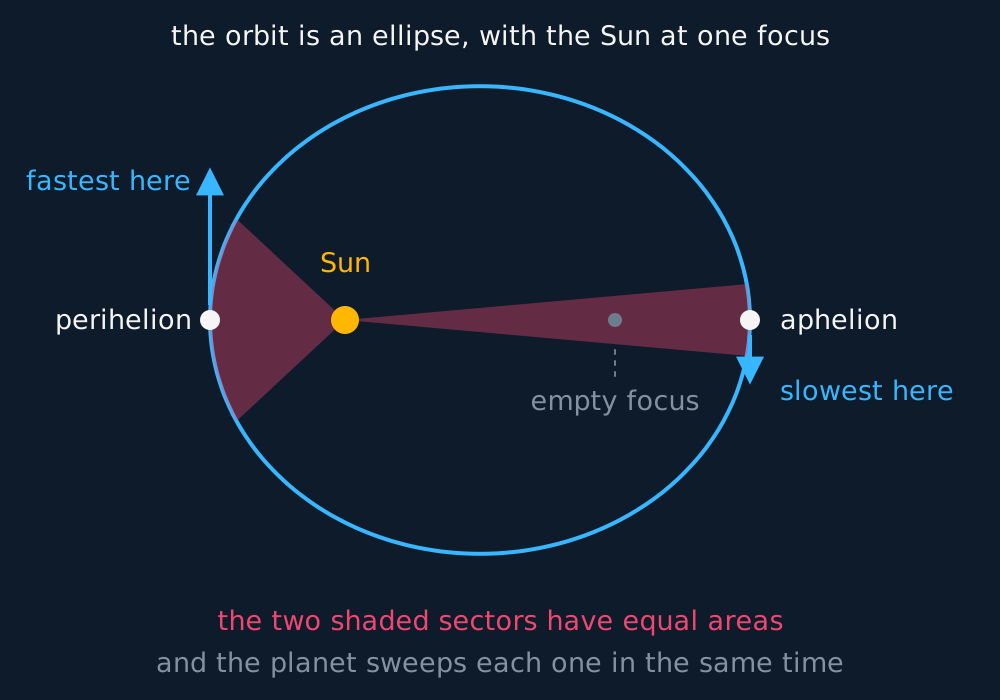
The second law is the law of equal areas. The line joining a planet to the Sun sweeps out equal areas in equal times. Near the Sun that line is short, so it must turn through a larger angle to sweep the same area; further out it is longer, and a narrower sector suffices. The planet therefore moves fastest at perihelion, its closest approach, and slowest at aphelion, its furthest. A comet passes close to the Sun in a few weeks and spends decades in the outer part of its orbit. The underlying reason is conservation of angular momentum, which a purely radial force cannot change.
Describe the drawing
An elliptical orbit drawn in cyan with the Sun marked at the left focus and the second focus left empty. Two shaded wedges of equal area run from the Sun: a short fat one at perihelion and a long thin one at aphelion. A long velocity arrow at perihelion and a short one at aphelion show the planet running three times faster at the near end than at the far end.
The third law is the law of periods. The square of the orbital period is proportional to the cube of the mean radius. The mean radius is the semi-major axis of the ellipse; for the near-circular orbits you will be given, it is simply the radius. It is the only one of the three that relates one orbit quantitatively to another, and it is the one the specifications ask you to derive.
GUIDED PRACTICE
A comet at both ends
A comet passes perihelion at 0.50 AU from the Sun travelling at 60 km s−1, and its aphelion lies at 35 AU. Use the second law to find its speed at aphelion.
Show the working
At either end of the orbit the velocity is at right angles to the Sun-comet line, so in a short time the swept area is a thin triangle of height r and base vδt, giving an area ½rvδt. Equal areas in equal times therefore means rv is the same at both ends.
v = 60 × 0.50/35 = 0.86 km s−1, about seventy times slower than at perihelion, which is why a comet is visible for only a few months of an orbit lasting decades. The step applies only at perihelion and aphelion, because only there is the velocity perpendicular to the radius.
The third law, derived
The derivation of the period-radius law is required, and takes three lines. Replace v in the centripetal equation with the circumference divided by the period, v = 2πr/T, then rearrange.
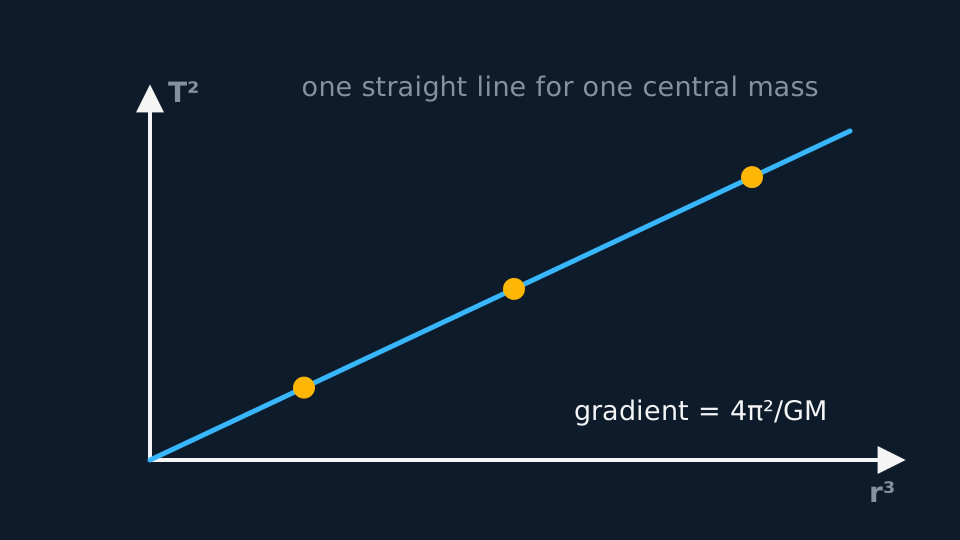
so T2 ∝ r3, and distant orbits are disproportionately slow. Plot T2 against r3 for any family of satellites and every one sits on a single straight line through the origin, whose gradient is 4π2/GM and therefore gives the mass of the central body.
WORKED EXAMPLE
A satellite's speed and clock
A satellite orbits at r = 7.0 × 10⁶ m from the Earth's centre. Find its orbital speed and period.
Gravity is the centripetal force, so GMm/r2 = mv2/r, and the satellite's own mass cancels immediately.
v = the square root of GM/r = the square root of (6.67 × 10−11 × 5.97 × 1024)/(7.0 × 106) = 7.5 km s−1.
T = 2πr/v = 2π × 7.0 × 106/7540 = 5.8 × 10³ s, about 97 minutes, which is typical of a low Earth orbit.
Orbital energy and escape
An orbiting satellite has kinetic energy and negative gravitational potential energy, and its total energy is constant while it stays in one stable orbit. For a circular orbit each term has a simple form. The potential energy is from the potential lesson; the orbit condition GMm/r2 = mv2/r rearranges to , half the magnitude of U; and adding them gives the total,
Its total energy is therefore −GMm/(2r): negative, as any bound orbit's total energy must be, and rising towards zero as r increases. A lower circular orbit has a more negative total energy but a greater orbital speed. When a low satellite loses a little total energy to atmospheric drag, its orbital radius decreases, and the decrease in potential energy is twice the loss in total energy, so the kinetic energy and the orbital speed both increase. The satellite therefore ends up lower and faster.
Escaping from the field means supplying the full change in potential energy from radius r to infinity. Setting the kinetic energy equal to that change, ½mv2 = GMm/r, gives the escape velocity,
about 11 km s−1 from the Earth's surface, independent of the escaping mass.
GUIDED PRACTICE
Escape speed from the Earth's surface
Using M = 5.97 × 1024 kg and R = 6.37 × 10⁶ m, verify the quoted escape speed from the Earth's surface.
Show the working
v = the square root of 2GM/R = the square root of (2 × 6.67 × 10−11 × 5.97 × 1024)/(6.37 × 106).
v = 1.1 × 10⁴ m s−1, the 11 km s−1 quoted earlier. The factor of 2 distinguishes the escape speed from the orbital speed at the same radius.
The special orbits
A synchronous orbit has a period equal to its planet's rotation period. The geostationary orbit adds three conditions: it is circular, it lies in the equatorial plane, and it is in the same direction as the Earth's rotation, so the satellite stays above one fixed point on the equator. Kepler's third law then fixes its radius at about 4.2 × 10⁷ m from the Earth's centre, roughly 36 000 km above the surface. Fixed satellite dishes are aimed at satellites in this orbit.
Low orbits, a few hundred kilometres above the surface, have periods near 90 minutes. Imaging resolution is high and signal delays are short, but each satellite is above any given place only briefly, so low-orbit systems use constellations of satellites.
INDEPENDENT PRACTICE
The length of the Martian year
Mars orbits the Sun at 1.52 times the Earth's orbital radius. Using Kepler's third law as a ratio, find the Martian year in Earth years.
Show the working
T2 ∝ r3, so T = 1.52 raised to the power 3/2 = 1.9 Earth years.
The ratio form needs no value for G, for the Sun's mass or for the orbital radius in metres, because all three cancel.
ASSESSMENT FOCUS
- Kepler's three laws are recall marks, so learn all three in order: an ellipse with the Sun at one focus; the Sun-planet line sweeping equal areas in equal times; and T² ∝ r³. For the second, give the statement first and the consequence second, that the planet moves fastest at its closest point.
- The T² ∝ r³ derivation is required. Set the gravitational force equal to the centripetal force, substitute v = 2πr/T, then rearrange. Practise writing out all three lines.
- A lower orbit means a faster satellite and a shorter period, and also a lower total energy. All three results are examined, sometimes in the same question.
- Escape velocity follows from energy: the kinetic energy supplied equals GMm/r, and the escaping mass cancels, so the escape speed is the same for any mass.
- A geostationary satellite has a circular equatorial orbit in Earth's rotation direction with a period of one sidereal day, approximately 23 h 56 min. Its radius is near 4.2 × 10⁷ m from the Earth's centre.
- “Why does the satellite need no engine?” Gravity supplies the centripetal force, and the circular path is an equipotential, so gravity does no work over an orbit. Give both sentences.
- The satellite's own mass cancels from every speed, period and radius calculation here, so a question that supplies it may be testing whether you recognise that. Its mass is needed only for an energy calculation.
CHECK YOURSELF
Show that the geostationary orbit has a radius of about 4.2 × 10⁷ m. (M = 5.97 × 1024 kg; take the period as 24 hours.)
Show a hint
The derived form of Kepler's third law, rearranged for r cubed.
Show the answer
T = 24 × 3600 = 8.64 × 10⁴ s. Rearrange the derived law to r3 = GMT2/4π2.
r3 = (6.67 × 10−11 × 5.97 × 1024 × (8.64 × 104)2) / 4π2 = 7.5 × 10²² m3.
r = 4.2 × 10⁷ m from the Earth's centre, about 36 000 km above the surface, in the equatorial plane. Every geostationary satellite uses this radius. Using the sidereal day of 23 h 56 min instead of 24 h reduces the radius by under 0.2%, which does not change the answer to two significant figures.
Kepler: an ellipse with the Sun at one focus, equal areas in equal times, and T² ∝ r³.
Gravity is the centripetal force; T² grows as r³.
Lower orbit, faster satellite, lower total energy.
Geostationary: a circular equatorial orbit in the Earth's rotation direction, with a period of one sidereal day.
WORKBOOK
Printable practice for this topic: original exam-style questions with room to work, and a fully worked answer book. Free to use; please do not redistribute or sell.
Or read them with their mark schemes on the orbits and satellites questions page.
WHERE TO GO NEXT
- Proportional reasoning is the maths this lesson leans on, worked through step by step.
USED LATER IN
CHECK YOUR PROGRESS
Rate how confident you feel with each objective for this lesson. Ratings are saved in this browser, on this device, unless you sign in.
- State Kepler's three laws, and use the equal-areas law to compare a planet's speed at the two ends of its orbit.
- Derive T² ∝ r³ from gravity as the centripetal force.
- Find the orbital speed at any radius, and say why lower orbits are faster.
- Account for a satellite's kinetic, potential and total energy.
- Use escape velocity, and explain why the escaping mass drops out of it.
- Describe synchronous, geostationary and low orbits, including the geostationary plane and radius.
Open the full revision checklist to track your progress across the whole unit.