Physics › Mechanics › Mass and weight
Mass and weight
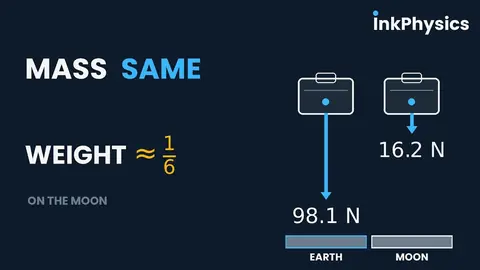
Mass is a scalar measure of inertia, in kilograms, while weight is the gravitational force on that mass, W = mg, measured in newtons. Move an object to a place where g differs and its mass is unchanged while its weight is not. A beam balance compares masses and reads the same anywhere; a newton meter measures force.
Choose your exam board to show the notes and questions relevant to your specification. You can change this setting at any time, and content for other boards remains available.
Builds on Newton's laws and the resultant force.
IN THIS TOPIC
- Separate mass, a scalar in kilograms, from weight, a force in newtons.
- Use W = mg with g as the gravitational field strength at the object's location, and state what a beam balance and a newton meter each measure.
COMMON MISCONCEPTION
Mass and weight are two words for the same thing.
Mass and weight are different quantities. Mass, in kilograms, is the same everywhere; weight is the gravitational force on that mass, W = mg, in newtons, so it changes with g.
Two different quantities
Mass is a scalar measure of an object's inertia, its resistance to acceleration: the m in F = ma, measured in kilograms, the same wherever the object goes. The everyday picture of mass as an amount of matter is a fair first idea, and mark schemes accept it, but inertia is the more precise definition.
Weight is a force: the gravitational pull on that mass, a vector pointing towards the centre of the planet, measured in newtons. The two are related by
where g is the gravitational field strength at the object's location, about 9.81 N kg−1 at the Earth's surface. Written in those units, g is the number of newtons of gravitational force per kilogram of mass. It is a property of the location, not of the object. The AQA and OCR A booklets print g among the constants without printing W = mg, so on those boards it is yours to remember; Edexcel's formulae sheet does print it.
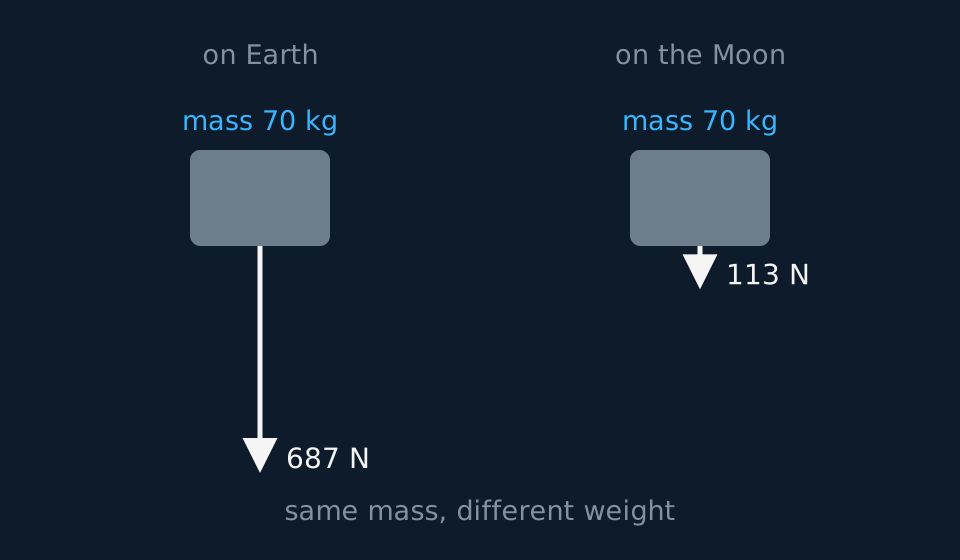
Take a 70 kg astronaut to the Moon, where g is 1.62 N kg−1, and the mass is still 70 kg while the weight falls from about 687 N to about 113 N. Only the gravitational field strength has changed.
Why the two are conflated on Earth
On the Earth's surface g varies very little, so weight is always nearly the same multiple of mass and one number appears to serve for both. Bathroom scales rely on that. The distinction matters as soon as g changes.
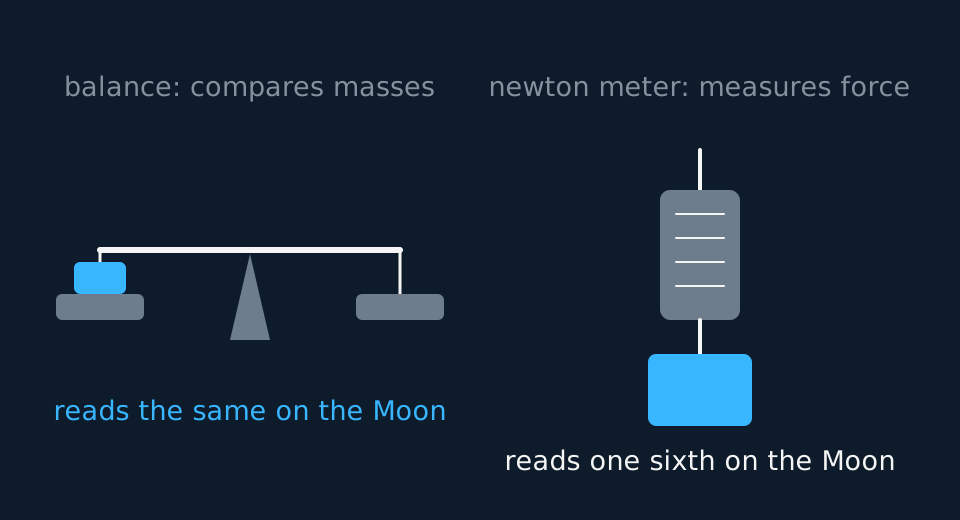
The two instruments differ for the same reason. A beam balance compares one mass against standard masses, and since gravity pulls equally on both sides it cancels out, so it reads identically on the Moon. An electronic balance actually senses the force on its pan and is calibrated to report the mass that force implies, so it needs recalibrating anywhere g differs. A newton meter measures the gravitational force directly through a stretched spring, so on the Moon it reads a sixth of its Earth value. Which instrument is appropriate depends on whether mass or weight is wanted.
INDEPENDENT PRACTICE
Weighed on another world
A 180 kg probe weighs 668 N on the surface of another planet. Find the gravitational field strength there, and state what has and has not changed since the probe left Earth.
Show the working
g = W/m = 668/180 = 3.7 N kg−1, which happens to be Mars.
The mass is 180 kg on any planet. Only the weight changes, because weight is the gravitational force acting on an unchanged mass.
ASSESSMENT FOCUS
- State the units with the definitions. Mass in kilograms, weight in newtons. A weight quoted in kilograms is a different quantity.
- “The same object is taken to planet X” means mass unchanged and weight rescaled by the new g. Note that g doubles as the acceleration of free fall, and N kg−1 is the same unit as m s−2, so answer in whichever form the question uses.
- In free fall the object still has weight. What vanishes is the support force, so “weightless” in orbit means no normal contact force, not no gravity.
CHECK YOURSELF
An astronaut has a mass of 70 kg. On the Moon, g = 1.62 N kg−1. What are the astronaut's mass and weight on the Moon?
Show a hint
One of the two quantities never changes.
Show the answer
The mass is 70 kg, exactly as on Earth. Mass measures inertia and does not depend on location.
The weight is = 70 × 1.62 = 113 N, about a sixth of the 687 N it was on Earth, because the Moon's field strength is about a sixth of ours.
Mass is independent of gravitational field strength.
Weight is W = mg, so it changes when g changes.
WORKBOOK
Printable practice for this topic: original exam-style questions with room to work, and a fully worked answer book. Free to use; please do not redistribute or sell.
Or read them with their mark schemes on the mass and weight questions page.
WHERE TO GO NEXT
- Required practical 3: measuring g by free fall puts this topic in the lab, and the written papers ask about it.
USED LATER IN
CHECK YOUR PROGRESS
Rate how confident you feel with each objective for this lesson. Ratings are saved in this browser, on this device, unless you sign in.
- Separate mass, a scalar in kilograms, from weight, a force in newtons.
- Use W = mg with g as the gravitational field strength at the object's location, and state what a beam balance and a newton meter each measure.
Open the full revision checklist to track your progress across the whole unit.