Physics › Mechanics › Drag and terminal speed
Drag and terminal speed
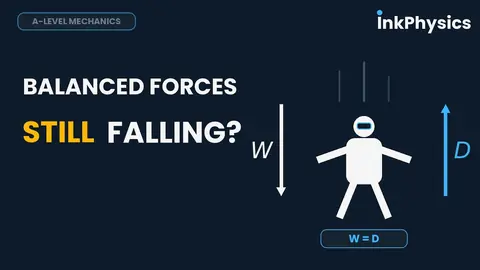
Air resistance grows with the speed of whatever is moving through it, so a falling object accelerates less and less as the fall goes on. Terminal speed is where drag equals weight, the resultant force is zero and the velocity stays constant. Opening a parachute produces a second, lower one, and the same balance fixes a vehicle's top speed.
Choose your exam board to show the notes and questions relevant to your specification. You can change this setting at any time, and content for other boards remains available.
Builds on Newton's laws and the resultant force and Motion graphs and the SUVAT equations.
IN THIS TOPIC
- Describe friction, lift and drag qualitatively, including that air resistance increases with speed.
- Explain terminal speed using Newton's laws, and sketch the velocity-time graph it produces.
- Apply the same balance argument to a parachutist's two terminal speeds and to a vehicle's maximum speed.
COMMON MISCONCEPTION
Falling objects just keep speeding up.
Drag grows with speed, so a falling object cannot speed up forever: eventually drag equals weight, the resultant force is zero, and the object continues at that terminal speed.
Friction, drag and lift
Friction acts between solid surfaces and opposes relative motion, or attempted motion, between them. The required treatment is qualitative only, and the distinction between static and dynamic friction is not tested. Drag is the resistive force from moving through a fluid, air or water, and lift is the component of the fluid's force perpendicular to the flow, the force that holds aircraft up.
Everything else in this topic follows from the fact that air resistance increases with speed. At a higher speed more air is displaced each second and each parcel of air is given a larger change of momentum. Friction between solid surfaces does not increase with speed in this way, which is why drag rather than friction sets speed limits.
Terminal speed
Drop an object and follow the forces. At the moment of release the speed is zero, so drag is zero, the resultant is the full weight and the acceleration is g. As speed builds, drag grows, the resultant shrinks, and the acceleration fades.

Describe the drawing
Weight never changes; drag grows with speed until the net force dies and the fall settles at the first terminal speed. The parachute multiplies the drag at a stroke: for a moment drag beats weight (the coral net arrow flips upward), the fall slows, and a second, lower terminal speed is reached. The curve records all of it. Arrow lengths are capped for scale during the brief spike, when the true drag exceeds nine times the weight.
Eventually drag has grown until it equals the weight. The resultant force is zero, and by Newton's first law the object stops accelerating and falls at constant velocity. That speed is the terminal speed. The forces are balanced, not absent, and the object is still moving quickly.
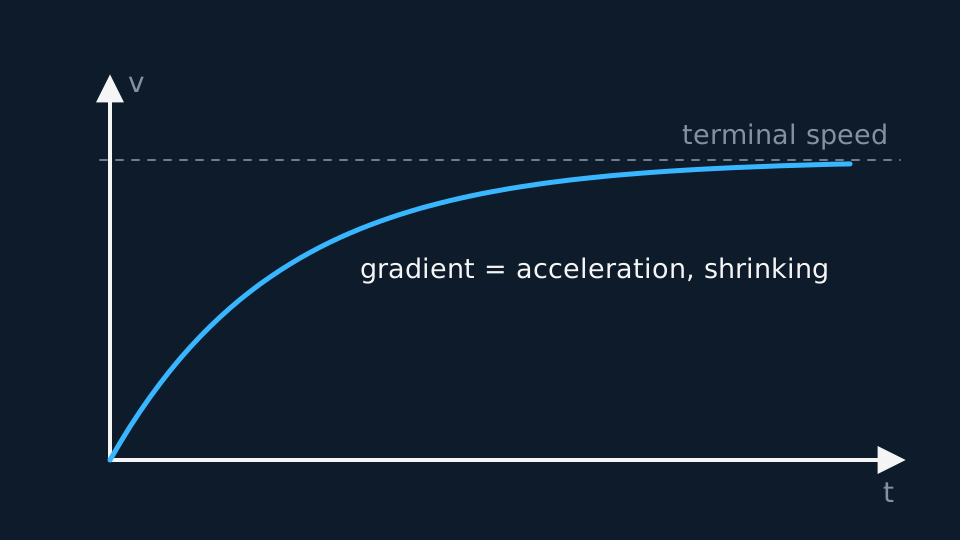
Every stage of the argument is visible on the velocity-time graph. Initial gradient g, then curvature as the resultant shrinks, then a horizontal asymptote at terminal speed. Sketching that graph with all three features labelled is a standard question.
WORKED EXAMPLE
The forces at half terminal speed
An 80 kg skydiver has a terminal speed of 50 m s−1, with drag proportional to speed squared. Find the resultant force and acceleration at 25 m s−1.
At terminal speed the drag equals the weight, 80 × 9.81 = 785 N. This fixes the drag at terminal speed without needing the drag constant.
Halve the speed and the squared law leaves a quarter of the drag, 785/4 = 196 N.
Resultant = 785 − 196 = 589 N downward, so a = 589/80 = 7.4 m s−2. This is still most of g, so the speed rises rapidly in the early part of the fall.
The parachutist's second terminal speed
Before the parachute opens, the parachutist reaches a high terminal speed. Opening the parachute greatly increases drag, producing an upward resultant force and reducing the speed. As the speed falls, drag decreases until it again equals weight at a lower terminal speed.
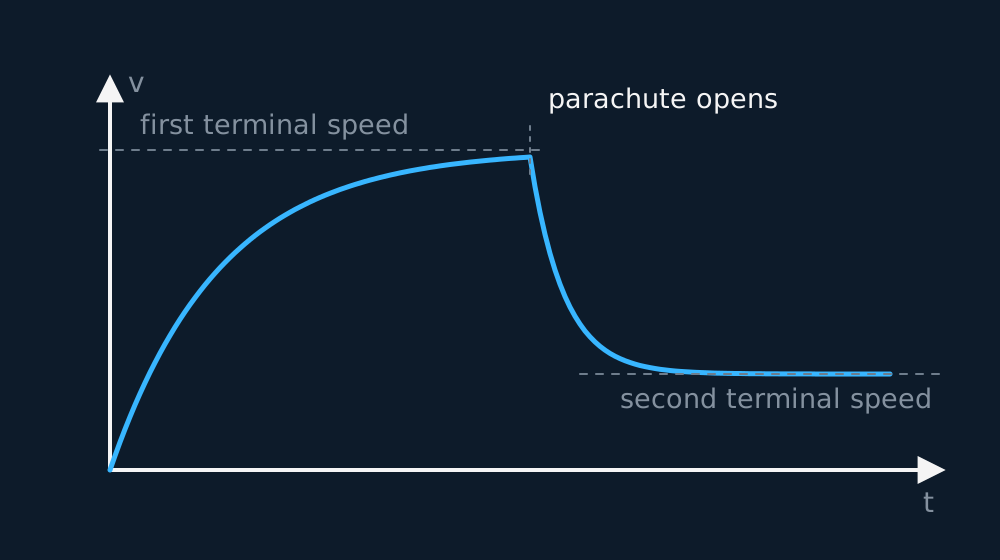
No new upward force appears when the canopy opens. The drag force increases because the area presented to the air increases, and it decreases again as the speed falls.
The top speed of a vehicle
A vehicle's maximum speed is the same force balance. The engine provides a driving force, and the total resistive force rises with speed until it equals that driving force. The resultant force and the acceleration are then zero, and the vehicle is at its top speed. Increasing the driving force or reducing the drag, through more power or better streamlining, raises the speed at which the two are equal.
GUIDED PRACTICE
A top speed from power and drag
A car's drag is 0.35v2 newtons at speed v, and its engine delivers a maximum useful power of 25 kW. Using P = Fv at the balance point, find its top speed.
Show the working
At top speed the driving force equals the drag, so P = Fv becomes 25 000 = 0.35v2 × v = 0.35v3.
v3 = 71 400, so v = 41 m s−1, about 150 km h−1. The cube is why doubling a car's top speed needs roughly eight times the power.
ASSESSMENT FOCUS
- Give the terminal-speed explanation as an ordered sequence: drag increases with speed, so the resultant force falls, so the acceleration falls, until drag equals weight, the resultant is zero and the velocity is constant.
- At terminal speed the forces are balanced, and the object is still moving and still has weight. Balanced forces give constant velocity, not rest.
- On the skydiver graph, the parachute moment is a steep negative gradient and never a vertical cliff to zero. The speed falls to the new terminal value, not to rest.
- For objects of the same shape and size, the heavier one has the higher terminal speed. More weight needs more drag to balance it, and more drag needs more speed, so a steel ball has a higher terminal speed than a plastic ball of the same size.
- For a vehicle's top speed: at maximum speed the driving force equals the total resistive force, so the resultant force and the acceleration are both zero.
CHECK YOURSELF
A skydiver falls at a terminal speed of 55 m s−1, then opens a parachute and reaches a new terminal speed of 6 m s−1. Explain, in terms of forces, why the new terminal speed is lower.
Show a hint
The weight has not changed. What has, and what does that do to the speed at which drag can match it?
Show the answer
Opening the parachute greatly increases the area pushing through the air, so at any given speed the drag is far larger than before.
Drag therefore matches the unchanged weight at a much lower speed, and it is at that lower speed that the resultant returns to zero and the fall becomes steady.
Between the two plateaus, drag exceeds weight, the resultant acts upward, and the skydiver decelerates: the steep falling section of the velocity-time graph.
Drag increases with speed.
Terminal speed is reached when drag equals weight.
WORKBOOK
Printable practice for this topic: original exam-style questions with room to work, and a fully worked answer book. Free to use; please do not redistribute or sell.
Or read them with their mark schemes on the drag and terminal speed questions page.
WHERE TO GO NEXT
- Exponentials and logarithms is the maths this lesson leans on, worked through step by step.
USED LATER IN
CHECK YOUR PROGRESS
Rate how confident you feel with each objective for this lesson. Ratings are saved in this browser, on this device, unless you sign in.
- Describe friction, lift and drag qualitatively, including that air resistance increases with speed.
- Explain terminal speed using Newton's laws, and sketch the velocity-time graph it produces.
- Apply the same balance argument to a parachutist's two terminal speeds and to a vehicle's maximum speed.
Open the full revision checklist to track your progress across the whole unit.