Physics › Mechanics
Mechanics
Scalars and vectors, moments and equilibrium, motion graphs and SUVAT, projectiles, Newton's laws, drag and terminal speed, momentum, work, energy and power.
Year 12 · 10 topics.
- Scalars and vectors
- Moments and equilibrium
- Motion graphs and the SUVAT equations
- Projectile motion
- Newton's laws and the resultant force
- Mass and weight
- Drag and terminal speed
- Momentum and impulse
- Work, energy and power
- Conservation of energy
Practise this unit
- Scalars and vectors questions
- Moments and equilibrium questions
- Motion graphs and the SUVAT equations questions
- Projectile motion questions
- Newton's laws and the resultant force questions
- Mass and weight questions
- Drag and terminal speed questions
- Momentum and impulse questions
- Work, energy and power questions
- Conservation of energy questions
What mechanics covers
The largest Year 12 unit, and the one most other units are built on. It covers describing motion, predicting it from the forces acting, and then solving the same problems again with momentum and energy when the forces are unknown. Circular motion, gravitational fields and the engineering physics option all assume you can work through this quickly.
The main ideas
- Scalars and vectors: adding a perpendicular pair by calculation, others by scale drawing, and resolving weight on a slope.
- Moments, couples and the principle of moments, with weight placed at the centre of mass.
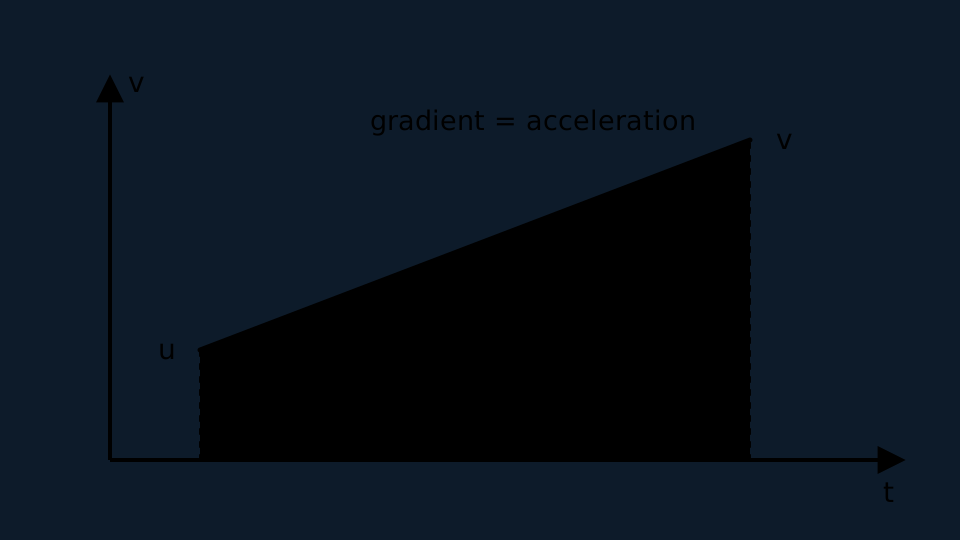
- Motion graphs read as gradients and areas, and the four constant-acceleration equations with the condition attached.
- Projectiles as two independent motions linked only by a shared time.
- Newton's three laws applied from a free-body diagram, and what makes a genuine third-law pair.
- Drag and terminal speed, and the same balance argument applied to a vehicle's top speed.
- Momentum, impulse and conservation, then work, energy, power and efficiency, including budgets with friction in them.
Key equations
- the four equations, valid only while acceleration is constant
- the resultant force on a body of constant mass
- momentum, and the general form of the second law
- impulse, the area under a force-time graph
- work done by a force, and power at a steady speed
- the two stores most problems exchange
Every equation the mechanics notes display is collected, with its conditions, on the mechanics equations page.
Common errors
- Weight and the normal contact force are not a third-law pair. They act on the same body and are different types of force, and a pair fails on either count.
- The constant-acceleration equations stop being valid once drag matters. Where acceleration varies, the area under a velocity-time graph gives displacement.
- Momentum is signed, so a direction has to be chosen before anything is conserved, and a two-dimensional collision must be resolved into components.
- Momentum is conserved in every collision, kinetic energy only in an elastic one, so deciding the type takes a separate energy audit.
Suggested order
Start with scalars and vectors, then motion graphs and SUVAT, since projectiles use both. Newton's laws, mass and weight, and drag follow as one group. Leave momentum and energy last, since they reuse everything before them.