Physics › Medical physics › Defects of vision and their correction
Defects of vision and their correction
Myopia brings the far point in from infinity and hypermetropia leaves the eye too little power for its length, and each takes its own lens. That lens forms a virtual image where the eye can already focus, so v is negative and short sight ends up with a negative power. Astigmatism adds a cylinder and an axis to the prescription.
Choose your exam board to show the notes and questions relevant to your specification. You can change this setting at any time, and content for other boards remains available.
The physics of the eye, part 2 of 2. Part 1 is The eye as an optical system.
Builds on The eye as an optical system and Lenses and images.
IN THIS TOPIC
- Find the power in dioptres of the lens that corrects myopia or hypermetropia.
- Say what astigmatism is and read the three numbers of its prescription.
COMMON MISCONCEPTION
A correcting lens works by focusing the image straight onto the retina itself.
A correcting lens forms no image on the retina: it makes a virtual image of the object at a distance the defective eye can already focus, the far point for myopia, the near point for hypermetropia, and the eye's own optics do the rest.
Two defects, two lenses
A healthy eye has its far point at infinity, its near point at 0.25 m, and a power it adjusts to suit the object. Correcting-lens power is calculated using P = 1/f and the thin-lens equation 1/u + 1/v = 1/f, with m = v/u for the size, in the real is positive convention and with the retina as a fixed screen. A defect of vision is what happens when the power the eye can supply no longer matches its length, and each defect is read off the limit, near point or far point, that has moved.
Myopia, short sight, is the eye that is too powerful for its own length, so parallel rays from a distant object converge in front of the retina and arrive at it already spreading again. Distant objects blur. The eye's far point is no longer at infinity but at some finite distance, and near vision is usually fine.
Hypermetropia, long sight, is the opposite. The eye has too little power for its length, so rays from a close object would meet behind the retina. Close objects blur, and the near point has moved further out than 0.25 m.
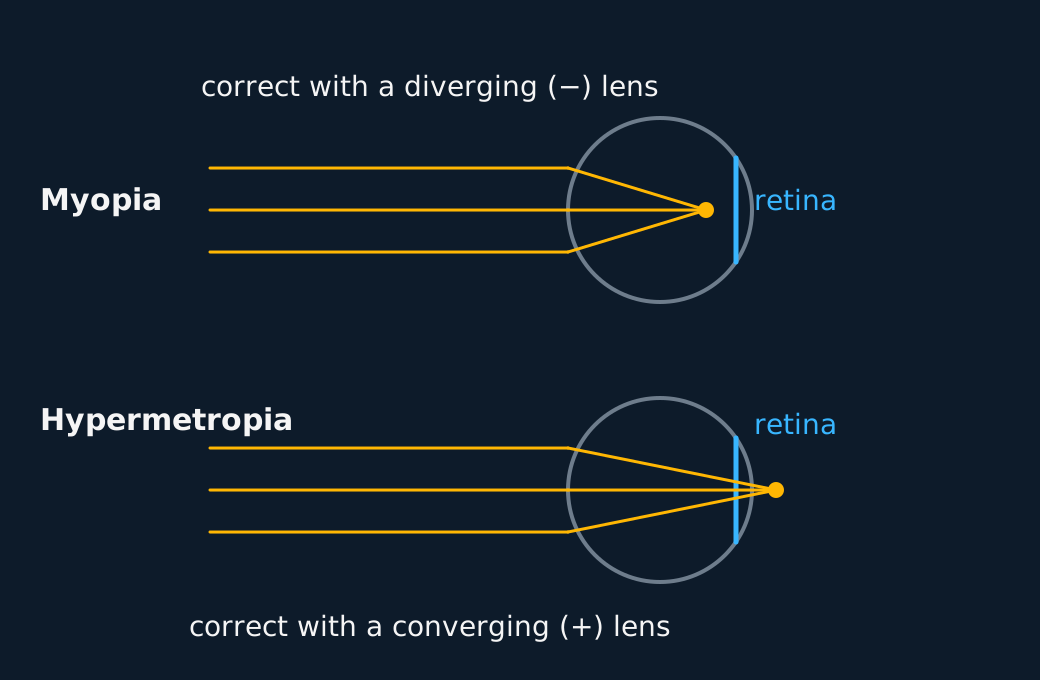
Read each defect off the limit that actually shows it. Myopia shows in the far point, which has come in from infinity. Hypermetropia is a shortage of power at every distance, but what the patient notices is the near point, pushed out beyond 0.25 m. So a distant near point on its own does not establish long sight. If the far point is still at infinity, the unaccommodated eye focuses distant objects perfectly and the refraction is normal; only the range of accommodation has shrunk, which is presbyopia, the loss that comes with a stiffening lens. The reading correction is worked out exactly as for hypermetropia.
The correcting lens
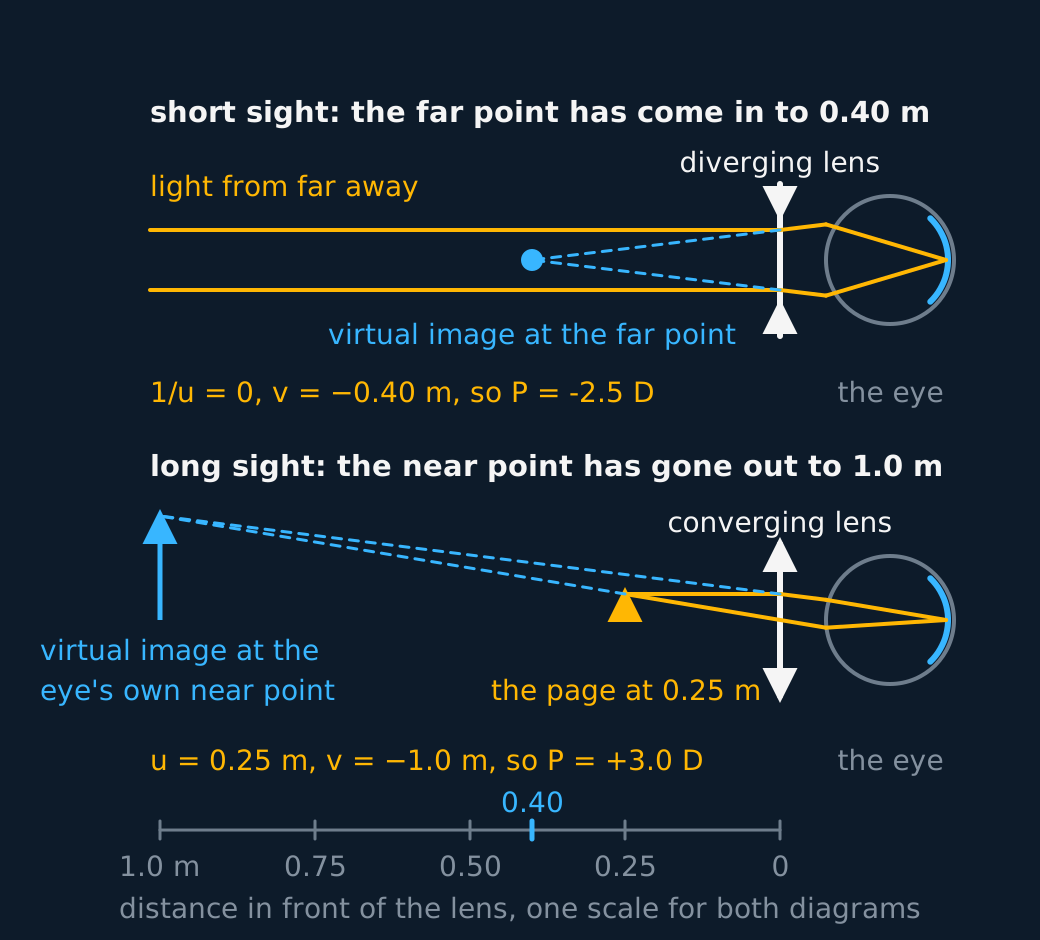
A correcting lens is not asked to form an image on the retina. It is asked to move the object to somewhere the eye can already cope with, and the image it makes is the object the eye then works on. That image is virtual, on the same side as the object, so it carries a negative v.
A spectacle lens sits about a centimetre in front of the eye and forms its image outside the eye, so it cannot place anything on the retina; it presents the eye with a virtual image standing within the eye's own range of focus. For distant vision that means taking an object at infinity and forming its image at the far point. For reading it means taking a page at 0.25 m and forming its image at the eye's own near point. The eye then focuses that image on the retina.
WORKED EXAMPLE
The lens for a short-sighted eye
A myopic eye has its far point 0.40 m away. Find the power of the spectacle lens that lets it see distant objects.
The lens must take an object at infinity and place its image at the far point, so u is infinite and v = −0.40 m.
1/f = 0 + 1/(−0.40) = −2.5, so P = −2.5 D, a diverging lens.
Dropping the minus sign on v gives +2.5 D. That lens would converge the light still earlier and make the sight worse, so the sign carries the physics.
WORKED EXAMPLE
The lens for a long-sighted eye
A hypermetropic eye has its near point 1.0 m away. Find the power of the lens that lets it read at the normal 0.25 m.
The lens must take the page at u = 0.25 m and form a virtual image at the eye's own near point, so v = −1.0 m.
1/f = 1/0.25 + 1/(−1.0) = 4.0 − 1.0 = 3.0, so P = +3.0 D, a converging lens.
Note which distance is which. The near point belongs to the eye and becomes v; where the patient wants to read becomes u.
Astigmatism and the prescription
Astigmatism is a different fault. The cornea, or sometimes the lens, is not the same shape in every direction across its face, so it has more power along one axis than along the one at right angles to it. A point object cannot be brought to a point image in both directions at once, and the patient sees lines sharp in one orientation and blurred in the other.
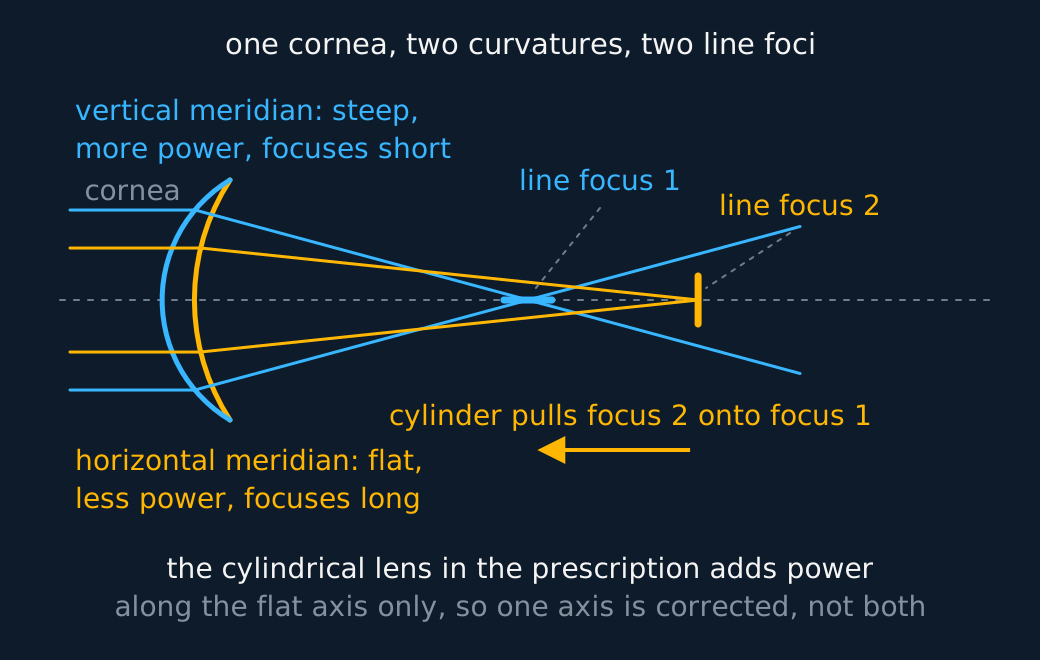
The cure is a lens carrying matching extra power along one axis only, so a prescription needs three numbers rather than one. SPH is the ordinary spherical power in dioptres. CYL is the extra cylindrical power, again in dioptres. AXIS is an angle in degrees from 0 to 180, measured round from the horizontal, naming the meridian along which the cylinder adds no power at all; its power acts in the meridian at right angles to that. A prescription reading −2.50 / −0.75 × 90 has its axis vertical, so the extra −0.75 D works across the horizontal meridian. The axis marks the meridian in which the cylinder adds no power, not the one in which it acts.
Combined defects are the normal case rather than the exception. The spherical number corrects the myopia or hypermetropia exactly as above, the cylinder corrects the astigmatism on top of it, and the axis tells the lens maker how to orient the cylinder in the frame. Reading all three off a prescription, and saying what each one corrects, is the whole of what the specification asks.
ASSESSMENT FOCUS
- Check the far point before you name long sight. A far point at infinity with a near point beyond 0.25 m is reduced accommodation, presbyopia, not hypermetropia: the distance refraction is normal and only the range of power has gone.
- Correcting-lens questions turn on one virtual image. Myopia: object at infinity, image at the far point, v negative, so the power comes out negative. Hypermetropia: object at 0.25 m, image at the patient's near point, v negative again, and the power comes out positive.
- Convert to metres and keep the sign. A dioptre is one per metre, the correcting lens's image is always virtual, so its v is always negative, and dropping that sign turns the lens into the wrong type.
- Check the answer's sign against the defect before moving on. Myopia takes a diverging lens and a negative power; hypermetropia takes a converging lens and a positive one.
- For astigmatism, AQA asks for the format of the prescription rather than the optics. Three numbers: spherical power, cylindrical power, and the axis in degrees.
CHECK YOURSELF
An eye has its retina 23 mm behind its lens. Its far point is 0.50 m away. Find the power of the relaxed eye, state which defect this is, and find the power of the correcting lens.
Show a hint
Relaxed means focused on the far point. The correcting lens takes an object at infinity to that same far point.
Show the answer
Relaxed on the far point: 1/f = 1/0.50 + 1/0.023 = 2.0 + 43.5 = 45.5, so P = 45.5 D.
A far point at a finite 0.50 m instead of infinity is myopia. The relaxed eye is more powerful than its length needs, so distant objects focus in front of the retina.
The correcting lens must place an object at infinity at the far point: u infinite, v = −0.50 m, so 1/f = −2.0 and P = −2.0 D, a diverging lens.
Check the sense of it. The eye is 2.0 D too strong for infinity, and the lens takes exactly 2.0 D away.
Myopia is a finite far point corrected by a diverging lens; hypermetropia is too little power for the eye's length, corrected by a converging lens. A distant near point with the far point still at infinity is lost accommodation, not long sight.
Power in dioptres needs the focal length in metres, and a diverging lens has a negative power.
The correcting lens forms a virtual image where the eye can already focus, so its v always carries a minus sign.
A prescription is SPH, CYL and AXIS, and the axis names the meridian where the cylinder adds no power.
Or read them with their mark schemes on the eye as an optical system questions page.
CHECK YOUR PROGRESS
Rate how confident you feel with each objective for this lesson. Ratings are saved in this browser, on this device, unless you sign in.
- Find the power in dioptres of the lens that corrects myopia or hypermetropia.
- Say what astigmatism is and read the three numbers of its prescription.
Open the full revision checklist to track your progress across the whole unit.