Physics › Medical physics › The eye as an optical system
The eye as an optical system
Cornea and lens throw a real, inverted, diminished image onto the retina, and because the retina cannot move, the eye focuses by changing its power. That change is accommodation, calculated in dioptres from 1/u + 1/v = 1/f. Cones in the fovea carry colour and detail; many rods share one nerve fibre, trading resolution for sensitivity.
Choose your exam board to show the notes and questions relevant to your specification. You can change this setting at any time, and content for other boards remains available.
The physics of the eye, part 1 of 2. Part 2 is Defects of vision and their correction.
Builds on Lenses and images and Refraction and Snell's law.
IN THIS TOPIC
- Trace rays through the eye and say what kind of image lands on the retina.
- Explain accommodation as a change of power at fixed image distance, and use 1/u + 1/v = 1/f to find the eye's focal length.
- Explain the eye's spectral response and its spatial resolution in terms of rods and cones.
COMMON MISCONCEPTION
The eye focuses on near and far objects by moving its lens, the way a camera does.
The lens does not move: the retina is a fixed distance behind it, so v cannot change. Ciliary muscles change the shape of the lens instead, altering its focal length and so its power, and that change of power is accommodation.
One converging system, one fixed screen
Light entering the eye is bent twice. Most of the bending happens at the cornea, the curved front window, because that is where light crosses the largest change of refractive index. The lens behind it makes the smaller adjustment, and the iris opens and closes the pupil to control how much light gets in. For calculations the whole arrangement is treated as one thin converging lens, with the retina acting as the screen about 23 mm behind it.
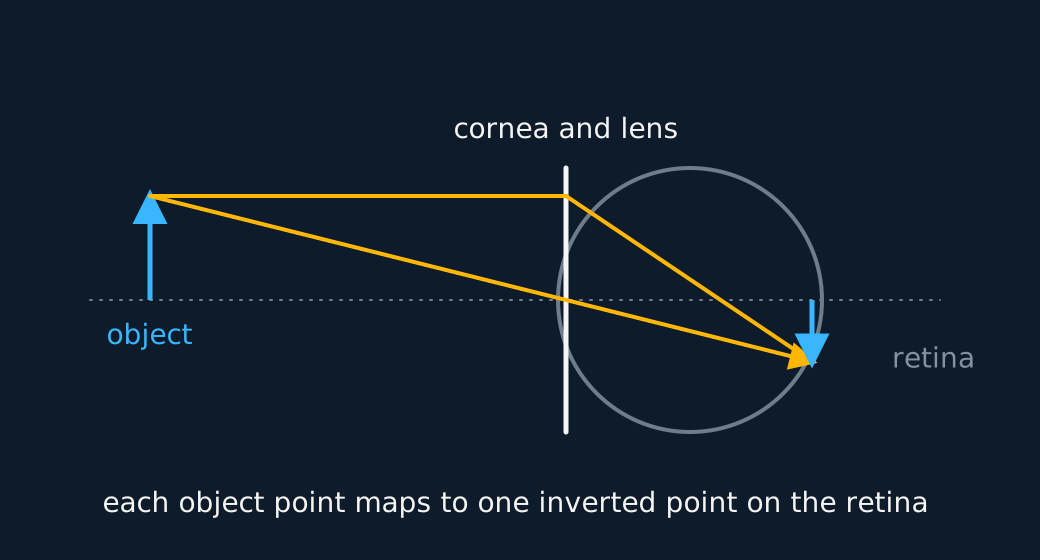
So the image on the retina is real, inverted and diminished. Nothing later turns it the right way up. The brain learns to interpret it, so a question about the retinal image is a question about the optics, not about perception.
Three equations from the lenses lesson do all the arithmetic here. Power and focal length are two names for one property,
with f in metres and P in dioptres. Object distance, image distance and focal length are tied together by
in the real-is-positive convention, and the size of the image follows from
Accommodation: the power that changes
The retina cannot move, so v is stuck at about 23 mm whatever you look at. Read 1/u + 1/v = 1/f with v fixed and one thing has to give. When u changes, f must change with it, and the eye must supply a different power for every distance. The ciliary muscles do it indirectly: contracting, they slacken the suspensory ligaments holding the lens, and the elastic lens rounds itself into a fatter, more strongly converging shape. That is accommodation.
Two distances mark the limits of what accommodation can reach. The far point is the furthest object the eye can focus, at infinity for a healthy eye, and the eye is fully relaxed there. The near point is the closest, taken as 0.25 m for a normal adult eye and reached with the lens working hardest. That 0.25 m is also called the least distance of distinct vision, and it is the distance every reading calculation assumes.
WORKED EXAMPLE
How much power does accommodation supply?
An eye has its retina 23 mm behind the lens and its far point at infinity. Find the power of the relaxed eye, and the power it needs to focus on a page 0.25 m away.
Relaxed: u is infinite, so 1/u is zero and 1/f = 1/0.023. The focal length is 23 mm and P = 43.5 D.
On the page: 1/f = 1/0.25 + 1/0.023 = 4.0 + 43.5 = 47.5, so P = 47.5 D and f = 21 mm.
Accommodation therefore supplies 47.5 − 43.5 = 4.0 D, which is exactly 1/0.25. The extra power an eye needs is always one over the object distance, because the 1/v term never moves.
The trap is writing v = 0.25 m. The object is at 0.25 m; the image is on the retina, where it always is.
Accommodation has limits, and the near point and the far point are where they show. When the far point comes in from infinity, or the near point moves out beyond 0.25 m, the eye has a defect of vision that a spectacle lens corrects.
The retina as a photodetector
As a detector the eye has two kinds of cell. Cones work in bright light, come in three types responding to different bands of wavelength, and between them give colour vision. Rods work in dim light, come in one type only, and so report brightness and nothing about colour.
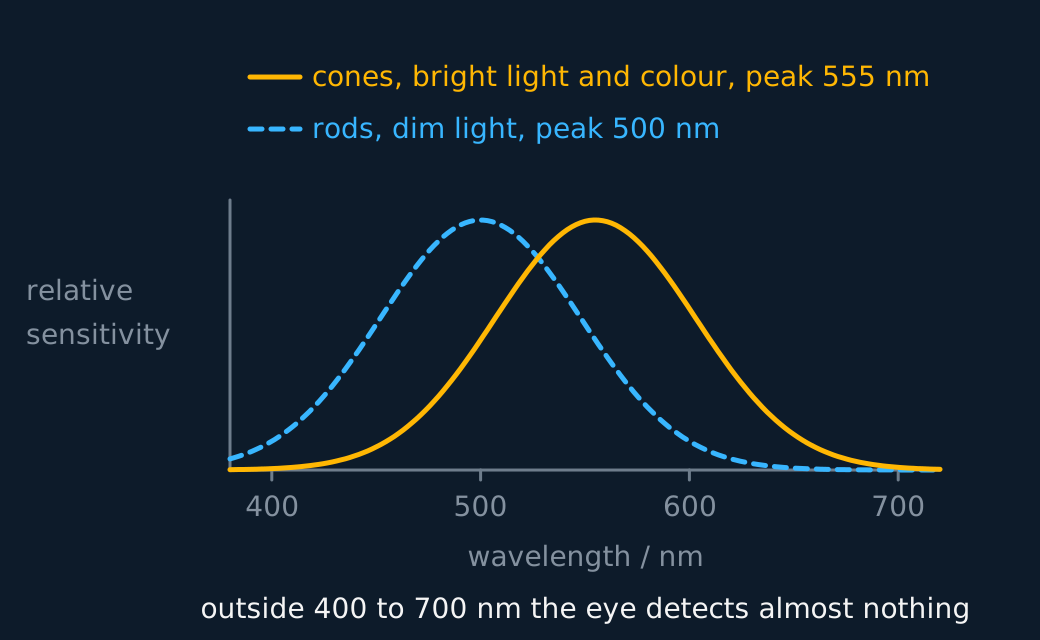
That figure is the eye's spectral response, and it is the reason the visible spectrum ends where it does. Sensitivity peaks in the yellow-green, near 555 nm in good light, and falls to nothing outside roughly 400 nm to 700 nm. The rods peak at a shorter wavelength, near 500 nm, so as the light fades the eye's peak sensitivity shifts towards blue-green and reds go dark first. That is a shift in sensitivity, not a new best colour, because the rods that take over do not distinguish colours at all.
Spatial resolution depends on how closely the cells are packed and how they are wired. Cones crowd into the fovea, a small patch on the axis of the eye, and each one there has effectively its own nerve fibre. Two lit cones with an unlit one between them therefore arrive at the brain as two separate signals, and detail survives. Rods lie outside the fovea and many of them share a single fibre, so their signals are added together before they leave the eye.
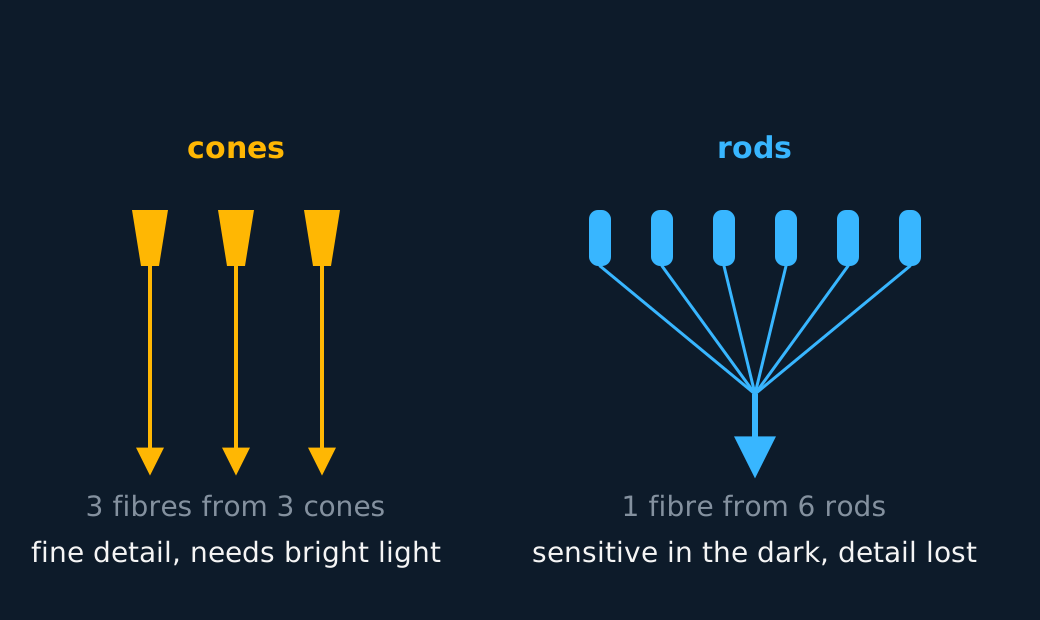
That convergence increases sensitivity in low light but reduces spatial resolution, because the brain cannot tell which rod in the group was lit; it is why the dark-adapted eye can work by starlight. Cones have less convergence, giving greater acuity in bright light, and the eye's practical resolution of about one minute of arc, roughly 3 × 10⁻⁴ rad, is a fovea figure. Look slightly to one side of a faint star and it brightens, because you have moved its image off the fovea and onto the rods.
Two defects, two lenses has moved to the next part of this lesson.
ASSESSMENT FOCUS
- Say real, inverted and diminished for the retinal image. All three words are needed, and the whole phrase takes one line.
- Accommodation answers must name what stays fixed. The image distance is the length of the eyeball and cannot change, so the focal length and hence the power must change instead, and the ciliary muscles change the shape of the lens to do it.
- In every eye calculation the retina is the image, so v is the eyeball length and u is the object distance. Interchanging them gives a focal length of the wrong order of magnitude.
- Convert to metres before taking any reciprocal. A dioptre is one per metre, so 23 mm has to be 0.023 m; a power computed from centimetres is out by a factor of 100.
- Resolution answers must reach the nerve fibres. Cones in the fovea have one fibre each, so nearby cones stay separate; many rods share a fibre, so their signals are combined and cannot be told apart.
CHECK YOURSELF
An eye has its retina 23 mm behind its lens. It looks at a tree 4.0 m tall standing 50 m away. Find the power the eye must supply, state the nature of the image on the retina, and find the size of that image.
Show a hint
The retina is the image, so v = 0.023 m whatever the tree does. The size comes from m = v/u.
Show the answer
1/f = 1/u + 1/v = 1/50 + 1/0.023 = 0.02 + 43.5, so P = 43.5 D, barely above the fully relaxed power: at 50 m the eye is doing almost no accommodating.
The image is real, inverted and diminished, as it is for every object the eye focuses.
m = v/u = 0.023/50 = 4.6 × 10⁻⁴, so the image is 4.0 × 4.6 × 10−4 = 1.8 mm tall.
A four-metre tree lands on under two millimetres of retina. That is why the packing of the cones in the fovea, and the wiring behind them, decides how much of the tree you actually resolve.
The image distance in the eye is fixed, so focusing changes the power, not the position of the lens.
The extra power the eye must supply for a near object is always 1/u, because the 1/v term never moves.
Cones give colour and detail in bright light; rods give sensitivity in the dark and lose the detail by sharing nerve fibres.
WORKBOOK
Printable practice for this topic: original exam-style questions with room to work, and a fully worked answer book. Free to use; please do not redistribute or sell.
Or read them with their mark schemes on the eye as an optical system questions page.
CHECK YOUR PROGRESS
Rate how confident you feel with each objective for this lesson. Ratings are saved in this browser, on this device, unless you sign in.
- Trace rays through the eye and say what kind of image lands on the retina.
- Explain accommodation as a change of power at fixed image distance, and use 1/u + 1/v = 1/f to find the eye's focal length.
- Explain the eye's spectral response and its spatial resolution in terms of rods and cones.
Open the full revision checklist to track your progress across the whole unit.