Physics › Particles › Decays at quark level
Decays at quark level
Beta-minus decay of the neutron is one down quark becoming an up quark, udd to uud, with a W⁻ boson carrying off the charge. Any decay comes apart the same way: write the quark content under both sides and find the quark that changed flavour. A change of strangeness names the weak interaction.
Choose your exam board to show the notes and questions relevant to your specification. You can change this setting at any time, and content for other boards remains available.
Watch Quarks and antiquarks: hadrons and beta decay on the InkPhysics YouTube channel
Quarks and antiquarks, part 2 of 2. Part 1 is Quarks and the hadrons built from them.
IN THIS TOPIC
- Describe the decay of the neutron in terms of its quarks.
- Take any decay apart at quark level, naming the quark that changed flavour and the W boson that carried the charge away.
COMMON MISCONCEPTION
In beta-minus decay a down quark turns into an electron.
The down quark is not destroyed and does not become the electron: it changes flavour to an up quark and emits a W− boson, and it is the W that becomes the electron and the electron antineutrino.
The neutron's decay at quark level
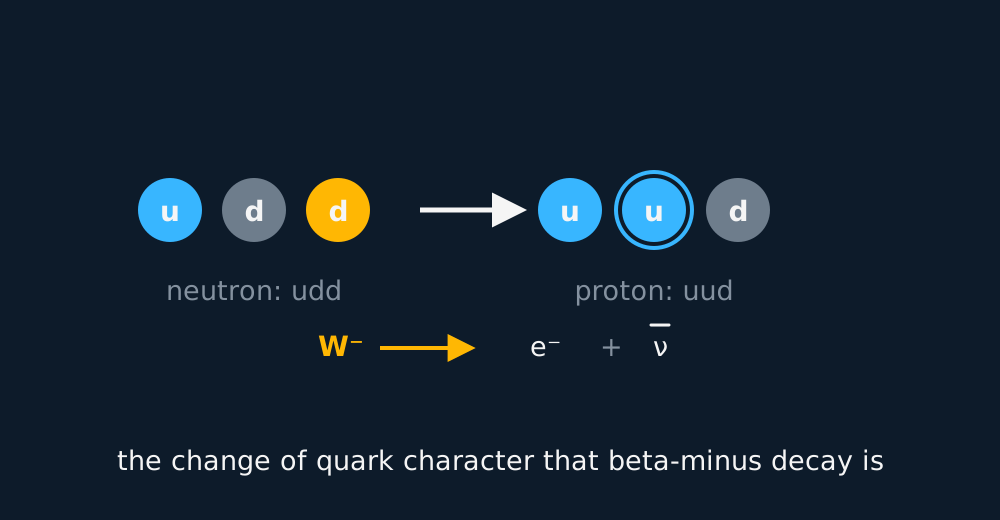
In beta-minus decay, one down quark changes into an up quark through the weak interaction: udd → uud. This changes a neutron into a proton. A W− carries away the charge difference and becomes the electron and the electron antineutrino, while the other two quarks are unchanged.
Any decay, taken apart the same way
The neutron has no monopoly on that method, and OCR names the general version as an outcome of its own. Write the quark content under every particle on both sides of the arrow, then look for the single quark that changed flavour. Everything else is spectators, and a W boson carrying off whatever charge the change released.
Run it on the kaon's decay into pions. A K− is s, and it goes to a π− and a π0. The strange quark becomes an up quark, emitting a W− exactly as the neutron's down quark did. That W− becomes a d with an , which is the π−, while the kaon's own spectates throughout and pairs with the new up quark to make the π0.
That accounts for the strangeness rule. All of a kaon's strangeness is carried by its one strange quark, so removing that quark takes S from −1 to 0, and only the weak interaction changes quark flavour. Strong interactions conserve quark flavour and therefore conserve strangeness; weak interactions may change it. That is why the strong interaction can create strange particles only in pairs of opposite strangeness, and cannot decay one on its own.
INDEPENDENT PRACTICE
A heavier strange particle
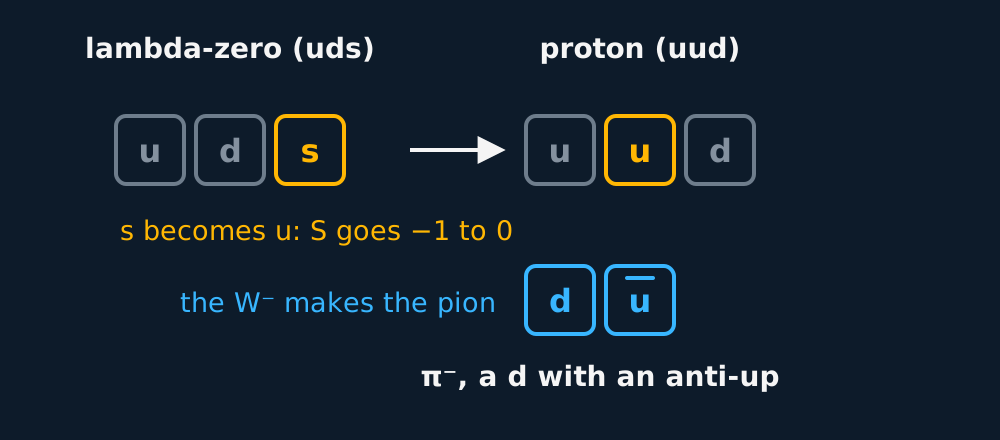
A Λ0 baryon has quark content uds, and it decays to a proton and a π−. Identify the quark that changes flavour, name the interaction, and say what happens to strangeness.
Show the working
Line up the contents. The proton is uud and the π− is d, so the lambda's u and d are spectators and the quark that moved is the s, which became a u. The W− it emitted became the d and the of the pion.
Strangeness runs −1 → 0, a change of one, so this is the weak interaction and nothing else. The lambda's comparatively long life is consistent with that. The method is the same every time: find the quark that changed flavour, and the interaction follows from it.
ASSESSMENT FOCUS
- Give neutron decay at quark level when the paper is on this topic. One d becomes a u, a W− leaves, and it becomes e− with an electron antineutrino. “n → p” alone leaves out the quark-level detail the question asks for.
- Check the vertex in thirds. A d at −⅓ becoming a u at +⅔ means the W carried off one whole negative charge, and a vertex that does not balance in thirds has the wrong W on it.
- OCR alone asks for decays beyond beta at quark level, and the method is always the same: write the quark content under every particle, point at the one that changed flavour, and name the W that carried the charge off. For a kaon that is s becoming u, with the W− turning into a pion and strangeness dropping by one.
- Only the weak interaction changes quark flavour, so a decay in which strangeness changes is weak and nothing else. Say that rather than inferring it from the lifetime alone.
CHECK YOURSELF
A Σ− baryon has quark content dds and decays to a neutron and a π− (d). (a) Identify the quark that changes flavour and what it becomes. (b) Name the interaction and justify it. (c) State what the emitted W boson became.
Show a hint
Write the quark content under both sides and look for the single change.
Show the answer
(a) The neutron is udd, so the sigma's two d quarks spectate and the s becomes a u.
(b) Strangeness runs −1 → 0, and only the weak interaction can change quark flavour and so strangeness. The strong interaction conserves it exactly.
(c) The s at −⅓ became a u at +⅔, so a W− left, and it became the d and the anti-up that make the π−.
It is the lambda's decay again with a different spectator pair, which is the point of the method: one recipe, and the particle names change nothing about it.
Write the quark content under both sides and find the one quark that changed flavour.
The neutron's decay is one d becoming a u.
Only the weak interaction changes flavour, so a change of strangeness names the interaction.
Or read them with their mark schemes on the quarks and the hadrons built from them questions page.
CHECK YOUR PROGRESS
Rate how confident you feel with each objective for this lesson. Ratings are saved in this browser, on this device, unless you sign in.
- Describe the decay of the neutron in terms of its quarks.
- Take any decay apart at quark level, naming the quark that changed flavour and the W boson that carried the charge away.
Open the full revision checklist to track your progress across the whole unit.