Physics › Periodic motion › Energy in an oscillation and damping
Energy in an oscillation and damping
Kinetic and potential energy swap twice in every cycle of an undamped oscillation, while the total stays constant at E = ½kA², or ½mω²x₀². Damping passes that total to the surroundings, so the amplitude decays inside an exponential envelope while the period barely changes. Light, heavy and critical damping differ in how the system settles.
Choose your exam board to show the notes and questions relevant to your specification. You can change this setting at any time, and content for other boards remains available.
Watch Pendulums, springs, energy and damping on the InkPhysics YouTube channel
SHM systems: pendulums and springs, part 2 of 2. Part 1 is The mass on a spring and the simple pendulum.
IN THIS TOPIC
- Describe how Ek, Ep and the total energy vary with displacement and with time.
- Put a number on the total with E = ½kA², and get CIE's E = ½mω²x₀² out of it through ω² = k/m.
- Tell light, heavy and critical damping apart by what each does to the motion.
COMMON MISCONCEPTION
The kinetic energy of an oscillator goes through one complete cycle each oscillation.
The energy peaks twice per oscillation, not once: kinetic energy is greatest at the centre going each way, and zero at both extremes. So the energy graphs run at twice the frequency of the displacement graph.
Energy in an oscillation
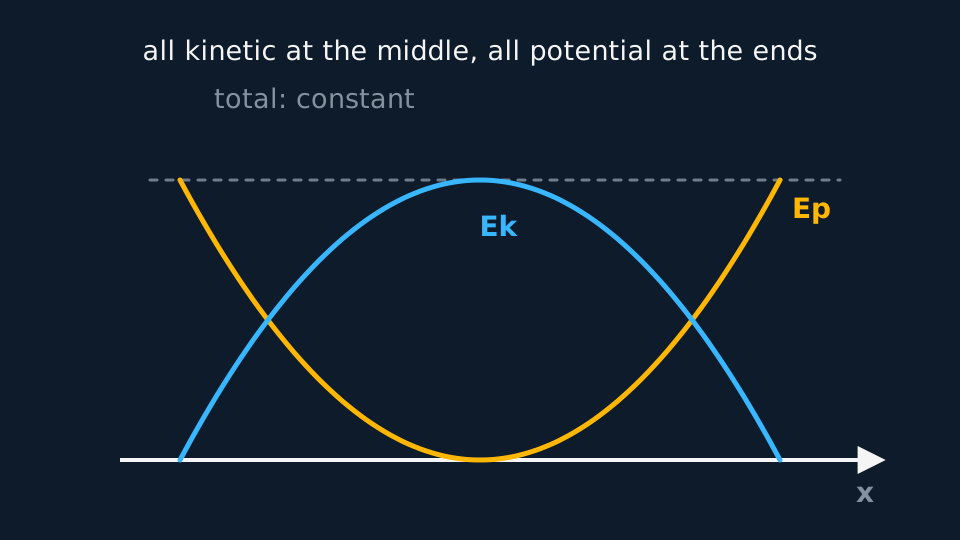
During ideal SHM, energy transfers continuously between kinetic and potential energy while the total remains constant. Potential energy is maximum at the extremes and zero at the centre, growing as the square of the displacement; kinetic energy is maximum at the centre and zero at the extremes; the total stays constant. Against time, each energy oscillates at twice the frequency of the motion, because the two extremes of a cycle give the same energies. Sketching either graph, energy against displacement or against time, is a standard question.
The total energy follows from the extreme position, where all of it is potential. For a horizontal mass-spring that potential is the spring's elastic energy, ½kx2. For a vertical spring, x is measured from the hanging equilibrium, and the quantity growing as ½kx2 is the combined spring-plus-gravity potential measured from its minimum there, not the spring's elastic energy alone. The two effects combine into the same expression, so one formula serves both arrangements. An oscillation of amplitude A therefore carries
This total is the energy of the motion at every instant. CIE asks for the same quantity in a form that mentions no spring at all, writing x0 for the amplitude,
so on that specification it is a recall item, printed in no booklet. These are one equation and not two. The mass-spring result at the top of this lesson was ω2 = k/m, which rearranges to k = mω2, and substituting that into ½kA2 gives ½mω2A2. Check the two forms against each other: take the 0.20 kg mass on the 32 N m−1 spring, where ω2 = 32/0.20 = 160 s−2, and ½ × 0.20 × 160 × 0.0502 = 0.040 J, which is the ½kA2 answer below to the last digit.
The second form is also the more general one. Every simple harmonic oscillator obeys it, spring or not, because ω and the amplitude are all simple harmonic motion has; ½kA2 needs a stiffness and so applies only to springs. Use it when a question gives a mass and a period but no value of k, which is how most pendulum questions are set.
GUIDED PRACTICE
Total energy and speed at the centre
The same oscillator, k = 32 N m−1 and m = 0.20 kg, swings with amplitude 0.050 m. Find the total energy, then the speed at the centre.
Show the working
At the ends the energy is all potential, so E = ½kA2 = ½ × 32 × 0.0502 = 0.040 J.
At the centre it is all kinetic, so ½mv2 = 0.040 and v = 0.63 m s−1. The same answer follows from v = ωA, which is a useful cross-check.
INDEPENDENT PRACTICE
A pendulum abroad
A 1.0 m pendulum ticks on Earth (g = 9.81) and then on Mars (g = 3.71 m s−2). Find both periods, and state the general rule your answers illustrate.
Show the working
On Earth, T = 2π × the square root of 1.0/9.81 = 2.0 s. On Mars, T = 2π × the square root of 1.0/3.71 = 3.3 s.
Weaker gravity gives a longer period. T is proportional to one over the square root of g, so a pendulum's period can be used to measure the local value of g.
Damping
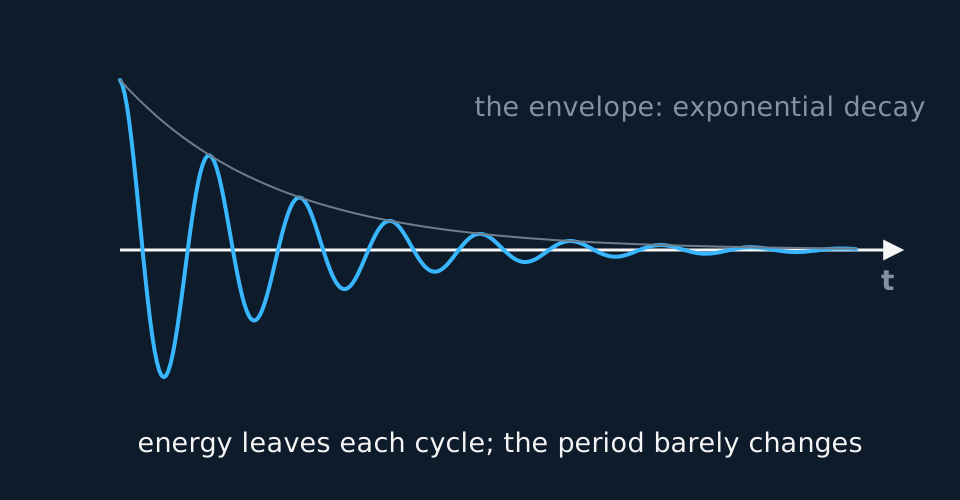
Real oscillators lose energy. Damping is the loss of energy to resistive forces, air resistance and internal friction among them, and its signature is an amplitude that decays, exponentially in the common case, while the period barely changes. The energy is transferred to internal energy in the surroundings. The oscillation continues at nearly the same period with a steadily decreasing amplitude.
Three grades of damping are examined by name. Light damping lets a system oscillate many times over, the amplitude shrinking slowly inside its envelope, which is a pendulum swinging in air. Heavy damping prevents oscillation, so the system returns to equilibrium slowly and does not cross it, which is that pendulum in treacle. Between them lies critical damping, the case that brings a system back to equilibrium in the shortest possible time with no oscillation at all. Car suspensions and the needle of a moving-coil meter are tuned for it, so that a bump or a reading settles once and stays settled.
ASSESSMENT FOCUS
- Energy against time oscillates at twice the frequency of the motion, and the total is a horizontal line. Show both features on a sketch.
- CIE prints neither form of the total energy, so learn E = ½mω²x0² and remember that ω² = k/m turns it straight back into ½kA². Quote whichever form is built from the quantities the question actually gave you.
- Critical damping means the quickest return to equilibrium with no oscillation. Heavy damping also avoids oscillation but takes longer, so distinguish the two.
- Damping takes the amplitude down and leaves the period almost alone. An answer that has a damped pendulum swinging more slowly has confused the two.
CHECK YOURSELF
A 0.40 kg mass on a spring of spring constant 90 N m−1 oscillates with an amplitude of 0.080 m. (a) Calculate the total energy of the oscillation. (b) Calculate the maximum speed of the mass. (c) The oscillation is then lightly damped. State what happens to the amplitude and to the period.
Show a hint
Where in the cycle is all the energy kinetic?
Show the answer
(a) E = ½kA2 = 0.5 × 90 × (0.080)2 = 0.29 J.
(b) At the centre the potential energy is zero and the whole total is kinetic, so ½mv2max = 0.29 J and vmax = √(2 × 0.29/0.40) = 1.2 m s−1.
(c) The amplitude decays, inside an exponential envelope, because energy is transferred to internal energy in the surroundings. The period barely changes: light damping takes the size of the oscillation away and leaves its timing almost untouched.
Taking the maximum speed from the energy rather than from ωA is the same answer by another route, and it is the route that works when the question gives k and A rather than ω.
Energy transfers between kinetic and potential; the total is constant while nothing damps it.
The energy varies at twice the frequency of the motion.
Damping reduces the amplitude, and light damping changes the period only slightly.
Or read them with their mark schemes on the mass on a spring and the simple pendulum questions page.
CHECK YOUR PROGRESS
Rate how confident you feel with each objective for this lesson. Ratings are saved in this browser, on this device, unless you sign in.
- Describe how Ek, Ep and the total energy vary with displacement and with time.
- Put a number on the total with E = ½kA², and get CIE's E = ½mω²x₀² out of it through ω² = k/m.
- Tell light, heavy and critical damping apart by what each does to the motion.
Open the full revision checklist to track your progress across the whole unit.