Physics › Periodic motion › The mass on a spring and the simple pendulum
The mass on a spring and the simple pendulum
The mass on a spring oscillates with period T = 2π√(m/k), and the simple pendulum with T = 2π√(l/g) provided its swings stay small. Each formula omits a quantity that questions ask about: no g in the spring's, no mass in the pendulum's. Plotting T² against mass or length gives k or g from the gradient.

Choose your exam board to show the notes and questions relevant to your specification. You can change this setting at any time, and content for other boards remains available.
SHM systems: pendulums and springs, part 1 of 2. Part 2 is Energy in an oscillation and damping.
Builds on Simple harmonic motion and Density and Hooke's law.
IN THIS TOPIC
- Use T = 2π√(m/k) for a mass-spring system, and say why g never appears in it.
- Use T = 2π√(l/g) for a simple pendulum, with the small-angle condition stated.
- Get k or g from the gradient of a T2 graph, the way required practical 7 does.
COMMON MISCONCEPTION
Heavier pendulums swing slower.
A pendulum's period is independent of mass: T = 2π√(L/g) depends only on length and g. Mass appears in the period only for a mass on a spring.
The mass-spring system
Hang a mass on a spring, displace it, and Hooke's law supplies exactly the restoring force SHM demands. From F = −kx comes a = −(k/m)x, the defining equation with ω² = k/m. The period follows.
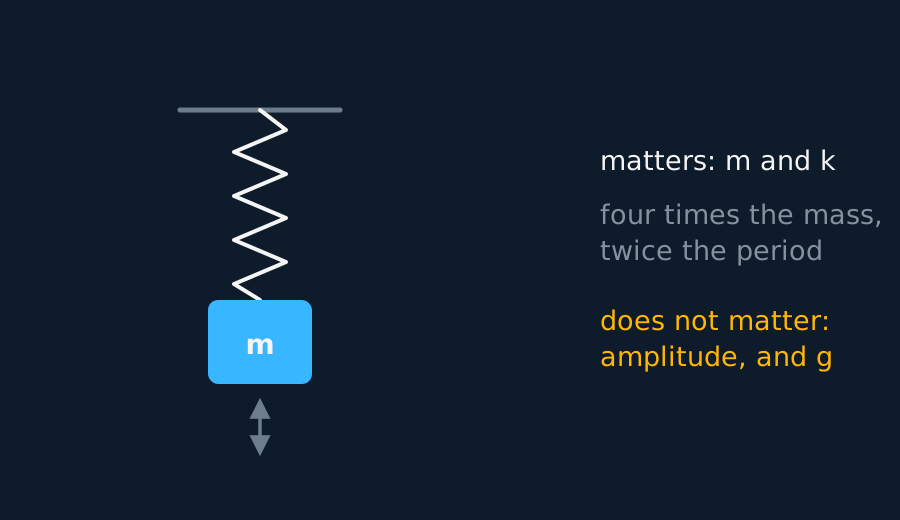
For a mass-spring system, T = 2π√(m/k): increasing m increases the period, while increasing k decreases it. Quadrupling m doubles T. Two quantities are absent. The amplitude does not appear because SHM is isochronous. g does not appear because gravity shifts the equilibrium position about which the mass oscillates without changing the restoring force for a given displacement from it, so the same system has the same period in orbit.
WORKED EXAMPLE
Reading a spring clock
A 0.20 kg mass hangs from a spring of stiffness 32 N m−1. Find the period and frequency of its oscillations.
T = 2π × the square root of m/k = 2π × the square root of 0.20/32.
That gives T = 2π × 0.079 = 0.50 s, and f = 1/T = 2.0 Hz.
Check the dependence: a stiffer spring or a smaller mass gives a shorter period, which is what k below the line and m above it in the formula require.
The simple pendulum
A pendulum's restoring force is the component of gravity along its arc, and for small angles that component is proportional to displacement, giving approximate SHM with

The mass is absent. Restoring force and inertia both scale with m, so it cancels, exactly as it did for objects in free fall. What does appear is g, so a pendulum can be used to measure the local gravitational field strength. The small-angle approximation is a condition on the result: both the formula and the simple harmonic motion behind it are approximations that hold for small swings only. Questions can also set other oscillators, liquid in a U-tube being the classic example, but they give all the information needed.
Required practical 7 tests both formulas. Time twenty oscillations and divide, so your reaction time is spread across twenty periods instead of one, then plot T2 against m for the spring or against l for the pendulum. Each gives a straight line through the origin, of gradient 4π2/k and 4π2/g respectively, so a stiffness or a value of g comes out of a whole graph instead of a single reading.
Energy in an oscillation has moved to the next part of this lesson.
Damping has moved to the next part of this lesson.
ASSESSMENT FOCUS
- Match the formula to the system, T = 2π√(m/k) for springs and T = 2π√(l/g) for pendulums, and notice that neither one contains the amplitude.
- The pendulum's period is independent of mass; the spring's is independent of g. Each absence gets asked about on its own.
- Both formulas hide a square root, so quadrupling m or l doubles T. Halving T needs a quarter of the length, not half of it.
- State the small-angle condition whenever you use the pendulum formula. For large swings the motion is no longer simple harmonic and the formula no longer applies.
- In required practical 7 the gradient is the answer, not any single reading. Plot T2 against m or against l, and take k from 4π2/gradient or g from the same expression.
CHECK YOURSELF
What length of simple pendulum has a period of 2.0 s? Take g = 9.81 m s−2. Would the answer change on the Moon?
Show a hint
Rearrange for l, and remember what sits inside the square root.
Show the answer
Rearranging: l = g(T/2π)2 = 9.81 × (2.0/2π)2 = 0.99 m, the metre-long “seconds pendulum” of old clocks.
On the Moon, yes. There g is about a sixth of ours, so the same 2.0 s period needs l = 1.62 × (0.318)2 ≈ 0.16 m. A pendulum reads its local gravity.
The bob's mass does not appear in the formula and is not needed.
A mass-spring period depends on m and k; a pendulum period on l and g.
Neither formula contains the amplitude, and the pendulum's does not contain the mass.
WORKBOOK
Printable practice for this topic: original exam-style questions with room to work, and a fully worked answer book. Free to use; please do not redistribute or sell.
Or read them with their mark schemes on the mass on a spring and the simple pendulum questions page.
WHERE TO GO NEXT
- Required practical 7: simple harmonic motion: mass-spring and pendulum puts this topic in the lab, and the written papers ask about it.
- Combining uncertainties is the maths this lesson leans on, worked through step by step.
USED LATER IN
CHECK YOUR PROGRESS
Rate how confident you feel with each objective for this lesson. Ratings are saved in this browser, on this device, unless you sign in.
- Use T = 2π√(m/k) for a mass-spring system, and say why g never appears in it.
- Use T = 2π√(l/g) for a simple pendulum, with the small-angle condition stated.
- Get k or g from the gradient of a T2 graph, the way required practical 7 does.
Open the full revision checklist to track your progress across the whole unit.