Physics › Periodic motion › Forced vibrations and resonance
Forced vibrations and resonance
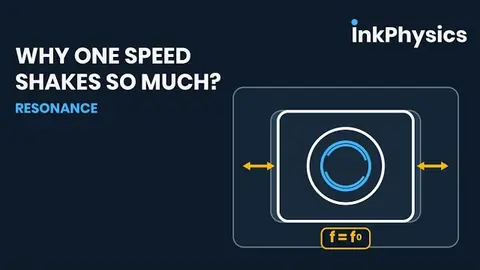
Resonance is the rise in amplitude that occurs when the driving frequency of a forced vibration matches the natural frequency of the system. Heavier damping lowers and broadens the peak and shifts it below the natural frequency, which is how unwanted resonance is engineered out. At the natural frequency the oscillator lags the driver by a quarter of a cycle.
Choose your exam board to show the notes and questions relevant to your specification. You can change this setting at any time, and content for other boards remains available.
Builds on The mass on a spring and the simple pendulum and Density and Hooke's law and Stationary waves on strings.
IN THIS TOPIC
- Separate free vibrations at the natural frequency from forced vibrations at the driving frequency, and state the resonance condition.
- Describe how damping reshapes the resonance curve and how the oscillator's phase sits relative to the driver, with mechanical and stationary-wave examples.
- For Edexcel, say how a resistive force and the plastic deformation of a ductile metal each take energy out of an oscillation and bring the amplitude down.
COMMON MISCONCEPTION
Pushing harder is all that matters.
Driving frequency decides the magnification, not the size of the response on its own. Double the driving force at any frequency and you double the amplitude; what matching the natural frequency buys you is the factor by which that push is magnified, which is why a small push at the right frequency beats a large one at the wrong one.
Free and forced
Displace a system and let go and it performs free vibrations at its own natural frequency, the one set by its mass and stiffness. Push it periodically instead and it performs forced vibrations at the driving frequency, whatever that is. The relationship between the two frequencies determines how large the response is.
Resonance
When the driving frequency equals the natural frequency, every push arrives in step with the velocity, pushing along the motion, so energy transfers in at the most efficient rate and the amplitude climbs to a maximum. That is resonance, stated for a lightly damped system. Think of a child on a swing: push twice as hard, at any frequency, and you get twice the amplitude: a linear oscillator's response is proportional to the driving force. What the timing changes is the factor by which that push is magnified. A mistimed push partly cancels the motion. A well-timed one builds it until the energy lost per cycle matches the energy supplied.

Describe the drawing
The driver sweeps slowly from below the natural frequency to above it. Far from f₀ the bob barely answers; as the frequencies meet it blooms, then shrinks again, and the cyan curve is the record of that sweep being drawn as it happens. The second pass reruns the sweep with heavier damping: the amber response is lower, broader, and peaks slightly early. Watch the lag too: in step below resonance, a quarter cycle behind at it, opposite above.
GUIDED PRACTICE
The singing glass
Flick a wine glass and it rings at one particular note. Explain why that note, and how a sustained loud sound at exactly that pitch could break the glass.
Show the working
The ring is the glass's natural frequency. Flicked, it vibrates freely at the frequency its stiffness and mass dictate, like every oscillator in this unit.
A loud tone at that same frequency is a periodic driving force at resonance. Each cycle arrives in step, energy transfers into the glass, and the amplitude climbs. Glass is brittle, so a large enough amplitude cracks it. Loudness on its own would not be enough. The match of frequencies is what does the damage.
Damping sets the sharpness
The shape of the amplitude-frequency curve is set by the damping. Light damping gives a tall, narrow peak at the natural frequency, so the system responds strongly only very close to that frequency and weakly at all others. Heavier damping gives a lower, broader peak, with its maximum slightly below the natural frequency. Sketch the family of curves on one set of axes.
The phase relationship between driver and oscillator is examined directly. Drive the system well below its natural frequency and the oscillator moves almost in step with the driver. At the natural frequency it lags by a quarter of a cycle, and by exactly that whatever the damping. Push the driving frequency well above the natural frequency and the lag grows towards half a cycle, leaving driver and oscillator moving in opposite directions.
The maximum of the amplitude curve moves further below the natural frequency as the damping increases, and beyond a certain amount of damping there is no peak at all: the response falls away as the driving frequency rises. The quarter-cycle phase lag at the natural frequency does not move. Elsewhere on this page, resonance refers to the lightly damped case, in which the two frequencies are close together.
Engineering uses both cases. Where resonance is a hazard (vehicle suspensions, buildings in wind or earthquakes, bridges under marching feet), designers add damping to flatten the peak. Where it is the aim (a musical instrument's body, radio tuning circuits), damping is kept light so the response stays sharp.
Resonance in stationary waves

Exam examples include situations involving stationary waves, and the stretched string is the cleanest of them. Drive it at one of its natural frequencies and the reflections reinforce, cycle after cycle, until a large stationary wave stands on the string. The large stationary wave corresponds to the peak of the resonance curve, and the harmonics of a stretched string are its set of resonant frequencies.
How damping removes energy from an oscillation
Exam-board note, Edexcel only. Edexcel asks by what mechanism damping reduces the amplitude, as well as what it does to the resonance curve. Damping reduces an amplitude for a single reason. Something takes energy out of the oscillator on every cycle. In a free oscillation that leaves less to swing with each time, so the amplitude decays; in a forced one it settles wherever the energy dissipated per cycle has grown to match the energy the driver puts in per cycle, which is exactly why a heavily damped system peaks so much lower. Two mechanisms are named, and both amount to the same energy loss described in different ways.
The first is a resistive force: air resistance, friction at a pivot, or oil driven through the narrow orifice of a car's dashpot. Such a force opposes the velocity at every instant, so it does negative work all the way round the cycle and never gives any of it back. The energy becomes internal energy, which is why a suspension worked hard on a rough road is warm to the touch afterwards.
The second is the plastic deformation of a ductile material. Take a ductile metal past its yield point and its structure rearranges permanently, so the work done in deforming it is not stored elastically and returned on the way back. It goes into moving dislocations through the metal and warming it, and on a force-extension graph it is the area between the loading line and the unloading line, which is the energy that is not recovered on unloading.
Engineers use that dissipation deliberately. Build a structure so that a sacrificial piece of mild steel yields a little on each large swing, and every swing removes energy from the oscillation until the amplitude falls. Steel yielding dampers in tall buildings and the crumpling members of a vehicle both work this way. The difference from a dashpot is that the deformation is permanent, so the part is replaced after a large event rather than simply used again.
ASSESSMENT FOCUS
- Definitions before anything else. Free vibrations happen at the natural frequency, forced vibrations at the driving frequency. A driven system oscillates at the driving frequency, not at its own.
- State the resonance condition in one line. Driving frequency equals natural frequency, giving maximum amplitude, because energy transfer from driver to oscillator is then most efficient. This is the lightly damped case.
- More damping means a lower and broader peak, sitting a little to the left of the natural frequency. Draw every requested curve on one set of axes and mark the natural frequency.
- Give the phase relationship between driver and oscillator: roughly in step well below the natural frequency, a quarter of a cycle behind at it whatever the damping, close to half a cycle behind well above it.
- Answer application questions the same way in both cases. Name the driver, name the natural frequency, then say whether damping is added (suspension, buildings) or kept low (instruments, tuning circuits).
- For a driven string, resonance shows up as a large-amplitude stationary wave, and the harmonics are its resonant frequencies.
- Edexcel: for “how does damping reduce the amplitude?”, give the energy account rather than the shape of the curve. Something removes energy every cycle, whether a resistive force doing negative work or a ductile metal yielding and keeping the work done on it. Name the mechanism, then say the energy is not returned to the oscillation.
CHECK YOURSELF
A washing machine vibrates violently at one particular spin speed and is calmer both above and below it. Explain the violence, and one design change that would reduce it.
Show a hint
One special frequency, and one property that reshapes the response curve.
Show the answer
At that spin speed the drum's driving frequency matches the machine's natural frequency, so the machine resonates. Each cycle of the imbalance feeds energy in exactly in step, and the amplitude builds to a maximum.
Above and below, the pushes fall out of step with the motion and partly cancel, so the response is far smaller: the machine is off the peak of its resonance curve.
Adding damping, shock absorbers say, lowers and broadens the peak, so even at that spin speed the amplitude stays modest. Stiffer mounts act differently: they raise the natural frequency, moving the peak away from the drum's working speeds rather than flattening it.
Resonance occurs when the driving frequency equals the system's natural frequency.
Heavier damping lowers and broadens the response peak.
WORKBOOK
Printable practice for this topic: original exam-style questions with room to work, and a fully worked answer book. Free to use; please do not redistribute or sell.
Or read them with their mark schemes on the forced vibrations and resonance questions page.
USED LATER IN
CHECK YOUR PROGRESS
Rate how confident you feel with each objective for this lesson. Ratings are saved in this browser, on this device, unless you sign in.
- Separate free vibrations at the natural frequency from forced vibrations at the driving frequency, and state the resonance condition.
- Describe how damping reshapes the resonance curve and how the oscillator's phase sits relative to the driver, with mechanical and stationary-wave examples.
- For Edexcel, say how a resistive force and the plastic deformation of a ductile metal each take energy out of an oscillation and bring the amplitude down.
Open the full revision checklist to track your progress across the whole unit.