Physics › Mechanics › Motion graphs and the SUVAT equations
Motion graphs and the SUVAT equations
Gradient and area read every motion graph: gradient gives velocity on a displacement-time graph and acceleration on a velocity-time graph. The area beneath a velocity-time graph is the displacement, whatever shape the curve takes. The four SUVAT equations are quicker but hold only while the acceleration stays constant.
Choose your exam board to show the notes and questions relevant to your specification. You can change this setting at any time, and content for other boards remains available.
The maths behind it: Kinematics with constant acceleration on InkMaths.
IN THIS TOPIC
- Use v = Δs/Δt and a = Δv/Δt, and tell an average value from an instantaneous one.
- Read gradients and areas off displacement-time, velocity-time and acceleration-time graphs, curved ones included.
- Choose the constant-acceleration equation that omits the quantity you neither have nor want.
- Derive all four constant-acceleration equations from the definitions of velocity and acceleration.
- Spot when the acceleration is not constant, and abandon SUVAT for the area under a graph.
COMMON MISCONCEPTION
SUVAT always works.
The SUVAT equations are derived assuming constant acceleration, so that is the only place they apply. When acceleration varies, the graphs still work: gradient and area never stop being true.
The quantities and their definitions
Motion runs on three quantities. Displacement s is the vector version of distance. Velocity is the rate of change of displacement, and acceleration the rate of change of velocity. Both defining equations are printed for you.
Applied over an interval these give average values. Shrink the interval and they become instantaneous ones, which is exactly what the gradient of a graph reads off at a point.
Reading the graphs
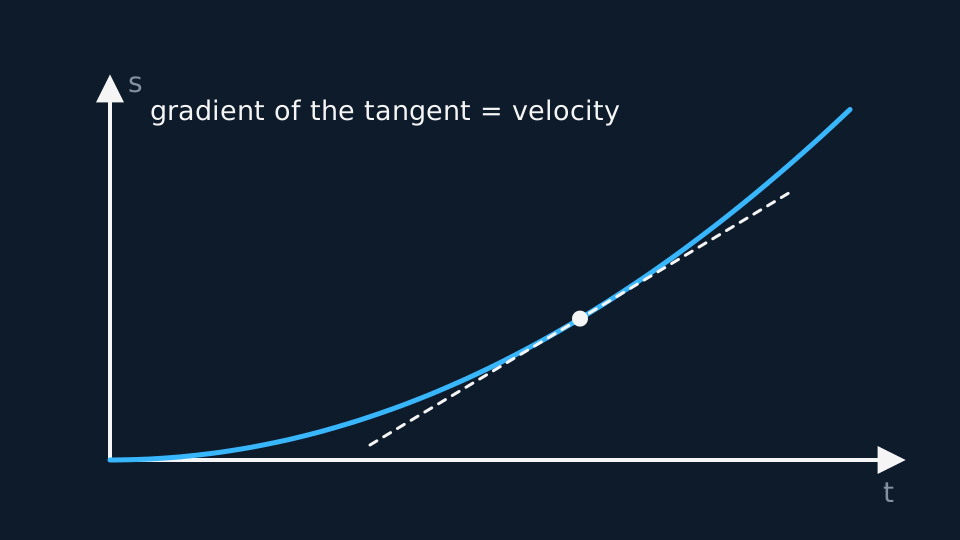
Two operations decode every motion graph in the course, gradient and area. On a displacement-time graph the gradient is the velocity. A curve whose gradient steepens is speeding up, and the gradient of the tangent gives the instantaneous velocity at that moment.
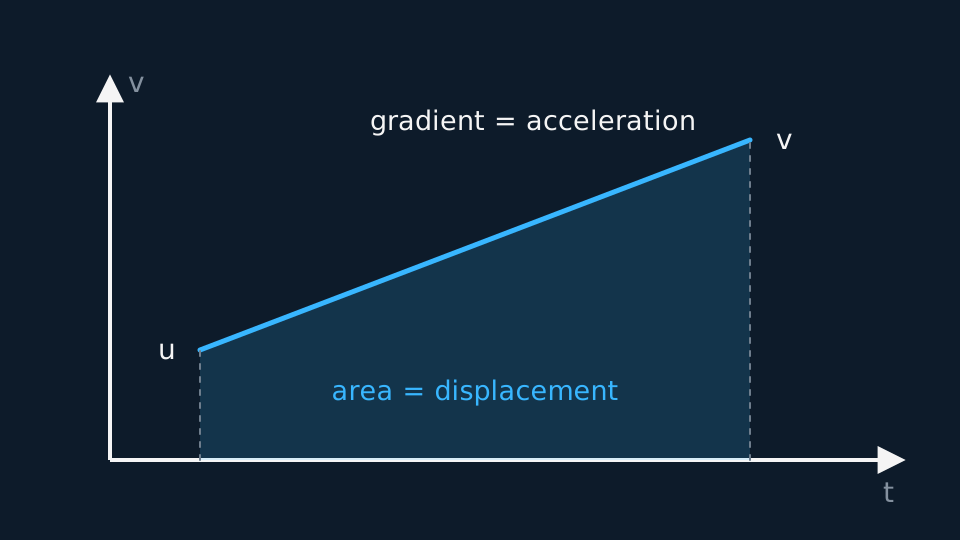
On a velocity-time graph, the gradient is the acceleration and the area beneath is the displacement. The area is the more valuable half, because it works for any shape of graph, including motions no equation describes. On an acceleration-time graph, the area gives the change in velocity.
Signs carry meaning throughout. Negative velocity is motion the other way, and area below the time axis subtracts from the displacement, which is how a ball thrown up and caught again ends with zero displacement despite plenty of distance travelled.

Describe the drawing
The ball falls, bounces, rises, and its velocity-time graph draws itself alongside: straight sloping lines of constant gradient, minus g all the way, with an instant vertical flip from the most negative to the most positive at every impact. Idealised with no energy loss, so the loop repeats exactly. The oddest feature of the v-t graph is just the bounce, seen in graph form.
The bouncing ball is a common exam example. During every flight, up or down, the only force is gravity, so every sloped section has the same gradient, −g. The bounce itself is the near-vertical jump. The figure is drawn lossless, every bounce returning to full height; for a real ball each bounce reaches a little lower than the last as speed is lost.
The four equations, and the condition
For constant acceleration only, four equations connect the five quantities s, u, v, a and t. The AQA, OCR A and Edexcel booklets print all four; CIE prints s = ut + ½at² and v² = u² + 2as only, so on 9702 the other two are recall items. Choosing the appropriate equation is the main step in most questions.
Each equation omits exactly one of the five quantities, which is how you choose between them.
WORKED EXAMPLE
Choosing the equation
A car brakes from 24 m s−1 to rest over 60 m. Find the deceleration.
List what is known. u = 24, v = 0, s = 60, and a is wanted. The quantity not involved anywhere is t, so reach for the equation without t in it, .
0 = 242 + 2a × 60, so a = −576/120 = −4.8 m s−2. The negative sign shows that the acceleration is opposite in direction to the initial velocity, so keep it in the answer.
The acceleration must be constant. A falling object with air resistance has an acceleration that decreases as it falls, so the SUVAT equations do not apply. Treat it as a velocity-time graph problem and take the displacement from the area instead. Free fall with no air resistance does qualify, with a = g downward.
GUIDED PRACTICE
Straight up, and briefly stopped
A ball is thrown straight up at 15 m s−1. Using v = 0 at the top and your own sign convention, find the maximum height and the time to reach it.
Show the working
Taking up as positive, a = −9.81. The t-free equation gives the height, 0 = 152 − 2 × 9.81 × s, so s = 225/19.62 = 11.5 m.
Then v = u + at gives the time, 0 = 15 − 9.81t, so t = 1.5 s. The sign convention set in the first line is what makes both answers come out positive.
INDEPENDENT PRACTICE
A ride in two stages
A cyclist accelerates from rest at 1.2 m s−2 for 5.0 s, then holds a steady speed for a further 8.0 s. Find the total distance. Treat the two stages separately.
Show the working
Stage one gives v = 1.2 × 5.0 = 6.0 m s−1 and s = ½ × 1.2 × 5.02 = 15 m.
Stage two has no acceleration at all, so SUVAT is not wanted. s = 6.0 × 8.0 = 48 m.
Adding them, 15 + 48 = 63 m. The two stages are treated separately because the acceleration changes between them.
Where the four come from
None of the four is a new law. All four follow by rearrangement from the definitions of velocity and acceleration, in four steps.
One. Constant acceleration means the average rate of change of velocity and the instantaneous one are the same number, so the definition can be applied across the whole interval with no approximation at all, as . Multiply through by t and add u to both sides, and the first equation follows as .
Two. Displacement is average velocity multiplied by time, straight from . Under constant acceleration the velocity climbs at a steady rate, so its average over the interval is the plain mean of the two end values, , giving the second equation . That is also the area of the trapezium under the velocity-time graph, so the graphical and algebraic routes give the same result.
Three. Substitute the first result into the second. Replacing v with u + at gives s = ½(u + u + at)t = ½(2u + at)t, and multiplying that out separates the two terms into .
Four. This time eliminate t rather than v. Rearranging the first result gives , and substituting that into the second gives . Multiply both sides by 2a and the right-hand side is a difference of two squares, , which multiplies out to , or with the terms moved across.
The condition enters once, at step two, where the average velocity is set equal to the mean of the first and last values. That step is valid only while the acceleration is constant, and the same restriction applies to all four equations.
ASSESSMENT FOCUS
- OCR words braking questions in road-safety language. Thinking distance is speed times reaction time, braking distance comes from work done against the braking force or from SUVAT, and stopping distance is their sum. Use the same terms as the question.
- Check that the acceleration is constant before using SUVAT. Air resistance, an engine easing off and any curved velocity-time graph all rule it out.
- Write the SUVAT list, fill in the known values, mark the wanted quantity, and pick the equation that omits the one you neither have nor need.
- CIE asks for the derivation itself, not only the use, so practise the four steps: a = (v − u)/t rearranged, average velocity ½(u + v) times t, one substituted into the other, then t eliminated between them.
- Set a sign convention in the first line and keep it. For an object thrown upward with downward taken as positive, u is negative and the displacement at the top is negative.
- “Instantaneous” means the gradient of the tangent at a point; “average” means total change over total time. Give the distinction in words and use the matching method.
- On any graph question, state what the gradient and the area represent for those axes before calculating.
CHECK YOURSELF
A car brakes uniformly from 24 m s−1 to rest over 60 m. How long does the braking take?
Show a hint
You know u, v and s. The quickest route uses the equation without a.
Show the answer
Using , 60 = 12 × t, so t = 5.0 s.
You can also get there through v = u + at, once a = −4.8 m s−2 comes out of v2 = u2 + 2as. Two independent routes giving the same value is a useful check.
Gradient and area read every graph.
SUVAT needs constant acceleration.
WORKBOOK
Printable practice for this topic: original exam-style questions with room to work, and a fully worked answer book. Free to use; please do not redistribute or sell.
Or read them with their mark schemes on the motion graphs and the SUVAT equations questions page.
WHERE TO GO NEXT
- Required practical 3: measuring g by free fall puts this topic in the lab, and the written papers ask about it.
- Gradients and areas under graphs is the maths this lesson leans on, worked through step by step.
USED LATER IN
CHECK YOUR PROGRESS
Rate how confident you feel with each objective for this lesson. Ratings are saved in this browser, on this device, unless you sign in.
- Use v = Δs/Δt and a = Δv/Δt, and tell an average value from an instantaneous one.
- Read gradients and areas off displacement-time, velocity-time and acceleration-time graphs, curved ones included.
- Choose the constant-acceleration equation that omits the quantity you neither have nor want.
- Derive all four constant-acceleration equations from the definitions of velocity and acceleration.
- Spot when the acceleration is not constant, and abandon SUVAT for the area under a graph.
Open the full revision checklist to track your progress across the whole unit.