Physics › Materials › Density and Hooke's law
Density and Hooke's law
Density is the mass a material carries per cubic metre, and one gram per cubic centimetre converts to a thousand kilograms per cubic metre. Hooke's law makes extension proportional to force up to the limit of proportionality, and reversibility ends further on at the elastic limit. The stored energy is the area under the force-extension graph.
Choose your exam board to show the notes and questions relevant to your specification. You can change this setting at any time, and content for other boards remains available.
IN THIS TOPIC
- Use , and get the g cm−3 to kg m−3 conversion the right way round.
- Apply while it holds, and say what the spring constant belongs to.
- Separate the limit of proportionality from the elastic limit.
- Find the stored energy from the area under a force-extension graph, and account for the energy that never comes back after plastic deformation.
COMMON MISCONCEPTION
Hooke's law holds right up until the spring snaps.
Hooke's law fails well before the spring snaps: beyond the limit of proportionality, force is no longer proportional to extension.
Density
The density of a material is its mass per unit volume.
Density is measured in kg m−3, and for a homogeneous sample at a given temperature, pressure and state it belongs to the material and not to any particular lump of it. Cut a brick in half and mass and volume both halve, leaving the ratio exactly where it was. Water sits at 1000 kg m−3, a benchmark worth carrying everywhere, since a fully immersed lump of anything denser than the fluid around it sinks unless something else holds it up.
Handbooks quote densities in g cm−3, and the conversion is a factor students misplace constantly. 1 g cm−3 = 1000 kg m−3, because a kilogram is a thousand grams while a cubic metre is a million cubic centimetres. Convert before substituting, never after.
WORKED EXAMPLE
Identifying a metal
A solid metal cube of side 2.0 cm has a mass of 63 g. Find its density and suggest what the metal might be.
Work in SI from the first line. Side 0.020 m, mass 0.063 kg, so the volume is (0.020)3 = 8.0 × 10⁻⁶ m3.
ρ = m/V = 0.063/(8.0 × 10−6) = 7.9 × 10³ kg m−3.
Iron or steel, on any density table. Cube the side length in metres; using the side itself in place of the volume gives a result no density table matches.
Hooke's law, and where it stops
Load a spring or a wire and it extends. For modest loads the response obeys Hooke's law, which says the force is proportional to the extension.
Here k is the spring constant, or stiffness, measured in N m−1. It belongs to that particular object, not to the material it is made from. Hooke's law covers compression as well as stretching.
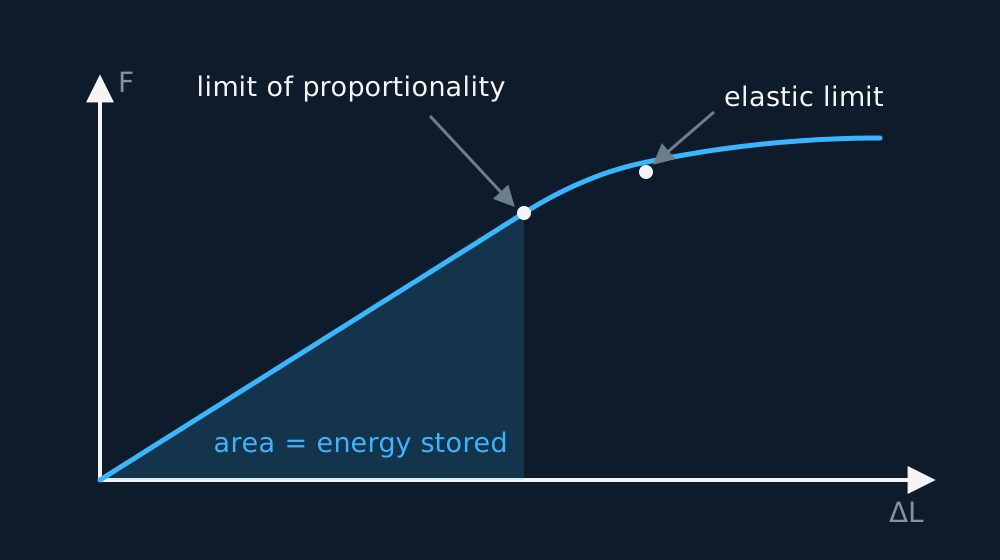
The law fails in two stages. The limit of proportionality is where the graph stops being straight. The elastic limit, usually a little beyond it, is where deformation stops being reversible. Load past that second point and the object no longer returns to its original length when you take the load off.
The energy stored
Stretching a spring transfers energy into it, the elastic strain energy, equal to the area under the force-extension graph. While the graph is straight that area is a triangle.
Substitute into that and the same triangle becomes . Only the first version is printed, so the second must be recalled. It shows the dependence on the square of the extension: double the extension and the stored energy goes up four times. Once the graph curves, the half-formula no longer applies but the area method still does, so count squares under the curve instead.
That stored energy is fully recoverable while the deformation is elastic. Release a catapult and the strain energy becomes kinetic energy of the projectile; fire it upwards and the kinetic energy becomes gravitational potential energy in turn.
GUIDED PRACTICE
A spring constant from data
A spring extends by 0.080 m under a 3.2 N load, within its limit of proportionality. Find k, then the energy stored at an extension of 0.15 m, choosing the right energy expression.
Show the working
k = F/ΔL = 3.2/0.080 = 40 N m−1.
At 0.15 m, use E = ½k(ΔL)2 = ½ × 40 × 0.152 = 0.45 J. The ½ is the triangle under the force-extension line; omitting it assumes the force was constant at its final value throughout the stretch.
INDEPENDENT PRACTICE
Energy from the area
A different spring's force-extension line passes through the origin and reaches 6.0 N at 0.12 m. Find the stored energy from the area under the line, and check it against ½FΔL.
Show the working
The area is a triangle: ½ × base × height = ½ × 0.12 × 6.0 = 0.36 J.
½FΔL gives ½ × 6.0 × 0.12 = 0.36 J, the same number, because the formula is that triangle written out. Once the line curves, only the area method applies.
Past the elastic limit
Load beyond the elastic limit and the material deforms plastically, meaning its internal structure rearranges for good. Unload it and, in the idealised metal model these graphs draw, the contraction follows a line parallel to the original elastic section but shifted sideways, meeting the extension axis some distance from the origin.

Describe the drawing
Loading first climbs the straight elastic line, then turns at the elastic limit and creeps along the shallow plastic path. Unloading runs straight back down, exactly parallel to the elastic line, but lands to the right of where it began: the sample keeps a permanent set. The wire on the left acts it out, stretching with the pen and never quite returning.
That intercept is the permanent extension. The energy transfer also changes. Work done during loading now exceeds the energy recovered during unloading, and the difference, which is the area trapped between the two curves, went into rearranging the material and warming it. Energy spent on plastic deformation is not recovered as mechanical work; it ends up mainly as internal energy.
This one-way transfer has a practical use. A ductile part designed to yield slightly on every large swing of an oscillation transfers the same energy to internal energy each cycle, so the amplitude falls. That is how a sacrificial steel damper protects a tall building, and it is one mechanism of damping.
ASSESSMENT FOCUS
- 1 g cm−3 = 1000 kg m−3. Convert before substituting. A density answer near 2.7 rather than 2700 kg m−3 shows the conversion was omitted.
- Limit of proportionality and elastic limit are different points: the first is where the graph stops being straight, the second where deformation stops being reversible.
- Strain energy is the area under the force-extension graph. Use only while the line is straight, and count squares once it curves.
- Read a permanent extension where the unloading line meets the extension axis, and expect it to run parallel to the original straight section.
- Volumes convert with the cube, so 1 cm3 is m3. Convert the length first and cube afterwards.
- , and are all printed for you. is not, so that one must be recalled.
CHECK YOURSELF
A spring with spring constant 25 N m−1 is stretched by 0.20 m, within its limit of proportionality. Find (a) the force applied and (b) the energy stored. (c) If the extension were doubled, still within the limit, what would the stored energy become?
Show a hint
Energy depends on the square of the extension.
Show the answer
(a) = 25 × 0.20 = 5.0 N.
(b) = ½ × 25 × 0.202 = 0.50 J.
(c) The square quadruples it, giving 2.0 J. Picture the triangle under the force-extension line. Doubling the extension doubles its base and its height at once, so the area goes up four times.
The energy stored is the area under the force-extension graph.
½FΔL is that area only while the line is straight.
WORKBOOK
Printable practice for this topic: original exam-style questions with room to work, and a fully worked answer book. Free to use; please do not redistribute or sell.
Or read them with their mark schemes on the density and Hooke's law questions page.
WHERE TO GO NEXT
- Gradients and areas under graphs is the maths this lesson leans on, worked through step by step.
USED LATER IN
CHECK YOUR PROGRESS
Rate how confident you feel with each objective for this lesson. Ratings are saved in this browser, on this device, unless you sign in.
- Use , and get the g cm−3 to kg m−3 conversion the right way round.
- Apply while it holds, and say what the spring constant belongs to.
- Separate the limit of proportionality from the elastic limit.
- Find the stored energy from the area under a force-extension graph, and account for the energy that never comes back after plastic deformation.
Open the full revision checklist to track your progress across the whole unit.