Physics › Mechanics › Work, energy and power
Work, energy and power
Work is the energy transferred when a force moves its point of application, and only the force component along the motion does work. Where the force varies, the work is the area under the force-displacement graph. Power is the rate of that transfer, P = Fv for a force along the motion, and efficiency is the useful fraction of the input.
Choose your exam board to show the notes and questions relevant to your specification. You can change this setting at any time, and content for other boards remains available.
Builds on Scalars and vectors.
IN THIS TOPIC
- Calculate work as W = Fs cos θ, and spot the forces that do no work at all or negative work.
- Take the work from the area under a force-displacement graph when the force varies.
- Use P = ΔW/Δt, derive P = Fv from W = Fs, and use it, top-speed problems included.
- Find efficiency as useful output over input, working in powers or in energies.
COMMON MISCONCEPTION
Work means effort.
Effort is not work. Work is done only when a force moves its point of application through a distance in the direction of the force; with no displacement, no work is done.
What counts as work
In physics, work is energy transferred by a force acting through a displacement.
θ is the angle between the force and the displacement, and the cos θ is there because only the component of the force along the motion transfers any energy.
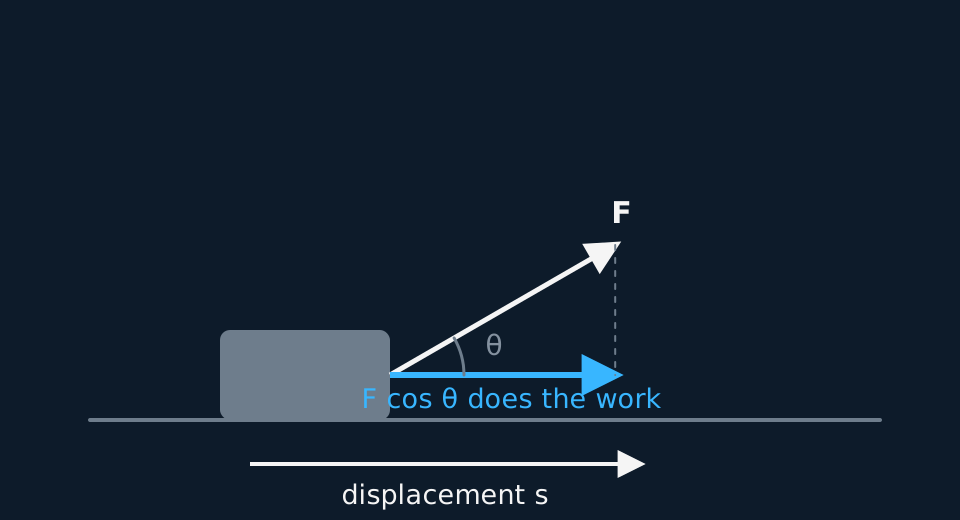
The definition gives results that differ from the everyday use of the word. Carry a heavy box across a room at constant height and you do no work on the box whatsoever. Your force is vertical, the motion is horizontal, and cos 90° = 0. Your muscles burn energy and you are genuinely tired, but not one joule of it went into the box.
A force with a component opposing the motion does negative work and takes energy back out. Friction and drag both do it, and the warmth you feel after rubbing your hands together is that energy turning up somewhere else.
WORKED EXAMPLE
Work at an angle
A sledge is pulled 12 m across level snow by a rope at 30° to the ground, with a tension of 40 N.
Only the horizontal component does anything, so = 40 × 12 × cos 30° = 420 J to two significant figures.
The vertical component of the tension merely lightens the sledge's press on the snow. It moves nothing vertically, so it transfers no energy.
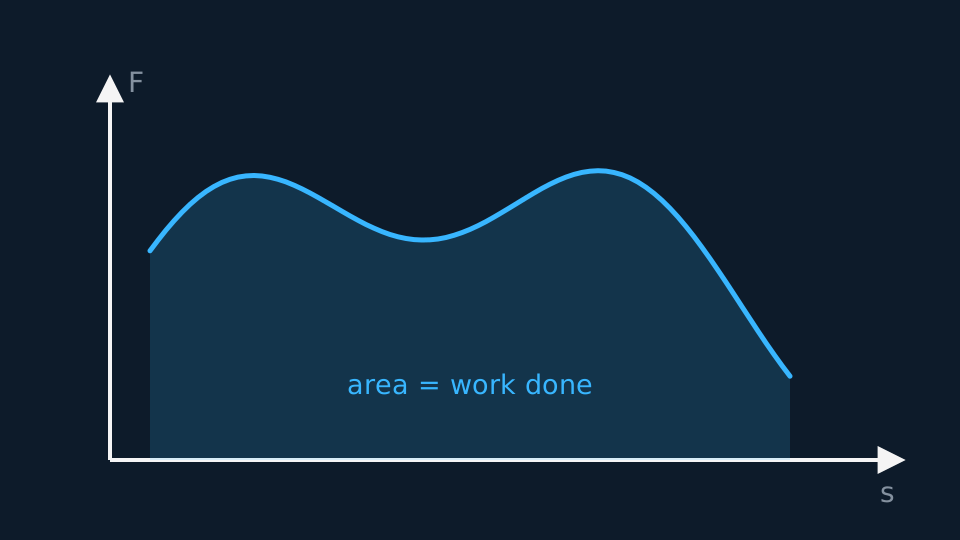
When the force varies with position, a stretching spring being the standard case, no single F exists to multiply. The area under the force-displacement graph is the work done, for any shape of force.
Power
Power is the rate of doing work, which is the same thing as the rate of energy transfer.
It is measured in watts, one joule per second. The second form is one line of algebra from the first, and that line is worth writing out. A constant force F acting along the motion does work over a displacement s, so dividing by the time taken gives , because s/t is the speed. Where the force sits at an angle to the motion, the same cos θ appears in the power equation too, giving P = Fv cos θ.
The Fv form is used for top-speed problems. At a vehicle's top speed the acceleration is zero, so the driving force exactly equals the total resistive force, and the engine's maximum power is that force times the top speed. Rearranged the other way, it explains why acceleration fades at speed. Hold the power fixed, raise v, and the available F falls.
GUIDED PRACTICE
Power up the stairs
A 65 kg student climbs a 12 m staircase in 30 s. Find their useful output power against gravity.
Show the working
The useful energy is the gain in gravitational potential energy, mgh = 65 × 9.81 × 12 = 7650 J.
P = E/t = 7650/30 = 255 W ≈ 260 W (2 s.f.). That is close to the mechanical power a person can sustain. Climbing the same stairs in half the time doubles the power while the energy transferred is unchanged.
Efficiency
No machine turns all its input into the output you wanted. Efficiency is the useful fraction.
Quote it as a decimal or as a percentage. The identical ratio works with energies in place of powers, so use whichever pair the question gives you.
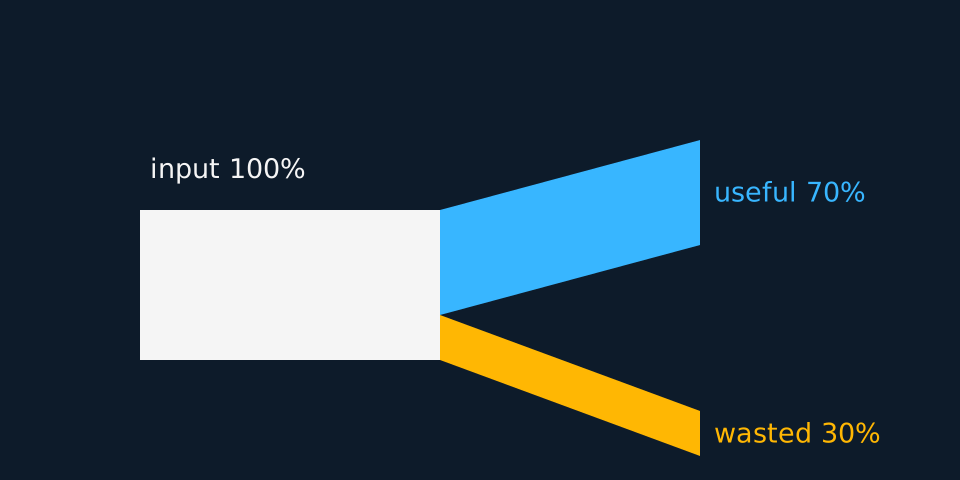
Efficiency can never exceed 100%, so any answer above it is a mistake, almost always the fraction inverted. And the “wasted” share is not destroyed; it is transferred somewhere useless, nearly always ending as internal energy in the surroundings.
INDEPENDENT PRACTICE
An electric winch, realistically rated
A winch draws 500 W of electrical power and lifts a 50 kg load through 8.0 m in 20 s. Find its efficiency.
Show the working
The useful output is mgh/t = 50 × 9.81 × 8.0/20 = 196 W.
Efficiency = 196/500 = 0.39, or 39%. The other 61% ends as internal energy in the motor and the gearbox, which is warm and no use for lifting anything.
ASSESSMENT FOCUS
- The cos θ is not optional. A rope at an angle does W = Fs cos θ, and the perpendicular component does no work at all.
- P = Fv is the equation for top-speed problems. At maximum speed the driving force equals the total resistive force, so P = Fres × vmax.
- CIE asks you to derive P = Fv as well as use it, and the derivation is one line: work is W = Fs, power is that divided by time, and s/t is v. Write those three steps rather than asserting the result.
- Friction and drag do negative work. Asked for the work done against friction, give the magnitude, and keep the same sign convention throughout the rest of the energy balance.
- For a variable force, the work is the area under the force-displacement graph. Count the squares rather than estimating an average force by eye.
CHECK YOURSELF
A car of mass 1200 kg travels at a constant 30 m s−1 against total resistive forces of 600 N. What power does the engine deliver, and why does the mass not matter?
Show a hint
Constant speed is a statement about the resultant force.
Show the answer
Constant speed means zero acceleration, so the resultant force is zero and the driving force matches the resistive force at 600 N.
= 600 × 30 = 18 kW.
The mass never enters, because nothing accelerates. Mass could only reach this calculation through F = ma, and a = 0.
Only the force along the motion does any work.
WORKBOOK
Printable practice for this topic: original exam-style questions with room to work, and a fully worked answer book. Free to use; please do not redistribute or sell.
Or read them with their mark schemes on the work, energy and power questions page.
WHERE TO GO NEXT
- Gradients and areas under graphs is the maths this lesson leans on, worked through step by step.
CHECK YOUR PROGRESS
Rate how confident you feel with each objective for this lesson. Ratings are saved in this browser, on this device, unless you sign in.
- Calculate work as W = Fs cos θ, and spot the forces that do no work at all or negative work.
- Take the work from the area under a force-displacement graph when the force varies.
- Use P = ΔW/Δt, derive P = Fv from W = Fs, and use it, top-speed problems included.
- Find efficiency as useful output over input, working in powers or in energies.
Open the full revision checklist to track your progress across the whole unit.