Physics › Turning points › Matter waves and electron microscopes
Matter waves and electron microscopes
De Broglie proposed that a particle of momentum p has a wavelength λ = h/p, and electron diffraction confirmed it within four years. For an electron accelerated through a pd, λ = h/√(2meV), so a higher voltage tightens the rings. A transmission electron microscope images with those wavelengths; a scanning tunnelling microscope maps a surface through a tunnelling current.
Choose your exam board to show the notes and questions relevant to your specification. You can change this setting at any time, and content for other boards remains available.
Quanta and wave-particle duality, part 2 of 2. Part 1 is Quanta and the photoelectric effect.
Builds on Quanta and the photoelectric effect and Wave-particle duality.
IN THIS TOPIC
- Use de Broglie's λ = h/√(2meV), and predict what happens to a diffraction pattern when the pd changes.
- Estimate the pd needed for atomic-scale electron wavelengths.
- Outline the TEM and the STM, and give the TEM's practical limitations.
COMMON MISCONCEPTION
Electron microscopes see finer detail because electrons are smaller than photons.
Resolution is set by wavelength, not particle size: an electron accelerated through a few kilovolts has a de Broglie wavelength thousands of times shorter than visible light, and that shorter wavelength is the whole advantage of the electron microscope.
Matter waves
Light behaves as a wave in Young's fringes and Maxwell's fields, and as a particle in Planck's quanta and Einstein's photons. In 1923 Louis de Broglie proposed the converse: that a particle also has an associated wavelength, given by the same momentum relation
For an electron accelerated from rest through a pd V, the momentum follows from eV = ½mv2, and substituting gives the working form for this option:
WORKED EXAMPLE
The wavelength that matched the atoms
Find the de Broglie wavelength of electrons accelerated through 54 V, the setting of the Davisson-Germer experiment.
λ = h/√(2meV) = 6.63 × 10⁻³⁴ / √(2 × 9.11 × 10−31 × 1.60 × 10−19 × 54).
λ = 1.7 × 10⁻¹⁰ m, the size of an atomic spacing.
That match is what made the experiment work. Fired at a nickel crystal, whose atomic planes form a natural diffraction grating on this scale, the electrons produced diffraction patterns.
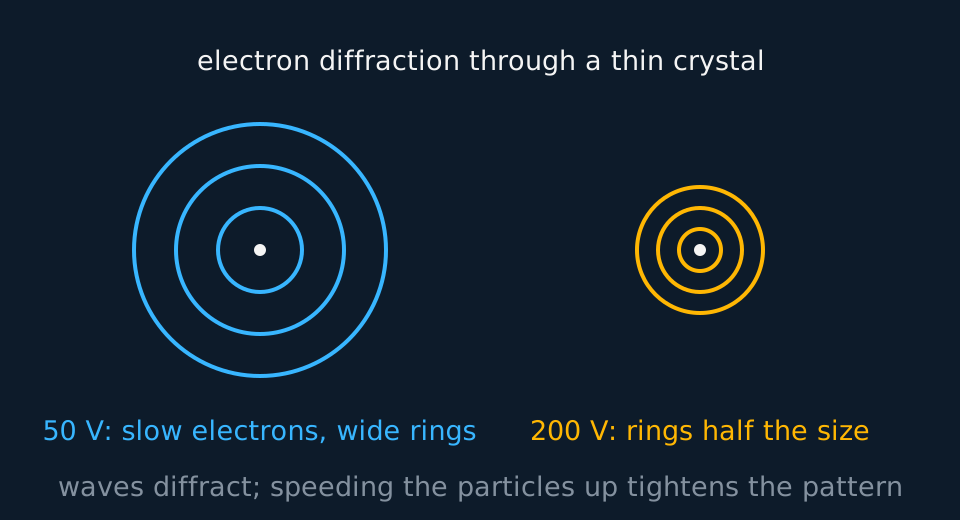
The qualitative check confirms the formula's shape. Raise the accelerating pd and the rings shrink, since faster electrons carry more momentum and therefore a shorter wavelength. Quadruple the pd and the wavelength halves. The pattern therefore responds to the accelerating pd exactly as λ = h/√(2meV) requires.
Microscopes from matter waves
A microscope cannot resolve detail much smaller than the wavelength it uses, which limits light microscopes to around 10−7 m. A modest accelerating pd brings an electron's de Broglie wavelength down to atomic scale, so an electron microscope resolves far finer detail.
GUIDED PRACTICE
The TEM's working wavelength
Estimate the de Broglie wavelength in a transmission electron microscope running at 100 kV.
Show the working
λ = h/√(2meV) = 6.63 × 10⁻³⁴ / √(2 × 9.11 × 10−31 × 1.60 × 10−19 × 105) = 3.9 × 10⁻¹² m.
Thousands of times shorter than visible light, and at this pd the electrons are fast enough that the classical formula is itself starting to err, a warning the relativity lessons will make precise.
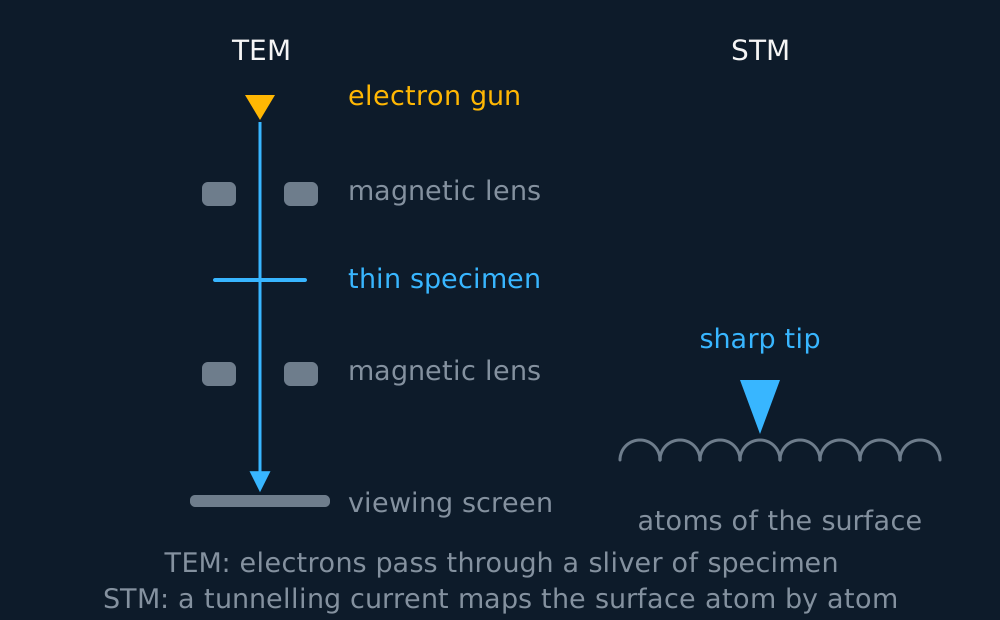
The transmission electron microscope is a light microscope rebuilt for electron waves. An electron gun supplies the source, and magnetic coils act as lenses, focusing the beam through a very thin specimen and projecting the transmitted pattern onto a fluorescent screen, all in vacuum. Denser regions scatter more electrons and show darker.
Those two words, thin and vacuum, are the TEM's limitations, and questions ask for them. The specimen must be thin enough for electrons to pass through, so it needs slicing and mounting. It must survive a vacuum, so nothing living can be imaged alive. And the electron beam itself heats and damages delicate samples.
The scanning tunnelling microscope abandons lenses entirely. A metal tip sharpened to almost a single atom is held about a nanometre above a conducting surface, close enough for electrons to tunnel across the gap. The tunnelling current falls off so steeply with distance that atom-height bumps change it measurably, and scanning the tip across the surface maps it atom by atom.
INDEPENDENT PRACTICE
The voltage for an atom
Estimate the anode voltage needed to give electrons a de Broglie wavelength of 1.0 × 10⁻¹⁰ m, the order of the size of an atom.
Show the working
Rearranging: V = h2/(2meλ2) = (6.63 × 10⁻³⁴)2 / (2 × 9.11 × 10−31 × 1.60 × 10−19 × (1.0 × 10−10)2).
V ≈ 150 V. Atomic-scale resolution costs less voltage than a cathode-ray television once did, and that is why electron diffraction turned up by accident within four years of de Broglie's guess.
ASSESSMENT FOCUS
- λ = h/√(2meV) assumes acceleration from rest and non-relativistic speeds. Quote answers to two significant figures, and expect the wording "estimate" once the pd runs into tens of kilovolts.
- Diffraction-pattern questions want the chain in order. Raise the pd, raise the momentum, shorten the wavelength, tighten the rings; quadruple the pd and the wavelength halves.
- TEM and STM answers want principles, not engineering. Magnetic lenses focusing electrons through a thin specimen for the TEM, plus its thin-and-vacuum limitations. A tunnelling current across a nanometre gap, mapped by scanning, for the STM.
CHECK YOURSELF
In a low-energy electron diffraction experiment the accelerating pd is doubled. Explain what happens to the ring pattern, and why an electron microscope can resolve detail no light microscope can reach.
Show a hint
Follow the chain pd, momentum, wavelength. Then remember resolution follows wavelength.
Show the answer
Doubling V multiplies the momentum by √2, so λ = h/p falls by a factor of √2 and the rings shrink by that factor. Faster electrons, shorter waves, tighter pattern.
Resolution is limited to roughly the wavelength used. Electrons at even 150 V carry λ ≈ 10−10 m, thousands of times shorter than visible light's 5 × 10⁻⁷ m.
An electron microscope therefore resolves atomic-scale structure that no arrangement of glass lenses could reach.
de Broglie proposed that a particle of momentum p has wavelength λ = h/p, which electron diffraction confirmed.
λ = h/√(2meV): raise the pd and the rings tighten, and about 150 V is already enough for an atomic-scale wavelength.
Or read them with their mark schemes on the quanta and the photoelectric effect questions page.
CHECK YOUR PROGRESS
Rate how confident you feel with each objective for this lesson. Ratings are saved in this browser, on this device, unless you sign in.
- Use de Broglie's λ = h/√(2meV), and predict what happens to a diffraction pattern when the pd changes.
- Estimate the pd needed for atomic-scale electron wavelengths.
- Outline the TEM and the STM, and give the TEM's practical limitations.
Open the full revision checklist to track your progress across the whole unit.