Physics › Quantum phenomena › Wave-particle duality
Wave-particle duality
Electron diffraction through graphite shows particles behaving as waves, while the photoelectric effect shows light behaving as particles. The de Broglie wavelength λ = h/mv links the two, so raising a particle's momentum shortens its wavelength and tightens the diffraction rings. Everyday objects carry far too much momentum for their wave behaviour to be measurable.
Choose your exam board to show the notes and questions relevant to your specification. You can change this setting at any time, and content for other boards remains available.
Builds on The photoelectric effect and the photon.
IN THIS TOPIC
- State the two-way evidence, electron diffraction for the wave nature of particles and the photoelectric effect for the particle nature of light.
- Use the de Broglie wavelength λ = h/mv, finding v from a kinetic energy where needed.
- Explain how and why the diffraction changes when a particle's momentum changes.
- Say why wave behaviour never shows up in everyday objects.
COMMON MISCONCEPTION
Light is a wave, and electrons are particles.
Neither label is complete: light also arrives as photons, and electrons also diffract. All matter and radiation show both wave and particle behaviour; the experiment decides which appears, with wavelength λ = h/p.
The evidence runs both ways
The photoelectric effect shows light, the textbook wave, delivering its energy in particle-like photons. The reverse result came from electrons. Fire a beam of them through a thin sheet of graphite and they do not land on the screen as a single spot. They arrive in concentric rings, a diffraction pattern, the signature behaviour of waves.
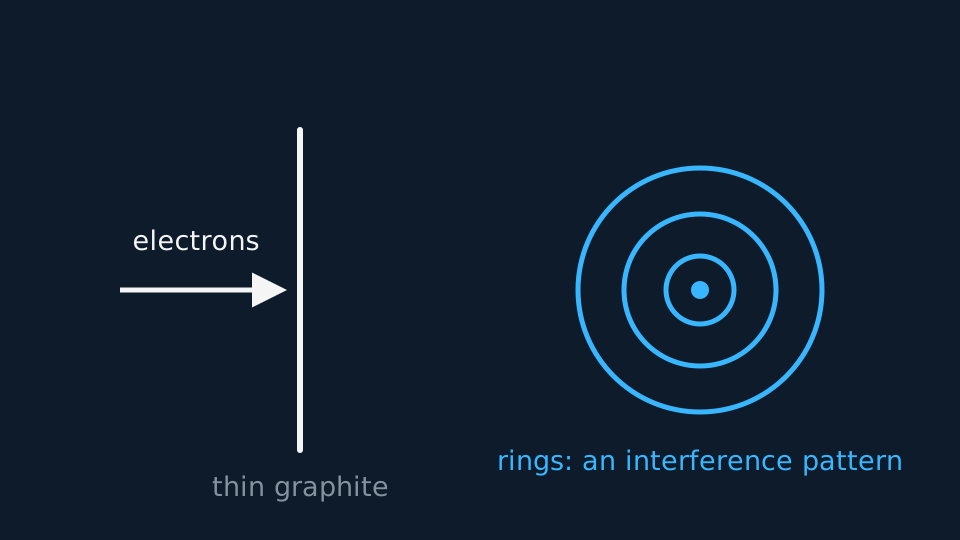
So electron diffraction shows that particles possess wave properties, while the photoelectric effect shows that electromagnetic waves have a particulate nature. Learn both halves of that sentence. The details of any particular diffraction apparatus are not examined.
The de Broglie wavelength
de Broglie's proposal gave that wave a wavelength, set by the particle's momentum.
where mv is the momentum. The smallness of the Planck constant is what keeps the world looking normal. Everyday objects carry so much momentum that their wavelengths are unmeasurably tiny. An electron's momentum is small enough to give a wavelength around the spacing of atoms, which is the scale needed to diffract off a crystal lattice.
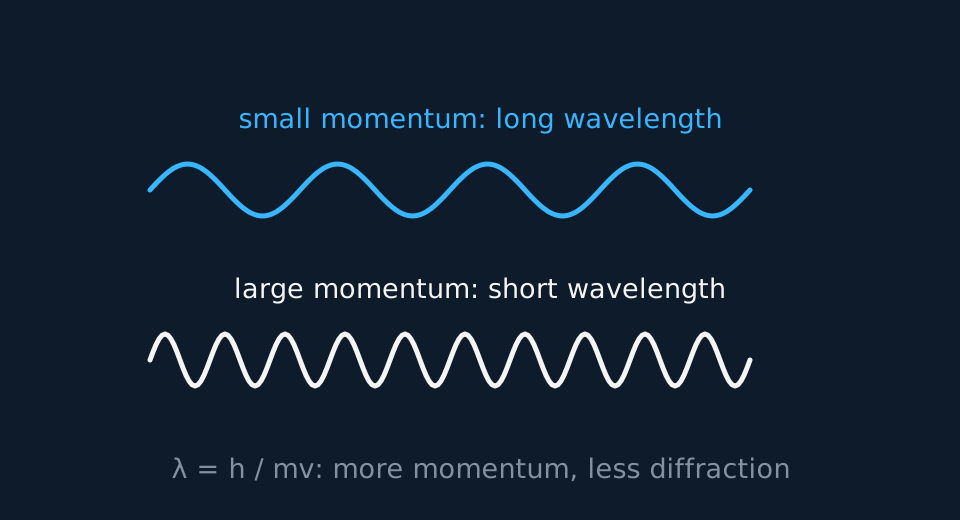
The equation also predicts what happens when you change the beam. Accelerate the electrons harder and their momentum rises, so λ shrinks. Diffraction is strong only while the wavelength is comparable to the spacing it meets, so the rings tighten towards the centre. More momentum, less diffraction. Raising the accelerating pd confirms it.
WORKED EXAMPLE
Why crystals, of all things
How fast must an electron travel for its de Broglie wavelength to match a crystal's atomic spacing of 1.0 × 10⁻¹⁰ m?
Diffraction needs the wavelength comparable to the gap, so crystals are the natural grating for electrons.
Rearrange λ = h/mv for v: v = h/mλ = 6.63 × 10⁻³⁴/(9.11 × 10−31 × 1.0 × 10−10) = 7.3 × 10⁶ m s−1.
About a hundred and fifty volts of accelerating pd reaches that speed. Electron diffraction therefore fits on a school bench.
GUIDED PRACTICE
Why you have never diffracted
Find the de Broglie wavelength of a 60 kg person walking at 1.5 m s−1, and use the answer to explain why people do not diffract through doorways.
Show the working
λ = h/mv = 6.63 × 10⁻³⁴/(60 × 1.5) = 7.4 × 10−36 m.
Twenty-five powers of ten smaller than an atom, let alone a doorway. Diffraction needs a gap near the wavelength, and nothing in the universe has a gap that small. The wave behaviour has not gone away. At large momentum it simply becomes too slight to measure.
INDEPENDENT PRACTICE
Electron against proton
An electron and a proton travel at the same speed. Which has the longer de Broglie wavelength, and by what factor? (The proton is about 1800 times more massive.)
Show the working
In λ = h/mv, at equal speed the wavelength is inversely proportional to mass.
The electron's wavelength is about 1800 times longer. Lighter particles are the wavier ones, and that is one reason the electron microscope became the practical instrument.
What the two models describe
The photoelectric effect requires a particle model of light, while interference and diffraction require a wave model. Electron diffraction likewise shows wave behaviour in matter. Scientific models are retained only while they remain consistent with reproducible evidence.
The wave description of light stood alone for a century before the photoelectric effect showed light exchanging energy in quanta; the particle description of the electron stood for about thirty years before electron diffraction. Results as significant as these are established through peer review and independent replication before a model is revised.
ASSESSMENT FOCUS
- The evidence pairing must point the right way. Electron diffraction shows particles behaving as waves, and the photoelectric effect shows light behaving as particles. Swapping them states the opposite of what each experiment shows.
- In λ = h/mv the denominator is the momentum. Given a kinetic energy instead, find v from ½mv2 first and then multiply by m.
- “Explain how the pattern changes if the accelerating pd increases” wants four links in order. Momentum rises, λ = h/mv falls, diffraction decreases, the rings move inwards.
- Diffraction matters only when λ is comparable to the gap or the spacing, and for a thrown ball the momentum is so large that any real gap outsizes λ by thirty powers of ten and more. Include that comparison, since it is what makes the wave behaviour unobservable rather than absent.
CHECK YOURSELF
An electron (m = 9.11 × 10⁻³¹ kg) moves at 3.3 × 10⁶ m s−1. Find its de Broglie wavelength, and state what happens to the diffraction pattern if the electrons are accelerated to a higher speed.
Show a hint
Momentum first. Then remember what diffraction needs from a wavelength.
Show the answer
Momentum first. mv = 9.11 × 10−31 × 3.3 × 106 = 3.0 × 10⁻²⁴ kg m s−1.
Then = 6.63 × 10⁻³⁴ / (3.0 × 10⁻²⁴) = 2.2 × 10⁻¹⁰ m, about one atomic spacing, and a crystal lattice therefore diffracts the beam well.
At higher speed the momentum grows, λ shrinks, and the electrons diffract less: the rings contract towards the centre.
Photons and matter particles can produce interference and diffraction, while detections occur as localised events. Which behaviour is observed depends on the measurement arrangement.
WORKBOOK
Printable practice for this topic: original exam-style questions with room to work, and a fully worked answer book. Free to use; please do not redistribute or sell.
Or read them with their mark schemes on the wave-particle duality questions page.
CHECK YOUR PROGRESS
Rate how confident you feel with each objective for this lesson. Ratings are saved in this browser, on this device, unless you sign in.
- State the two-way evidence, electron diffraction for the wave nature of particles and the photoelectric effect for the particle nature of light.
- Use the de Broglie wavelength λ = h/mv, finding v from a kinetic energy where needed.
- Explain how and why the diffraction changes when a particle's momentum changes.
- Say why wave behaviour never shows up in everyday objects.
Open the full revision checklist to track your progress across the whole unit.