Physics › Turning points › The specific charge of the electron
The specific charge of the electron
Specific charge is a particle's charge divided by its mass, and Thomson measured e/m for cathode rays in crossed electric and magnetic fields. An undeflected beam gives eE = Bev, so v = E/B, and the accelerating pd then gives e/m = v²/2V. The value came out about 1800 times the hydrogen ion's.
Choose your exam board to show the notes and questions relevant to your specification. You can change this setting at any time, and content for other boards remains available.
Cathode rays and the electron, part 2 of 2. Part 1 is Cathode rays and the electron gun.
Builds on Cathode rays and the electron gun and Force on a moving charge.
IN THIS TOPIC
- Outline the crossed-fields determination of e/m for the electron.
- Compare the electron's specific charge with the hydrogen ion's, and explain why Thomson's result mattered.
COMMON MISCONCEPTION
The atom is the smallest unit of matter; nothing can be pulled out of one.
Atoms are not indivisible: Thomson showed cathode rays have the same specific charge whatever the cathode metal, about 1800 times hydrogen's, so a particle far lighter than any atom comes from inside atoms.
Thomson and the specific charge
An electron gun delivers a narrow beam of unidentified negative particles at a speed set by eV = ½mv2. Neither the charge on one particle nor its mass could be measured separately with anything the 1890s owned, but their ratio could, and that ratio is the specific charge e/m, the charge per kilogram of whatever the beam is made of.
In 1897 J J Thomson measured it. One classic route uses crossed fields. Send the beam between charged plates, which push it one way, and add a magnetic field at right angles, tuned to push it back exactly the other. When the beam runs straight, the electric force eE equals the magnetic force Bev, so the speed is simply v = E/B. No clock is needed anywhere in the measurement.
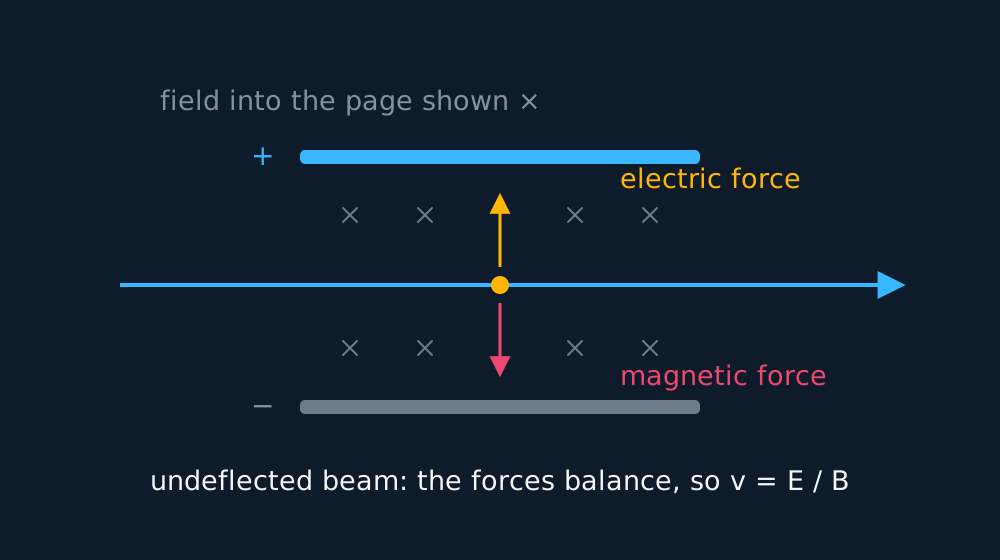
With v known, the gun's own accelerating pd finishes the job: eV = ½mv2 rearranges to e/m = v2/2V.
WORKED EXAMPLE
e/m from a balanced beam
A beam passes undeflected through crossed fields of E = 5.0 × 10⁴ V m−1 and B = 2.0 × 10⁻³ T, having been accelerated through 1.78 kV. Find the beam speed and the specific charge of its particles.
v = E/B = 5.0 × 10⁴ / (2.0 × 10⁻³) = 2.5 × 10⁷ m s−1.
e/m = v2/2V = (2.5 × 10⁷)2 / (2 × 1780) = 1.76 × 10¹¹ C kg−1.
Two measured field strengths and one dial reading on the supply. Nothing more was needed, and the answer is the modern value to three figures.
Lighter than any atom
The number's significance lies in a comparison. Before Thomson, the largest specific charge known belonged to the hydrogen ion, the lightest atom stripped of its electron. Thomson's particles exceeded it by a factor of about 1800, so either they carried far more charge or they were far lighter. The evidence pointed to lighter. That conclusion rewrote chemistry, because the cathode-ray particle, soon named the electron, is a constituent of atoms, torn from any metal and any gas alike. Atoms have parts.
GUIDED PRACTICE
The hydrogen benchmark
Calculate the specific charge of the hydrogen ion, a proton of mass 1.67 × 10⁻²⁷ kg carrying e = 1.60 × 10⁻¹⁹ C, and compare it with the electron's 1.76 × 10¹¹ C kg−1.
Show the working
e/mp = 1.60 × 10⁻¹⁹ / (1.67 × 10⁻²⁷) = 9.6 × 10⁷ C kg−1.
The electron's specific charge is about 1800 times larger. Same size of charge, so the electron must be about 1800 times lighter than the lightest atom: a particle smaller than atoms themselves.
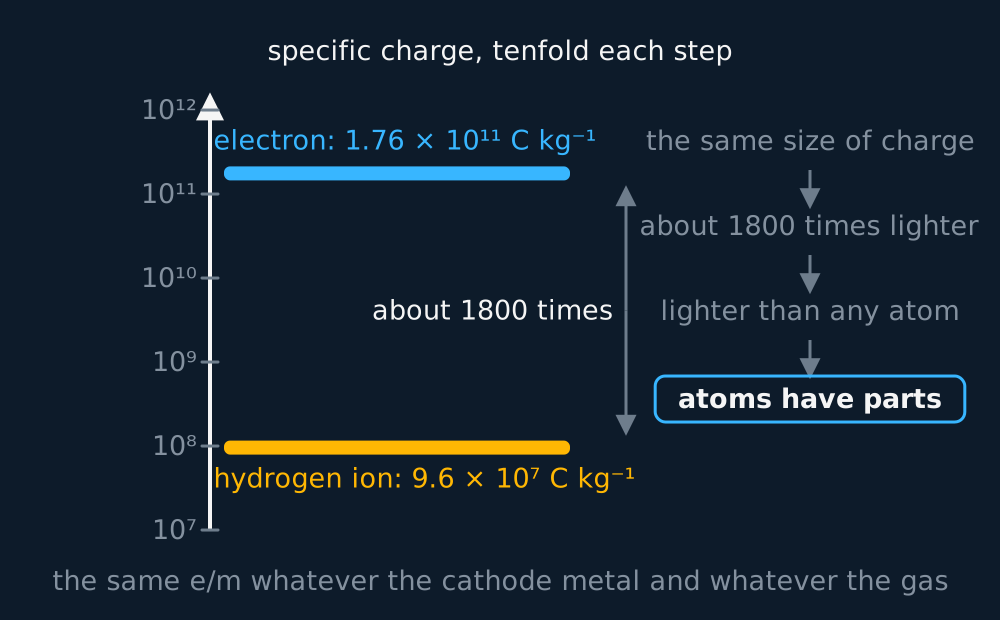
The same value of e/m was obtained with different cathode materials and gases, so the particle is not a fragment of one particular element but a constituent of all atoms. What the ratio could not do is separate e from m, and closing that gap by measuring the charge alone is the next lesson, Millikan's oil drop experiment.
INDEPENDENT PRACTICE
A faster gun
Using e/m = 1.76 × 10¹¹ C kg−1, find the speed of electrons accelerated from rest through 5.0 kV.
Show the working
v = = √(2 × 1.76 × 1011 × 5000) = 4.2 × 10⁷ m s−1.
Note the shortcut. With the specific charge in hand, neither e nor m is needed separately. Fourteen per cent of light speed, and the classical formula is already starting to creak.
ASSESSMENT FOCUS
- Define specific charge before using it: the charge of a particle divided by its mass, in C kg−1.
- For the crossed-fields method the logic scores as much as the algebra. Undeflected means eE = Bev, so v = E/B, and the accelerating pd then gives e/m = v2/2V.
- Given the specific charge alone, v = √(2(e/m)V) finds a beam speed with neither e nor m quoted separately.
- Thomson's significance needs three clauses. e/m about 1800 times the hydrogen ion's, so the particle is far lighter than the lightest atom, so atoms have smaller parts inside them.
CHECK YOURSELF
Show that the classical formula eV = ½mv² predicts electrons reaching the speed of light at an accelerating pd of about 260 kV, and comment on what this suggests.
Show a hint
Set v = c and solve for V using e/m = 1.76 × 10¹¹ C kg−1.
Show the answer
V = v2/(2e/m) = (3.0 × 10⁸)2 / (2 × 1.76 × 1011) = 2.6 × 10⁵ V, about 260 kV.
Laboratory supplies exceed this easily, yet no electron has ever been observed at or beyond the speed of light.
So the classical formula must fail at high speeds. What actually happens near 260 kV, and why, is the business of this unit's relativity lessons.
Balance eE against Bev and the beam's speed is E/B, no clock required; the gun's pd then gives e/m = v²/2V.
Thomson measured e/m, about 1800 times the hydrogen ion's value.
Same charge, far less mass, so atoms must have smaller parts inside them.
Or read them with their mark schemes on the cathode rays and the electron gun questions page.
CHECK YOUR PROGRESS
Rate how confident you feel with each objective for this lesson. Ratings are saved in this browser, on this device, unless you sign in.
- Outline the crossed-fields determination of e/m for the electron.
- Compare the electron's specific charge with the hydrogen ion's, and explain why Thomson's result mattered.
Open the full revision checklist to track your progress across the whole unit.