Physics › Turning points › Electromagnetic waves and the speed of light
Electromagnetic waves and the speed of light
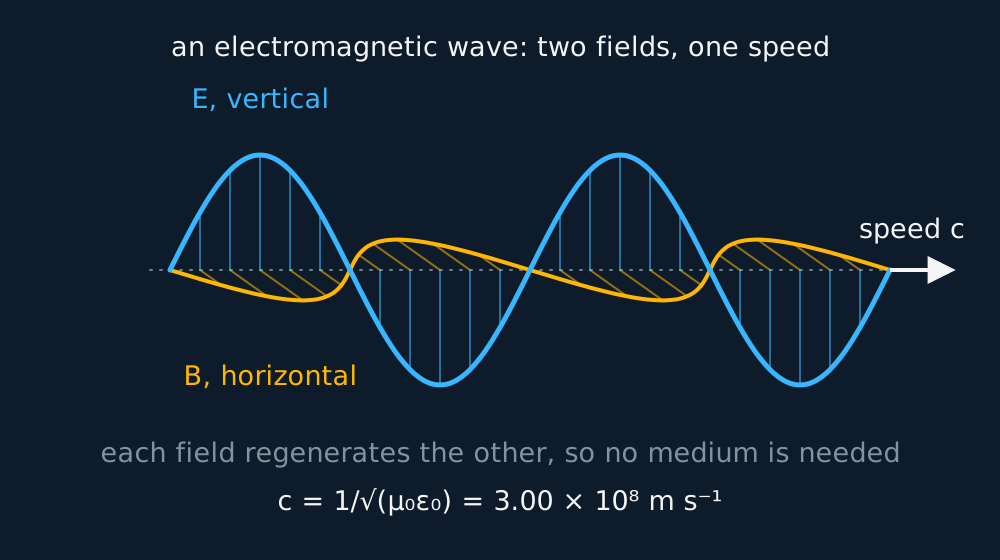
Maxwell showed that oscillating electric and magnetic fields travel as a wave at c = 1/√(μ₀ε₀), a speed built from two electrical constants. It matched the speed of light, which Fizeau's toothed wheel had just measured on Earth. Hertz then generated radio waves and measured them travelling at that same speed.
Choose your exam board to show the notes and questions relevant to your specification. You can change this setting at any time, and content for other boards remains available.
The nature of light, part 2 of 2. Part 1 is Corpuscles, waves and Young's fringes.
Builds on Corpuscles, waves and Young's fringes and Stationary waves.
IN THIS TOPIC
- Say what ε₀ and μ₀ each measure, and use c = 1/√(μ₀ε₀).
- Outline Fizeau's and Hertz's measurements, and what each one settled.
COMMON MISCONCEPTION
The speed of light is far too great to be measured in any experiment done on Earth.
The speed of light was measured on Earth in 1849: Fizeau timed it over a few kilometres with a spinning toothed wheel, the returning flash blocked when the wheel turned half a gap in the round trip. No astronomy required, only a long baseline and a fast clock.
Maxwell's two constants
Part 1 left the wave theory of light winning slowly on interference, with one gap left. Waves of what? The answer came from a different subject entirely. By the 1860s electricity and magnetism each carried a constant of proportionality. ε0, the permittivity of free space, sets the electric field strength around a charged object. μ0, the permeability of free space, sets the magnetic flux density around a current-carrying wire. James Clerk Maxwell showed the two fields could sustain each other as a travelling wave, an electromagnetic wave of oscillating electric and magnetic fields at right angles, needing no medium at all, moving at
WORKED EXAMPLE
Maxwell's speed from bench-top constants
Evaluate Maxwell's speed using μ0 = 4π × 10−7 H m−1 and ε0 = 8.85 × 10⁻¹² F m−1.
μ0ε0 = 4π × 10−7 × 8.85 × 10−12 = 1.11 × 10⁻¹⁷, so c = 1/√(1.11 × 10−17) = 3.00 × 10⁸ m s−1.
Both constants come from laboratory measurements on charges and currents, nothing to do with optics. That their combination equals the measured speed of light was Maxwell's thunderbolt. Light is an electromagnetic wave.
Fizeau, Foucault and Hertz
The comparison was only possible because the speed of light had finally been measured on Earth. In 1849 Armand Fizeau fired light through a gap in a spinning toothed wheel, off a mirror 8.63 km away and back. Spin the wheel fast enough and the returning light meets the next tooth instead of the gap, and the timing gives the speed.
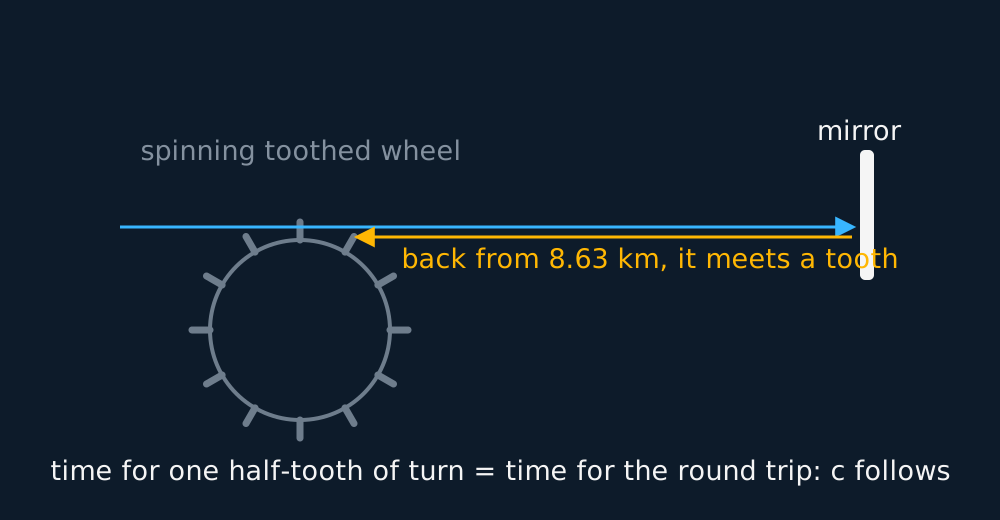
Fizeau's result, close to 3.1 × 10⁸ m s−1, mattered twice over. It made c a terrestrial, checkable quantity. And Foucault's rotating-mirror experiment, descended from the same race-the-light idea, soon showed light travelling slower in water than in air, exactly as Huygens required and Newton forbade. Then in 1887 Heinrich Hertz closed the case from the other side. Sparks in his laboratory generated invisible waves that reflected, refracted and formed stationary waves, and their measured speed came out at Maxwell's c. Radio waves existed. Light now had a family, and the wave theory had waves that needed no medium.
GUIDED PRACTICE
Hertz's stationary waves
Hertz set up stationary radio waves with adjacent nodes 2.5 m apart, from an oscillator of frequency 6.0 × 10⁷ Hz. Find the speed of his waves and state the significance.
Show the working
Adjacent nodes sit half a wavelength apart, so λ = 5.0 m, and c = fλ = 6.0 × 107 × 5.0 = 3.0 × 10⁸ m s−1.
Invisible waves made from electricity, travelling at exactly the speed of light. Maxwell's prediction stood confirmed, and the electromagnetic spectrum was thrown open beyond the visible.
INDEPENDENT PRACTICE
Fizeau's arithmetic
Fizeau's wheel had 720 teeth and the mirror stood 8.63 km away. The returning light was first blocked at 12.6 revolutions per second. Estimate the speed of light.
Show the working
First blocking means the wheel advanced half a tooth during the round trip, a rotation of 1/1440 of a turn, taking t = 1/(1440 × 12.6) = 5.51 × 10⁻⁵ s.
c = 2d/t = 2 × 8630 / (5.51 × 10⁻⁵) = 3.1 × 10⁸ m s−1. Within a few per cent of the modern value, from a cogwheel and a distant hill.
ASSESSMENT FOCUS
- Know what each constant means before you use c = 1/√(μ0ε0). ε0 comes from the electric field of a charged object, μ0 from the flux density around a current-carrying wire. Both are measured in electrical experiments, and that is the force of the argument.
- Fizeau's implications come in two parts. He made c a terrestrial, repeatable measurement, and the related rotating-mirror work showed light slower in water, so the waves won. Hertz then supplied radio waves at the same speed.
- In Fizeau arithmetic the first blocking means half a tooth's rotation during the round trip, so the time is 1/(2N × revolutions per second) for an N-toothed wheel, and the speed is 2d over that.
- Hertz's stationary waves are read with the waves unit's dictionary. Adjacent nodes sit half a wavelength apart, so double the node spacing before using c = fλ.
CHECK YOURSELF
Stationary radio waves from a 7.5 × 10⁷ Hz oscillator have adjacent nodes 2.0 m apart. Find the speed of the waves, and explain why this result, taken together with Maxwell's formula, identified light as an electromagnetic wave.
Show a hint
Node spacing is half a wavelength. Then compare three numbers: Hertz's speed, Maxwell's calculation, and the measured speed of light.
Show the answer
λ = 2 × 2.0 = 4.0 m, so c = fλ = 7.5 × 107 × 4.0 = 3.0 × 10⁸ m s−1.
Maxwell's c = 1/√(μ0ε0), built from two constants measured on charges and currents, predicts exactly this speed for waves of electric and magnetic fields.
Fizeau-style measurements give the same value for light itself. Waves made from electricity travel at the measured speed of light, so light is one of them: an electromagnetic wave.
Maxwell computed c from two electrical constants, and light turned out to be his wave.
Fizeau made the speed of light a terrestrial measurement, and light in water came out slower, as waves require.
Hertz made those waves in a laboratory and measured their speed at c.
Or read them with their mark schemes on the corpuscles, waves and young's fringes questions page.
CHECK YOUR PROGRESS
Rate how confident you feel with each objective for this lesson. Ratings are saved in this browser, on this device, unless you sign in.
- Say what ε₀ and μ₀ each measure, and use c = 1/√(μ₀ε₀).
- Outline Fizeau's and Hertz's measurements, and what each one settled.
Open the full revision checklist to track your progress across the whole unit.