Physics › Waves › Polarisation and electromagnetic waves
Polarisation and electromagnetic waves
A polarising filter passes only the oscillations along its transmission axis, so a second filter crossed at 90° blocks the light entirely. Sound cannot be filtered that way, which is the evidence that light is transverse. The same family of transverse waves runs from radio to gamma, every region travelling at c in a vacuum.
Choose your exam board to show the notes and questions relevant to your specification. You can change this setting at any time, and content for other boards remains available.
Longitudinal, transverse and polarisation, part 2 of 2. Part 1 is Longitudinal and transverse waves.
IN THIS TOPIC
- Describe what a polarising filter does to unpolarised light, and what a second, crossed filter does next.
- Explain why polarisation is evidence that light is transverse, and why sound, longitudinal in air, cannot be polarised.
- CIE only: use Malus's law on plane-polarised light passing one filter, and then a series of them.
- Order the regions of the electromagnetic spectrum by wavelength, all of them travelling at c in a vacuum, with the visible range in nanometres.
COMMON MISCONCEPTION
Any wave can be polarised if you build the right filter.
Only transverse waves can be polarised: polarisation confines the oscillations to a single plane. A longitudinal wave oscillates parallel to the direction of travel, so there is no plane of oscillation to select.
Polarisation
An ordinary lamp sends out light whose oscillations point in every direction perpendicular to the ray, changing randomly and rapidly. This is unpolarised light. A polarising filter transmits only the component of the oscillation along one direction, its transmission axis. What comes out is plane polarised, its oscillations now confined to a single plane containing the ray.
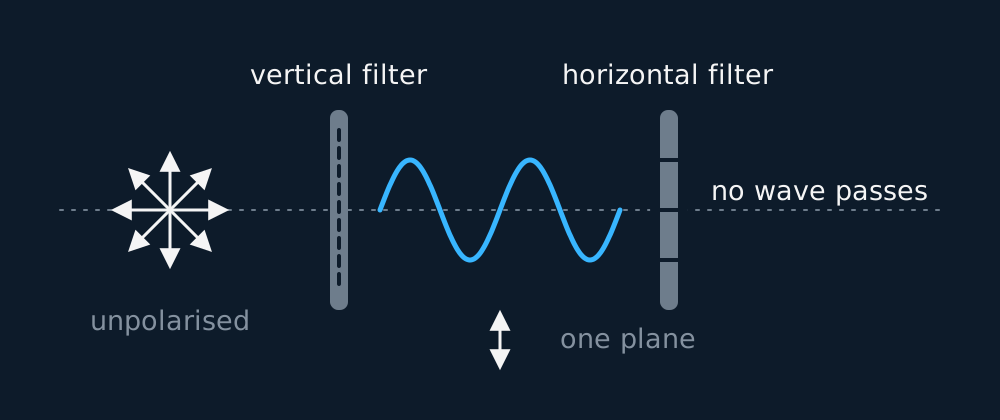
Hold up a second filter and rotate it. The transmitted intensity falls as the angle between the two transmission axes grows, and at 90°, with the filters crossed, the light is blocked completely. The first filter left only vertical oscillations, and a horizontal slot passes none of a vertical oscillation.
The argument runs in three steps. Filtering by oscillation direction only means anything if the oscillations are perpendicular to the ray in the first place. A longitudinal wave oscillates along its direction of travel, the one direction no filter orientation can distinguish. So the fact that light can be polarised is direct evidence that light is a transverse wave, and sound, which travels through air as a longitudinal wave, cannot be polarised. (Transverse vibrations do exist in solids, but the sound this course deals with is the longitudinal kind.)
How far the intensity falls between those two extremes is CIE's question and nobody else's. The other boards want that variation described in words and print no equation for it. CIE wants it as an equation, Malus's law. Take light that is already plane polarised, of intensity , and send it through a filter whose transmission axis makes an angle with the plane of polarisation. What emerges has intensity
which no board prints, so on 9702 it is a recall item. The square is worth understanding rather than memorising. The filter passes only the component of the oscillation lying along its own axis, and that cuts the amplitude by a factor of cos , while intensity goes with amplitude squared. Test it at the ends. Parallel axes give and , so the beam passes untouched, and crossed axes give and zero, the blackout described above.
A series of filters is handled one filter at a time, because each filter the light survives leaves it polarised along that filter's own axis. The angle to use at any filter is therefore the angle between its axis and the axis of the filter before it, not the angle back to the first one.
Take plane-polarised light of intensity , polarised vertically, and send it through three filters whose transmission axes are at 0°, 45° and 90° to the vertical. The first is aligned with the light and passes all of it. The second turns 45° from the first, so it passes . The third turns another 45° from the second, so it passes , a quarter of what went in. The first and last filters are genuinely crossed at 90°, and on their own they pass nothing at all. Adding a filter has let light through, which sounds impossible until you notice that the middle filter re-polarises the beam halfway across, so the last filter never sees the vertical light the first one made.
One line of the syllabus draws a firm boundary. Malus's law is for light that is already plane polarised. You are not asked to calculate what an unpolarised beam loses at the first filter it meets, so when a question opens with unpolarised light, that first filter's job is simply to polarise it, and the intensity leaving it is whatever the question gives you.
The electromagnetic family
Polarisation also supports a bigger claim, that light belongs to one family of transverse waves, the electromagnetic spectrum, every member travelling at 3.00 × 10⁸ m s−1 in a vacuum and differing only in wavelength.
| Region | Typical wavelength | A source |
|---|---|---|
| Radio | 103 m down to 0.1 m | transmitters |
| Microwave | 10 cm to 1 mm | ovens, satellite links |
| Infrared | 1 mm to 700 nm | warm objects |
| Visible | 700 nm to 400 nm | the Sun, red to violet |
| Ultraviolet | 400 nm to 10 nm | the Sun, arc lamps |
| X-ray | 10 nm to 0.01 nm | X-ray tubes |
| Gamma | below 0.01 nm | excited nuclei |
Carry the orders of magnitude in your head, visible light above all, from 400 nm at the violet end to 700 nm at the red. Questions ask for them directly, and they anchor every c = fλ calculation you will do. Every member of the family is transverse, so every member can be polarised, and that shared behaviour is how the family was assembled in the first place.
Where you meet it
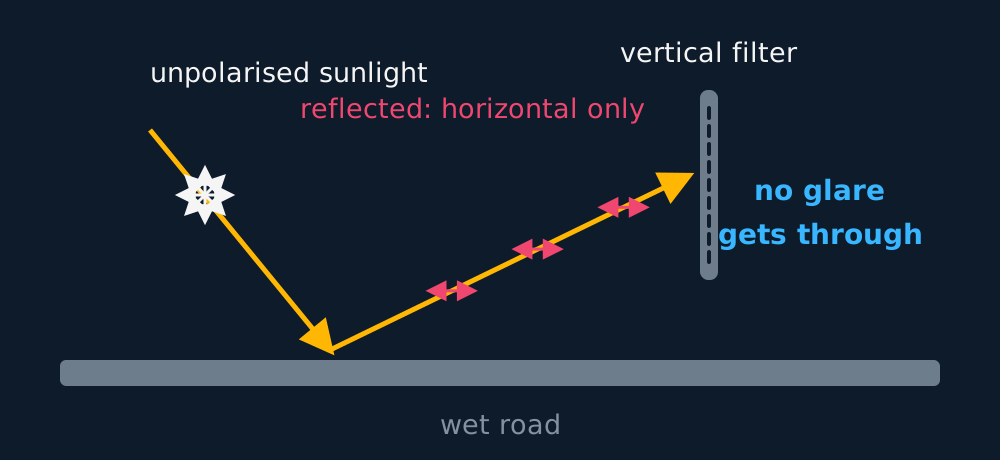
Sunlight reflected from water or wet road is partially polarised horizontally. Polarising sunglasses mount their filters with a vertical transmission axis, so they remove that glare while passing most other light.
Television and radio signals are transmitted plane polarised. An aerial receives best when its rods lie along the plane of polarisation of the incoming wave. Look along the rooftops of any town and every aerial points the same way, matched to the local transmitter.
GUIDED PRACTICE
Who can be polarised at all?
Sound diffracts around an open door; light does not noticeably do so, but light can be polarised and sound cannot. Explain both facts from the nature of each wave.
Show the working
A doorway is about a metre wide, comparable to sound's wavelength, so sound diffracts strongly; light's wavelength is millions of times smaller than the gap, so its spreading is imperceptible.
Polarisation needs oscillations across the travel direction, so that a filter has planes to choose between. Light is transverse and qualifies. Sound in air oscillates along its own travel direction, leaving a polariser with nothing to select.
ASSESSMENT FOCUS
- “Why can sound not be polarised?” wants two steps. Sound is longitudinal, and only transverse waves can be polarised. One step alone is half an answer.
- Rotating one filter above another, the intensity is greatest with the axes parallel and zero at 90°. AQA and Edexcel want that variation in words and set no equation for it. CIE wants Malus's law, , with measured between the transmission axis and the plane of polarisation of the light arriving at that filter.
- Say plane polarised, and name the plane where you can. Aerial questions are alignment questions, so state that the rods lie parallel to the plane of polarisation. “The light is filtered” describes the apparatus rather than the physics asked for.
- Spectrum questions are order-of-magnitude questions. Learn the visible range, 400 nm to 700 nm, and place everything else against it; a wavelength quoted without its region, or a region named without a wavelength, answers half of what is asked.
CHECK YOURSELF
Ultrasound is used to image a foetus, and light is used to read a barcode. One of these waves could in principle be polarised. Which one, and why?
Show a hint
Classify each wave first. Which way does each one oscillate compared with its direction of travel?
Show the answer
The light. Light is an electromagnetic wave, so it is transverse, and its oscillations sit perpendicular to the ray. A filter can select one of those oscillation directions, and that selection is what polarisation means.
Ultrasound is sound, so it is longitudinal. Its particles oscillate along the direction of travel, leaving no perpendicular directions to choose between, and no orientation of any filter can polarise it.
Only transverse waves can be polarised, and light can.
Every electromagnetic wave is transverse and travels at c in a vacuum; only the wavelength differs.
Or read them with their mark schemes on the longitudinal and transverse waves questions page.
CHECK YOUR PROGRESS
Rate how confident you feel with each objective for this lesson. Ratings are saved in this browser, on this device, unless you sign in.
- Describe what a polarising filter does to unpolarised light, and what a second, crossed filter does next.
- Explain why polarisation is evidence that light is transverse, and why sound, longitudinal in air, cannot be polarised.
- CIE only: use Malus's law on plane-polarised light passing one filter, and then a series of them.
- Order the regions of the electromagnetic spectrum by wavelength, all of them travelling at c in a vacuum, with the visible range in nanometres.
Open the full revision checklist to track your progress across the whole unit.